
Life on Earth Could Have Started in Volcanic Pools — but There Are Other Theories to Consider

The billions of microbes that make up the rich menagerie of life on our planet can be traced back to a humble beginning over 3.5 billion years ago, when our planet was a hot, violent world without oxygen or stable continents. But how, and where, on Earth did life start?
For decades, the popular imagination has been dominated by the story of a primordial soup; lightning strikes a warm pond, miraculously jolting dead molecules into living motion. Today, that origin story is being challenged. Researchers are increasingly looking for life’s cradle in very different places, from the deepest trenches of the ocean to the bubbling rims of volcanoes, and even beyond Earth itself.
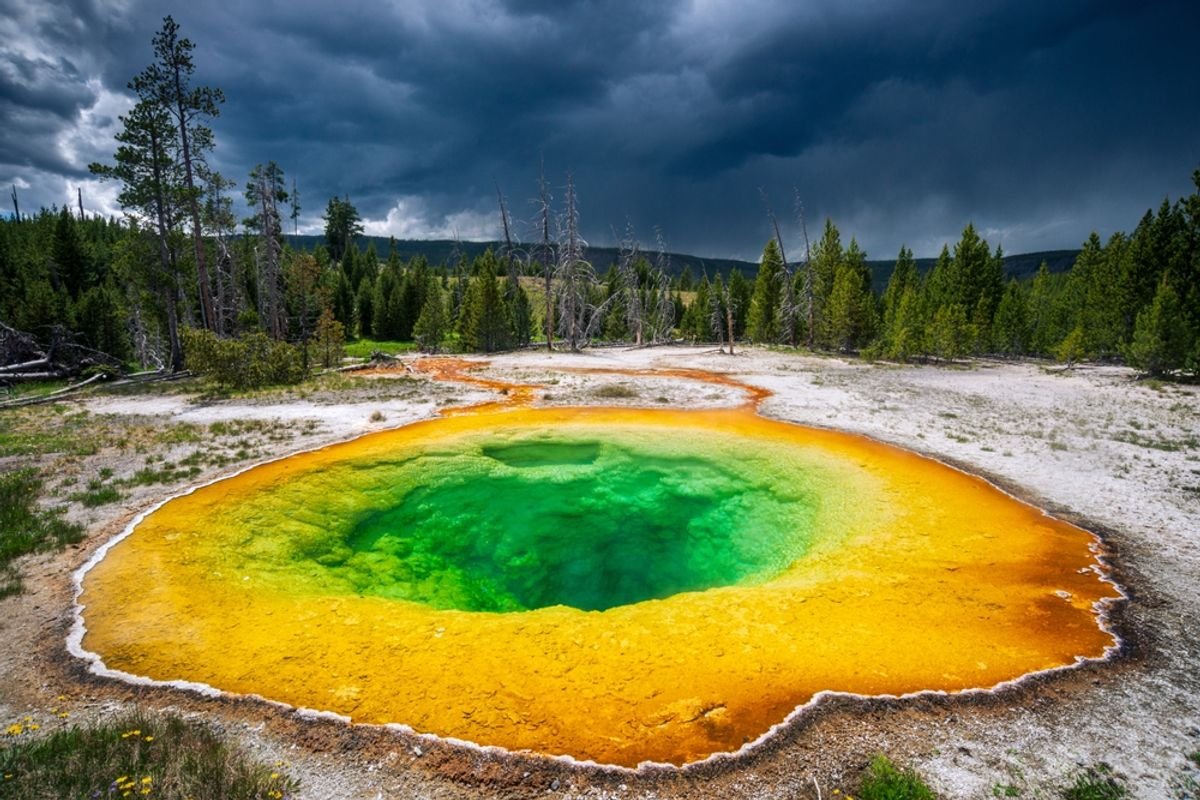
Instead of a permanently wet soup that can degrade delicate molecules, some scientists point to land-based pools, such as shallow volcanic hot springs, where chemistry is driven by repeated wet–dry cycles.
Here, chemicals are splashed onto hot rock, where the water evaporates, and the resultant concentrated sludge pushes reactants together to form larger structures, including the precursors to proteins. When water returns, those chains wash back into the pool, ready for another building cycle.
A 2024 study in the Proceedings of the National Academy of Sciences demonstrated this exact mechanism, showing that simple wet–dry cycles can spontaneously stitch building blocks into RNA chains dozens of units long. Over millions of repetitions, this natural production facility could have assembled some of the first genetic material.
Read More: One-Celled Organisms Laid the Foundations for Complex Life — Here’s How
Origin of Life Theory: The Battery in the Rocks
However, Nick Lane, a biochemist at University College London, thinks this picture might be incomplete. While surface pools harbor dynamic chemistry, they may have lacked a steady, sustained energy source necessary for early life.
Lane and his colleagues instead look deep underwater to alkaline hydrothermal vents, or white smokers. Unlike their more acidic counterparts, the black smokers that spew superheated fluid, these vents are cooler and chemically gentler. More intriguingly, they behave a bit like giant cells.
The water inside is basic, or alkaline, while the ocean outside is relatively acidic. That pH difference creates a persistent chemical gradient that can drive energetic processes, like how our mitochondria power our bodies with flowing protons.
“I would not talk about a spark at all,” Lane told Discover. “I would talk about driving forces.”
In this view, the continuous reaction between bubbling gases like hydrogen and carbon dioxide, aided by metal catalysts in the rock such as iron and nickel sulfides, could have produced the basic building blocks of metabolism long before genes or enzymes ever existed.
A 2016 study in Astrobiology even mapped out how these vent systems could power the conversion of CO2 into energy-rich carbon compounds. Before life could have genes, it needed a way to harvest energy to create complex structures in the first place.
“The rest of metabolism,” Lane said, “is spontaneous chemistry from that starting point.”
Origin of Life Theory: Did Life Hitchhike to Earth?
While fringe, there is a third conjecture that sidesteps messy early chemistry altogether called panspermia. This idea suggests that life, or at least its building blocks, arrived from space, riding in on comets or meteorites that settled on a lifeless Earth.
Space is surprisingly rich in organic compounds. In 2023, NASA’s OSIRIS-REx mission returned samples from the asteroid Bennu packed with carbon, water-bearing minerals, and phosphates, essential ingredients for life. Even some microbes can be resistant to the conditions of space, tolerating vacuum and radiation for short spans by entering a state of dormancy.
If panspermia did occur, then Earth didn’t need to invent life from scratch; it only needed to catch it, as one would catch a cold. Nonetheless, panspermia doesn’t solve the mystery so much as merely push it back to an unknown earlier birthplace.
Origin of Life Theory: Is the Universe Teeming with Life?
If life requires a rare combination of wet–dry cycles on a pristine patch of land, then living worlds might be few and far between. But if a biosphere can emerge spontaneously from hot rocks and simple gases, then the cosmos could be full of life.
“I see a wet, rocky planet or moon inevitably giving rise to alkaline hydrothermal vent systems,” Lane told Discover. Places like Enceladus and Europa, moons of Saturn and Jupiter with hidden oceans and active geology, suddenly look less like curiosities and more like potential bio-laboratories.
The sheer scientific enthusiasm is evident with the recent launch of Europa Clipper, the most sophisticated satellite yet sent to Jupiter’s orbit. Set to arrive in 2030, it will use ice-penetrating sensors to determine if the moon’s icy ocean carries ingredients for life.
Whether we are ultimately children of volcanic pools or deep-sea vents, it is becoming clearer that the origin of life may not have been a miraculous spark, but rather a predictable mechanism. By slowly learning how it works, we step closer to understanding our place in the universe.
Read More: Microbial Communities That Support Human and Plant Health Could Be Key to Life in Space
Article Sources
Our writers at Discovermagazine.com use peer-reviewed studies and high-quality sources for our articles, and our editors review for scientific accuracy and editorial standards. Review the sources used below for this article: