
JWST Identifies a New Class of Planet With Deep Magma Oceans — Which is Unlike Anything in our Solar System

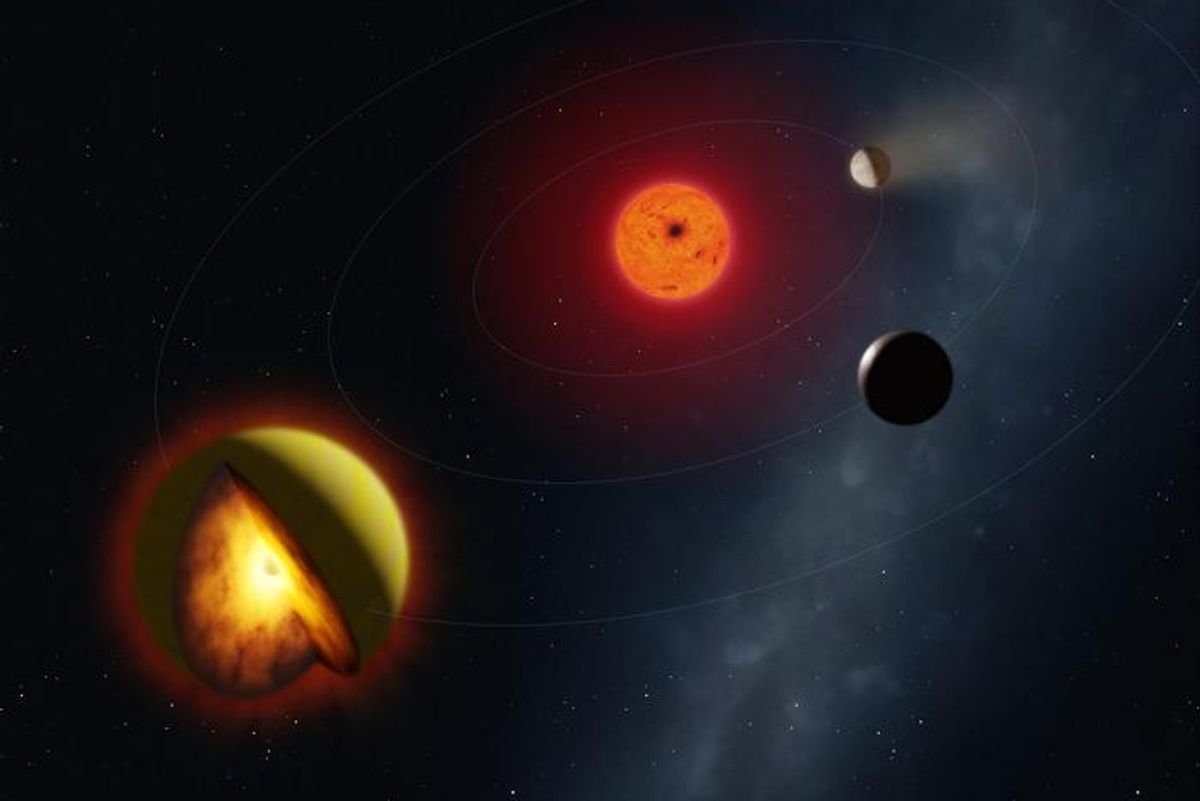
It wasn’t immediately obvious that L 98-59 d is an entirely new type of planet. Orbiting a small red star around 35 light-years away, the planet would have once been categorized as a ‘gas-dwarf’ — rocky, with a hydrogen-rich atmosphere — or as a water-covered world with icy oceans. But new analysis from the James Webb Space Telescope (JWST) and other observatories suggests that L 98-59 d doesn’t fit either category.
Instead, the planet, which is about one-and-a-half times Earth’s size, but with a much lower density, appears to be the first of a new class of planets, featuring deep oceans of magma and a largely sulfurous atmosphere. These new findings about L 98-59 d have been published in Nature Astronomy.
Read More: JWST Spots Unexpected Abundance of Organic Molecules in Nearby Ultra-Luminous Galaxy
A Planet With a Magma Ocean
The new research combined JWST observations with computer simulations.
“Our computer models simulate various planetary processes, effectively enabling us to turn back the clock and understand how this unusual rocky exoplanet, L 98-59 d, evolved,” said Richard Chatterjee, a planetary scientist at the University of Leeds and study co-author, in a statement.
The JWST observations show that L 98-59 d’s upper atmosphere was rich in gases such as sulfur dioxide. The latest models of the planet show that L 98-59 d’s star, a red dwarf named L 98-59, produces these gases by bathing the planet in ultraviolet light, which triggers chemical reactions.
The planet’s mantle is likely composed of lava-like molten silicate, with a magma ocean thousands of kilometers deep bubbling below.
This magma ocean can store huge amounts of sulfur, which is thought to help retain the sulfur-heavy atmosphere. Without these stores, the planet’s atmosphere would be lost to space as the planet is bombarded by X-ray radiation.
The paper’s authors suggest that L 98-59 d is the first recorded member of a new type of planet, featuring sulfurous atmosphere and enduring magma oceans.
“This discovery suggests that the categories astronomers currently use to describe small planets may be too simple. While this molten planet is unlikely to support life, it reflects the wide diversity of the worlds which exist beyond the Solar System. We may then ask: what other types of planet are waiting to be uncovered?” said Harrison Nicholls, a planetary scientist at the University of Oxford and study co-author, in a statement.
The team’s models suggest the planet may once have resembled a larger, hotter planet. Since then, L 98-59 has lost some of its atmosphere. All rocky planets, like Earth, begin with oceans of magma, suggesting that L 98-59 could provide a window into how our own planet formed.
Looking Beyond Our Solar System
The team hopes to use their computer models on new JWST data to further map the formation of planets beyond our Solar System.
“What’s exciting is that we can use computer models to uncover the hidden interior of a planet we will never visit. Although astronomers can only measure a planet’s size, mass, and atmospheric composition from afar, this research shows that it is possible to reconstruct the deep past of these alien worlds — and discover types of planets with no equivalent in our own Solar System,” said Raymond Pierrehumbert, a planetary physicist at the University of Oxford and study co-author, in a statement.
Read More: JWST Peers Into the Haze Surrounding an Unusual Cotton Candy-Like Planet
Article Sources
Our writers at Discovermagazine.com use peer-reviewed studies and high-quality sources for our articles, and our editors review for scientific accuracy and editorial standards. Review the sources used below for this article: