
JWST Helps Examine Atmosphere of Exoplanet 40 Light Years Away and in the Goldilocks Zone

In a big universe with vanishingly few signs of life, the TRAPPIST-1 system is rich with possibilities. The system is home to seven rocky planets, all of which are earth-sized and likely to have detectable atmospheres.
A new study published in The Astrophysical Journal Letters has investigated TRAPPIST-1 e, the planet most favorably positioned in the system’s “Goldilocks Zone,” a distance not too hot, not too cold, but just right for the presence of liquid water on its surface.
Narrowing Down an Exoplanet’s Atmosphere
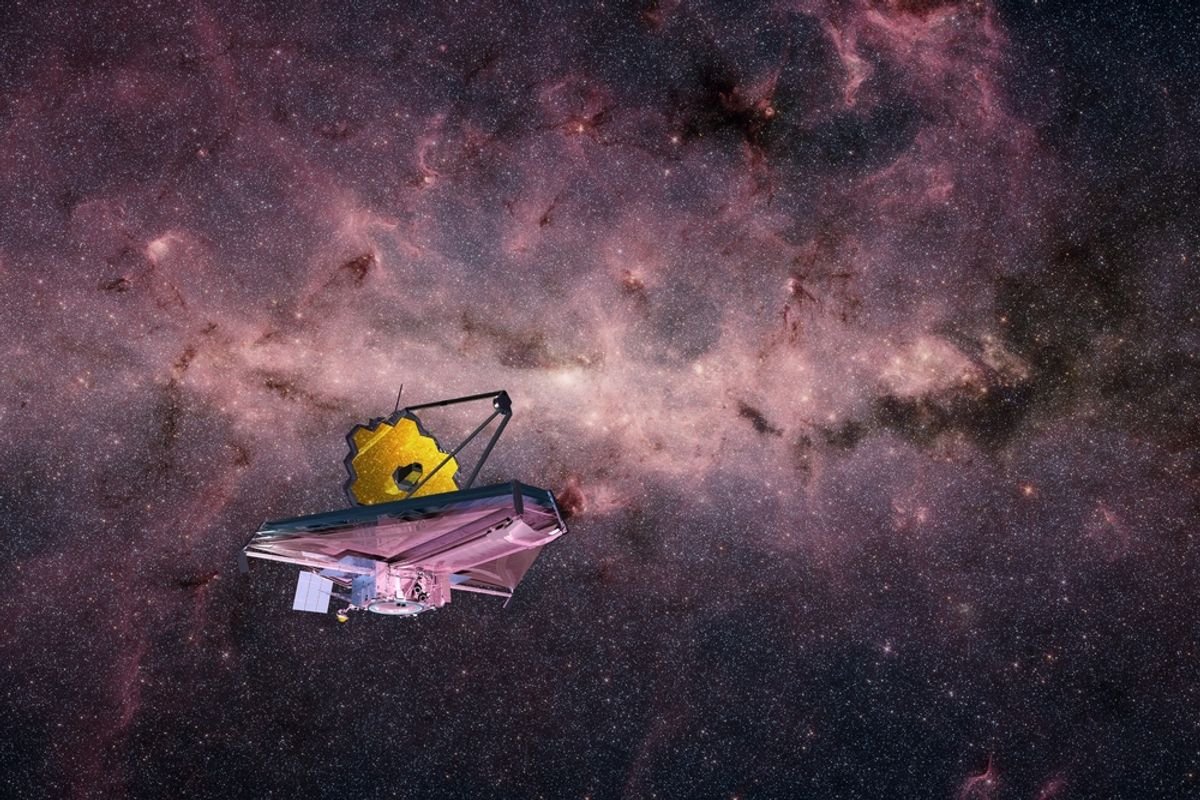
The study leveraged the power of the James Webb Space Telescope (JWST), the successor to the Hubble Space Telescope, to try to assess TRAPPIST-1 e’s atmosphere. The planet orbits a small red dwarf star around 40 light-years from Earth.
The TRAPPIST-1 system has been a hotbed of stellar research since 2016, when researchers identified its favorable conditions. While another of the TRAPPIST-1 planets in the Goldilocks Zone has since been found to have no atmosphere, TRAPPIST-1 e has remained a source of hope.
The research was unable to definitively map out the composition of TRAPPIST-1 e, and the study still leaves open the possibility that the planet could be an airless rock. However, the research has ruled out some potential atmospheric scenarios on the planet and narrowed down the range of atmospheric conditions that secondary generation processes, such as volcanic eruptions, can produce. The data still leaves open the possibility that the planet could have a surface ocean.
Read More: James Webb Space Telescope Captures Smallest Exoplanet Ever Seen in Historic First
Spectral Fingerprints
The researchers employed a technique known as transmission spectroscopy. Imagine a star positioned like a bright stage light. When a planet passes in front of the star, it filters the light, like a colored sheet placed in front of the stage light. In the same way that we would be able to estimate the sheet’s color and thickness by seeing how it affects the light, transmission spectroscopy can make estimations of a planet’s atmosphere by how it alters starlight.
These calculations can even extend to assessments of the molecules present in the atmosphere. The JWST’s scope can detect these molecules at a greater range of wavelengths and at a higher resolution than the Hubble. These improvements allowed the team to make assessments of common solar system molecules like methane and carbon dioxide.
“Each molecule has a spectral fingerprint. You can compare your observations with those fingerprints to suss out which molecules may be present,” said Ana Glidden, the paper’s first author and an astrophysicist at MIT, in a press release.
Life-Friendly or Airless?
The spectroscopy data suggested that TRAPPIST-1 e does not have a hydrogen-rich atmosphere — like Venus or Mars — but leaves open the possibility that it possesses a nitrogen-rich atmosphere, like Saturn’s moon Titan. That the study still leaves open a range of conditions, from a cozy, life-friendly greenhouse to a bare ball of ice, is a result of the problem of stellar contamination. This is where fluctuating temperatures in the observed star complicate the transmission spectroscopy signal.
“Stellar activity strongly interferes with the planetary interpretation of the data because we can only observe a potential atmosphere through starlight,” said Glidden in the press release. “It is challenging to separate out which signals come from the star versus from the planet itself.”
Still, the researchers were able to eliminate some of this noise, which has helped narrow down the range of potential conditions on the planet. Further observation of TRAPPIST-1 e will be key to refining these estimates.
“TRAPPIST-1e remains one of our most compelling habitable-zone planets, and these new results take us a step closer to knowing what kind of world it is,” said Sara Seager, a professor of planetary science at MIT and co-author on the study, in a press release. “The evidence pointing away from Venus- and Mars-like atmospheres sharpens our focus on the scenarios still in play.”
Read More: Earth-Sized Exoplanet Found 55 Million Light-years Away From Our Planet
Article Sources
Our writers at Discovermagazine.com use peer-reviewed studies and high-quality sources for our articles, and our editors review for scientific accuracy and editorial standards. Review the sources used below for this article: