
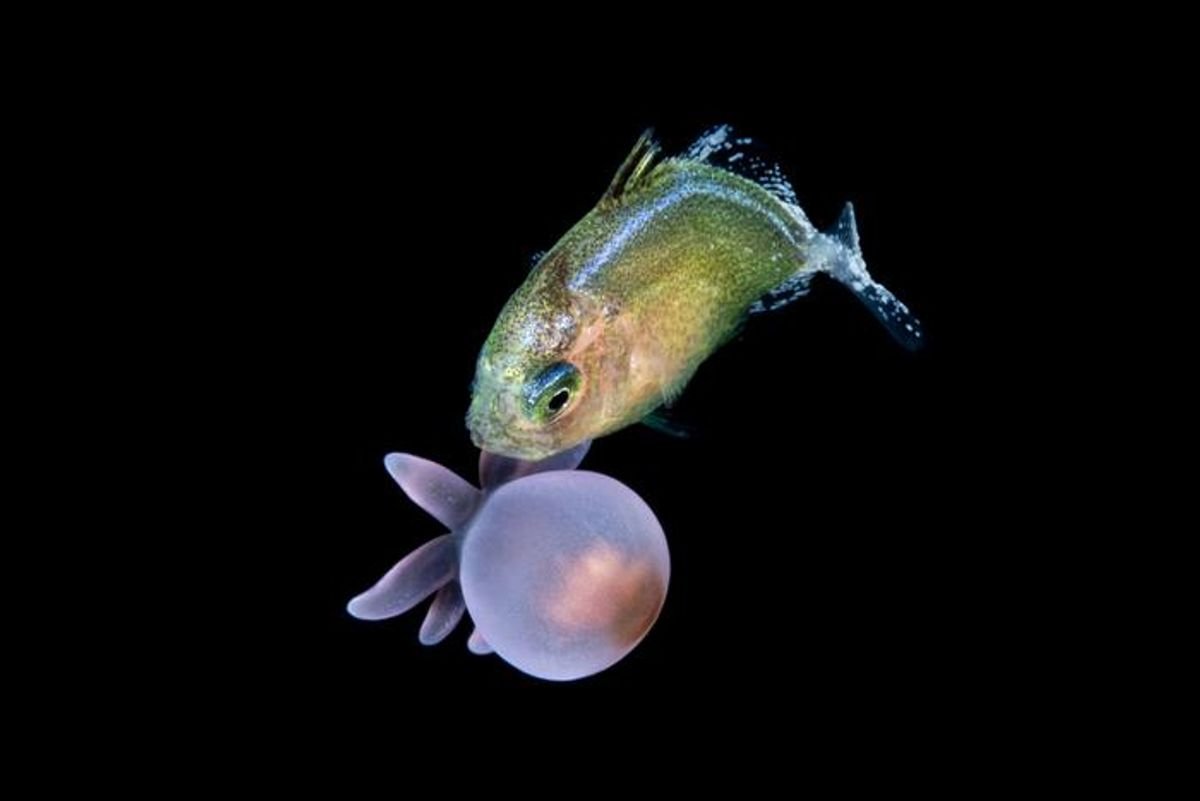
Juvenile Fish Are Wielding Sea Anemones Like Shields Against Predators
Off the coast of Tahiti, small fish have developed a big adaptation to prevent becoming prey. Divers photographed a small, silver, half-dollar-shaped fish, known as a Myers’ Pomfret, with the scientific name Brama myers, “riding” a larval anthozoan, or sea anemone.
With the invertebrate tucked neatly between the fish’s pelvic fin, scuba divers hypothesize that the small fish was using the anemone as a weapon of sorts, perhaps deploying its stinging cells as a defense against would-be predators.
Read More: Friends and Anemones: How Clownfish Strengthen Symbiotic Bonds with Their Hosts
Fish and Anemone: A Symbiotic Relationship

Juvenile filefish carrying a palythoa larva in its mouth.
(Image Credit: Rich Collins)
It’s not the only time this sort of symbiotic relationship between juvenile fish and larval anemones has been observed. In Florida’s West Palm Beach, newly hatched fish species have been spotted carrying anemone larvae in their mouths, caging the invertebrates with their sharp teeth.
One fish carrying its anemone larva in its mouth was actively swimming, demonstrating what the researchers called a “defensive posture, moving short distances and not attempting to flee.” The fish finally released the anemone, which was unharmed, and swam away, suggesting that the fish was not trying to eat the anemone
Symbiotic relationships between anemone and fish are well-documented — just ask any fan of Finding Nemo. The venomous anemone protects the fish, while its fishy inhabitant, in turn, provides nutrients to its host.
But the photographs newly published in the Journal of Fish Biology suggest that these anemone-fish relations are much deeper and more diverse than previously thought.
A Stinging Shield

Juvenile bamidae holding an anemone in its mouth.
(Image Credit: Linda Ianniello)
“Some species of vulnerable larval or juvenile fish use invertebrate species apparently for defensive purposes,” Rich Collins, a diver and consultant at Florida Museum of Natural History, said in a statement. “They’ll find something that’s noxious or stingy, and they just carry it around.”
Diverse captured photographs during blackwater drift dives, when scuba divers drift into deep, open water at night to photograph marine life, between 7:30 p.m. and 10:00 p.m. The dive team captured some images at depths of up to 60 feet, all in the epipelagic zone, where daylight still reaches the depths.
The team noted a variety of fish species associating with anemones — filefish, driftfish, pomfrets, and a young jack were all seen carrying larval tube anemones or button polyps in their mouth.
Anthozoans are marine organisms that lack bones, including corals, sea fans, and anemones. These invertebrates also have polyps and stinging nematocysts, microscopic, harpoon-like cells that discharge a venomous thread upon contact. The sting from a larval anemone wouldn’t kill a would-be predator, but Gabriel Alfonso, lead author of the study, said it would be “unpalatable.”
New Mutual Benefits
The images may also reveal evidence of an entirely new form of mutualism between the two species — the fish receives protection. In return, the anemone may benefit from being transported to new areas.
“Fishes in early stage of development have distinct survival strategies when interacting with pelagic invertebrates, such as hiding within them, mimicking potentially noxious, venomous, unpalatable, and or low-nutrition invertebrate models, or swimming alongside and holding associations between fishes and anthozoans in epipelagic waters,” wrote the authors in the study.
Collected by citizen scientists, these images underscore the significance of the emerging field of blackwater photography and how community science can enhance our understanding of the world’s oceans.
“This novel source of data offers numerous insights that are previously unattainable through fixed specimens from scientific surveys, including color in life, behavior, and association with other planktonic organisms,” concluded the authors. “Therefore, we underscore the significance of community science to the advancement of ichthyology by highlighting its connection with the blackwater divers community.”
Read More: 7 Surprising Symbiotic Relationships, And How Species Help Each Other Survive
Article Sources
Our writers at Discovermagazine.com use peer-reviewed studies and high-quality sources for our articles, and our editors review for scientific accuracy and editorial standards. Review the sources used below for this article: