
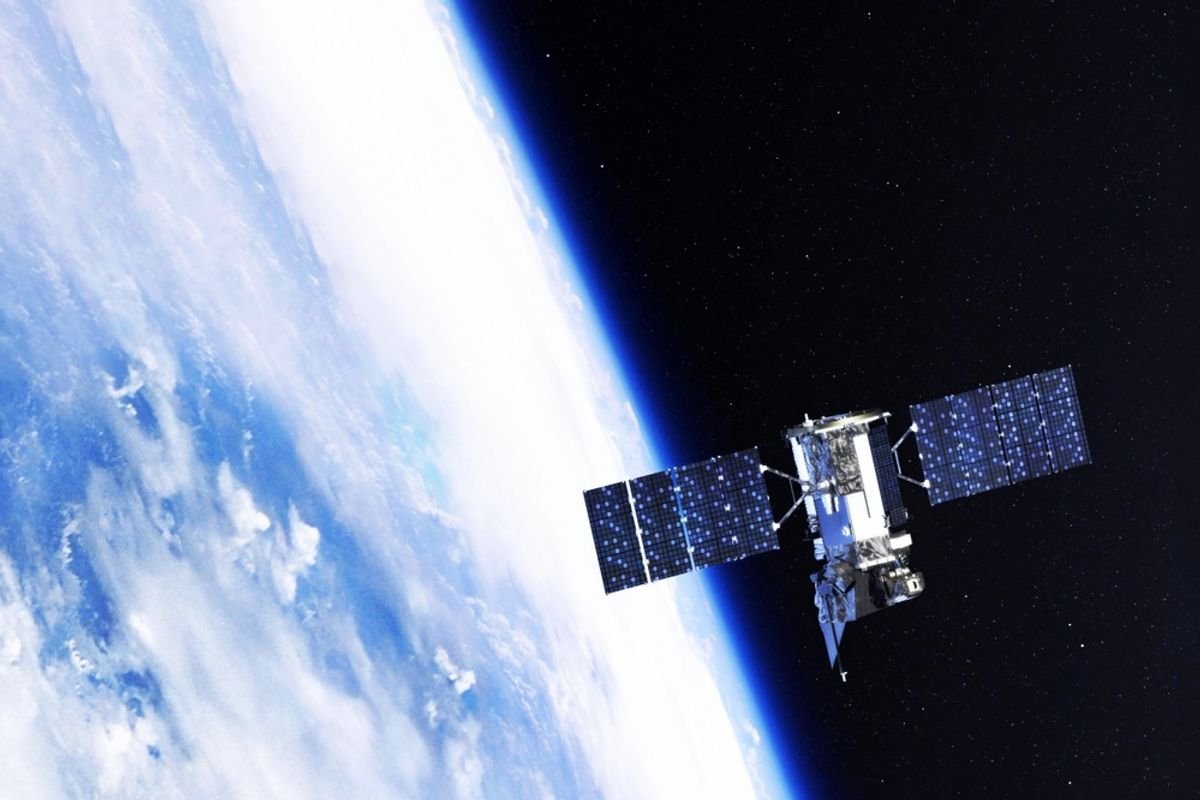
Intense Space Weather Forces NASA’s Van Allen Probe Back to Earth Nearly a Decade Early

After nearly 14 years and a treasure trove of invaluable data, a NASA spacecraft has completed its final journey in a blaze of atmospheric glory.
NASA’s Van Allen Probe A re-entered Earth’s atmosphere at 6:37 a.m. EDT on Wednesday, March 11, 2026, marking the official end to a mission that fundamentally changed the way we understand space weather and the radiation environment surrounding our planet. According to a NASA press release, the spacecraft re-entered over the eastern Pacific Ocean, most likely burning up completely during its fiery descent.
Designed for a two-year mission, the spacecraft ended up collecting data for nearly seven years alongside its twin, Van Allen Probe B. Both spacecraft ceased operations in 2019 and have been waiting patiently to be dragged back to Earth — a waiting period that will be a bit longer for the remaining Probe.
While the spacecraft is now gone, the discoveries it helped produce continue to shape how researchers understand space weather and the hazards it may pose to technology, astronauts, and future space missions.
Read More: A Growing Weak Spot in Earth’s Magnetic Field May Cause More Satellites to Short Circuit
Inside Earth’s Dangerous Van Allen Radiation Belts
For the seven years between 2012 and 2019, the twin spacecraft orbited through the Van Allen radiation belts, which are zones of charged particles trapped by Earth’s magnetic field. The behavior of these particles is influenced by many factors, including activity from the Sun like solar storms and solar wind.
Although they behave quite chaotically, the Van Allen belts act as a protective shield around Earth, preventing radiation and solar particles from negatively affecting both technological systems in low-Earth orbit and life on the planet’s surface. The Van Allen Probes were specially designed to withstand this harsh environment that most other space missions purposefully avoid.
The twin spacecraft, managed and operated by the Johns Hopkins University Applied Physics Laboratory (APL), not only gathered unprecedented readings from two known radiation belts, but also identified the existence of a temporary third radiation belt that forms only during periods of intense solar activity.
What Scientists Learned From Van Allen Probe A
Van Allen Probe A revealed that the radiation belts behave in a more dynamic way than scientists previously believed.
There can be dramatic spikes in radiation triggered by solar wind, plasma waves, and even our own magnetosphere. According to APL, understanding these spikes can help scientists protect electronics and communication systems, as well as build more resistant spacecraft for future missions.
Space weather was another important area of study for Van Allen Probe A. Like the belts, Earth’s radiation environment can quickly and unexpectedly change from calm to chaotic — changes that are key to accurately predicting space weather.
The Importance for Future Space Missions
Although the Van Allen Probe A has now burned up in Earth’s atmosphere, the mission’s scientific legacy is far from finished.
APL has reported that more than 700 scientific studies have already used data from the spacecraft, with researchers continuing to analyze its observations. Currently, scientists use Probe A’s data to predict how solar storms will affect satellites and astronauts in space, as well as power grids, navigation systems, and communication networks on Earth.
The importance of monitoring space weather was further emphasized through Van Allen Probe A’s earlier-than-expected return. When NASA ended the mission in 2019, they estimated that Probe A would return to Earth in 2034. Instead, the strong solar cycle we’ve been experiencing accelerated that timeline, with intense space weather increasing the atmospheric drag on the spacecraft and speeding up its re-entry.
For now, Van Allen Probe B, the twin spacecraft, is still orbiting Earth and is not expected to return until sometime after 2030.
Read More: Asteroid 2024 YR4 Won’t Strike the Moon in 2032, Negating the Chance of a Violent Lunar Impact
Article Sources
Our writers at Discovermagazine.com use peer-reviewed studies and high-quality sources for our articles, and our editors review for scientific accuracy and editorial standards. Review the sources used below for this article: