
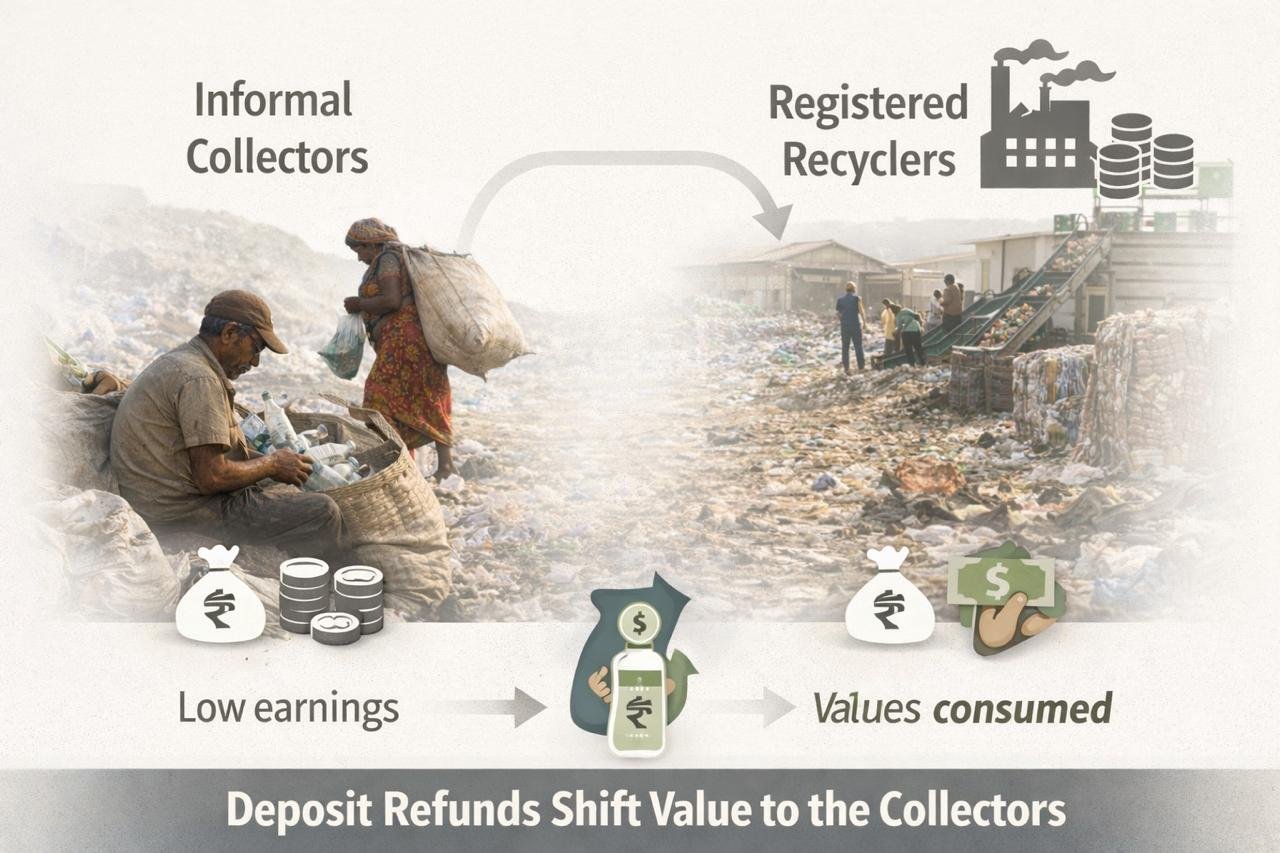

India’s recycling economy is built on the labour of informal waste collectors. Across cities and towns, they retrieve bottles, packaging, and scrap from streets, landfills, and public spaces, preventing large volumes of material from leaking into the environment. Yet despite their central role, the structure of India’s waste management system has consistently favoured downstream processors over those who collect waste at source.
Under existing arrangements, value in the recycling chain accrues primarily at the recycling and compliance stages. Informal collectors are paid based on fluctuating scrap prices, typically calculated per kilogram rather than per item. This pricing structure rewards volume, not effort, and disadvantages collectors working in public spaces where waste is scattered, mixed, and time-consuming to retrieve.
For commonly collected materials such as PET bottles, collectors may earn between ₹15 and ₹20 per kilogram. That kilogram often represents 40 to 50 bottles collected individually from streets, bins, or dumps. Glass bottles fetch even less, often around ₹2 per unit. Multi-layered plastic, which makes up a significant share of consumer packaging, frequently carries no value at all and is often discarded despite being collected. As a result, a large share of packaging waste remains economically unattractive to recover, even though it dominates visible litter.
Extended Producer Responsibility was designed to address financing gaps in waste management by shifting costs from municipalities to producers. In practice, however, EPR has largely strengthened the position of registered recyclers rather than collectors. Compliance value is generated through recycling certificates and credits, not through verified collection effort. The financial transaction typically occurs at the recycling stage, leaving informal collectors dependent on market prices rather than policy-backed value.
Evidence from national and state-level assessments highlights this imbalance. Many urban local bodies that actively manage plastic waste report limited access to EPR systems, low awareness of credit mechanisms, and minimal financial returns despite significant on-ground work. The result is a system where collection labour is essential, but poorly compensated.
The Deposit Refund Scheme addresses this imbalance by altering where value enters the chain. Instead of relying on resale margins, deposits assign value per unit at the point of consumption and release that value at the point of return. Whoever returns the container receives the deposit, regardless of their position in the formal economy. This shifts the economics of collection from weight-based aggregation to effort-based recovery.
International experience shows that this shift has material consequences. Deposit Refund Schemes operating across Europe, North America, and parts of Asia consistently report return rates above 80 per cent for beverage containers, with countries like Germany and Norway exceeding 90 per cent. These outcomes are driven not by enforcement intensity, but by the simple fact that discarded packaging has immediate monetary worth.
For informal collectors, the implications are direct. A per-unit deposit value reduces dependence on volatile scrap prices and intermediaries, shifting earnings from weight-based aggregation to item-level recovery. Materials that were previously ignored or weakly priced, such as low-value plastic packaging, become economically viable to collect. In practical terms, deposits translate into a step-change in earnings like PET bottles can yield up to a twelve-fold increase over prevailing scrap rates, glass bottles up to a ten-fold increase, and aluminium cans around a three-fold increase on a per-item basis. This improves income predictability and rewards collection effort at source. For materials such as multi-layered plastic, which often carries little or no scrap value, deposits create a 200X income stream where none previously existed.
The Deposit Refund Scheme also changes collection conditions. Because containers are returned clean and separately, collectors spend less time sorting contaminated waste and face lower health risks. Cleaner streams improve recycling efficiency downstream, but the immediate benefit is felt at the point of collection, where labour conditions matter most.
Seen against the national backdrop, Goa’s implementation of a Deposit Refund Scheme reflects an attempt to address long-standing structural imbalances in waste recovery. In a state where informal collectors manage a substantial share of consumer packaging waste, particularly from public spaces, the system has been introduced to shift value closer to the point of collection while continuing to rely on existing recovery networks and downstream processing capacity.
Crucially, the Deposit Refund Scheme integrates the informal sector better than any existing ecosystem currently operational in the market. They rely on them. What changes is the distribution of value. Instead of concentrating financial returns at the end of the chain, deposits reintroduce value at the beginning, where physical recovery occurs.
India’s waste management challenge is not only one of infrastructure or regulation. It is also a question of incentives. A system that depends on informal labour but does not reward it proportionately will continue to struggle with leakage, litter, and inequity. Deposit-based mechanisms offer a way to correct that imbalance, not by formalising workers overnight, but by paying fairly for the work they already do.
The debate, then, is not about replacing existing frameworks. It is about whether the economics of recycling can be realigned so that those who recover waste are no longer the least rewarded participants in the system.