
In a First, Watch as Orcas Team Up With Dolphins to Boost Their Salmon-Hunting Success
Killer whales, dolphins, and many other marine mammals thrive on collaboration and community within their pods and schools. And while interspecies interactions have been recorded before, the detailed strategies and motivations behind them are often unclear.
Now, for the first time, researchers have observed cooperative hunting between northern resident orcas and Pacific white-sided dolphins in Canadian waters off British Columbia’s coast. As described in a new paper in Scientific Reports, tagged orcas appeared to intentionally follow and listen in on the dolphins’ echolocation, which directly led them to Chinook salmon, their preferred food source.
So, what’s in it for the dolphins? Besides watching orcas share salmon scraps with their cetacean cousins after a successful hunt, scientists suggest that large resident orcas may offer dolphins protection from predators, like transient killer whales that frequently prey on them.
Read More: Watch These Killer Whales Use Kelp as a Grooming Tool – A Surprising Find for Researchers
Resident Orcas Struggle With Finding Food
Northern resident killer whales (Orcinus orca) are — just as their name suggests — permanently located in one region, stretching from south of Alaska to northern Vancouver Island. Unlike their transient relatives, these orcas rely almost exclusively on Chinook salmon (Oncorhynchus tshawytscha) as their main food source. But since Chinook populations have been steadily declining, the resident orcas are now listed as threatened in Canada.
Pacific white-sided dolphins (Lagenorhynchus obliquidens), however, have a more varied diet that includes smaller fish and squid. Interestingly, they’re often seen close to the local orcas without any signs of antagonistic behavior. In fact, they seem to enjoy each other’s company rather than ignoring or avoiding one another.
This has prompted scientists to wonder if there’s more to the relationship. As resident orcas face dwindling salmon numbers, they may be using their highly social and sophisticated hunting abilities to team up with a skilled potential companion.
Teaming Up With Dolphins Helps Spot Salmon
In August 2020, a team of scientists recorded the hunting behavior of nine northern resident orcas as they interacted with Pacific white-sided dolphins around northern Vancouver Island.

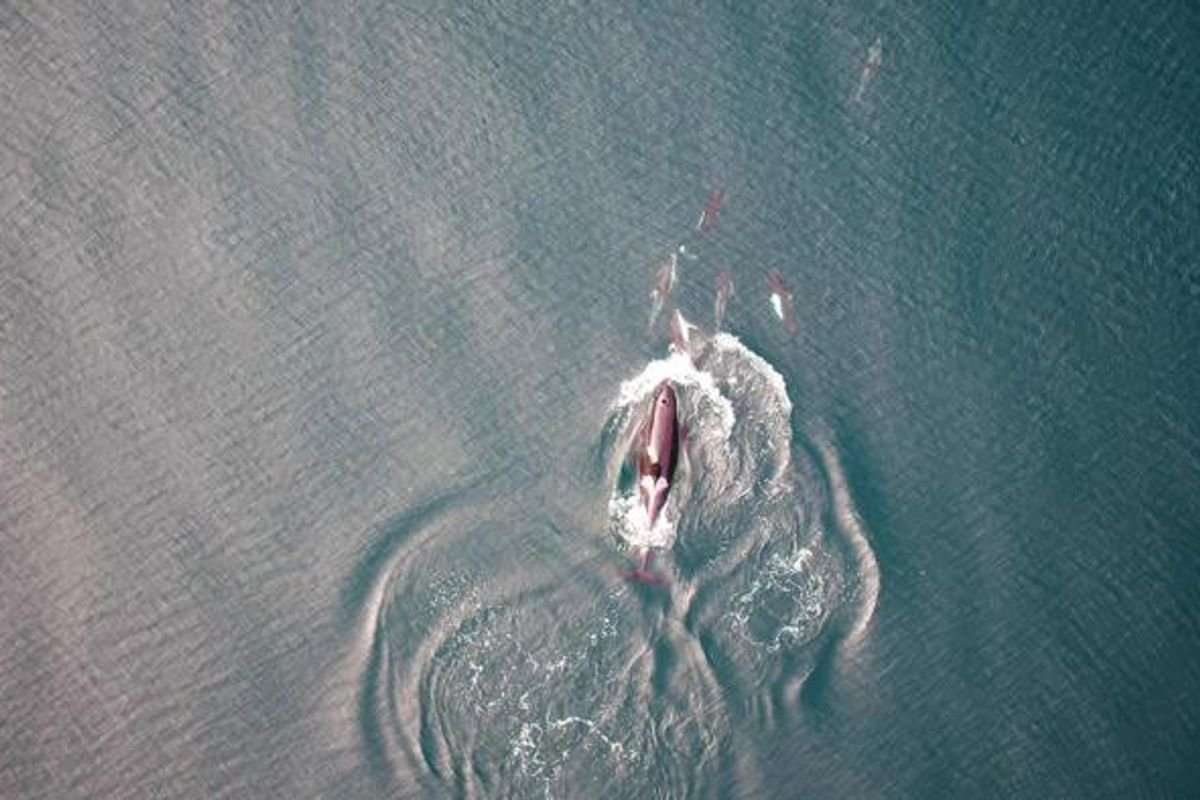
Dolphins hunting with a pod of northern resident killer whales.
(Image Credit: UBC (A.Trites);Dalhousie University (S. Fortune);Hakai Institute (K. Holmes);Leibniz Institute for Zoo and Wildlife Research (X. Cheng)
They gathered data using aerial drone footage, suction-cup bio-trackers attached to orcas, and acoustic recordings to better understand how the whales hunt when dolphins are nearby.
According to a press release, across 25 instances, orcas oriented toward dolphins and followed them on dives after encountering them in the water. Researchers also noticed that orcas reduced their own echolocation when dolphins were present.
After detecting and catching Chinook salmon, there were eight documented cases of killer whales sharing salmon scraps with the dolphins.
A Perfect Marine Alliance
The study authors interpret the reduced orca echolocation as a deliberate strategy to “eavesdrop” on the dolphins’ clicks and calls, potentially helping the whales zero in on large Chinook salmon, too big for the dolphins to target anyway.
Beyond scoring some smaller salmon bits, the dolphins may gain something even more valuable: safety. By sticking close to the local resident orcas, they may avoid encounters with mammal-eating transient orcas, which regularly prey on them but tend to avoid resident pods when passing through. The alliance may also help dolphins avoid great white sharks that are increasingly migrating into northern waters.
Confirming this hypothesis will require more observational studies. Still, these findings highlight just how naturally mutual alliances can form in the animal kingdom and how collaboration can boost a species’ odds of success.
Read More: Orcas Imitate Human Speech as a Way to Communicate With Us
Article Sources
Our writers at Discovermagazine.com use peer-reviewed studies and high-quality sources for our articles, and our editors review for scientific accuracy and editorial standards. Review the sources used below for this article: