
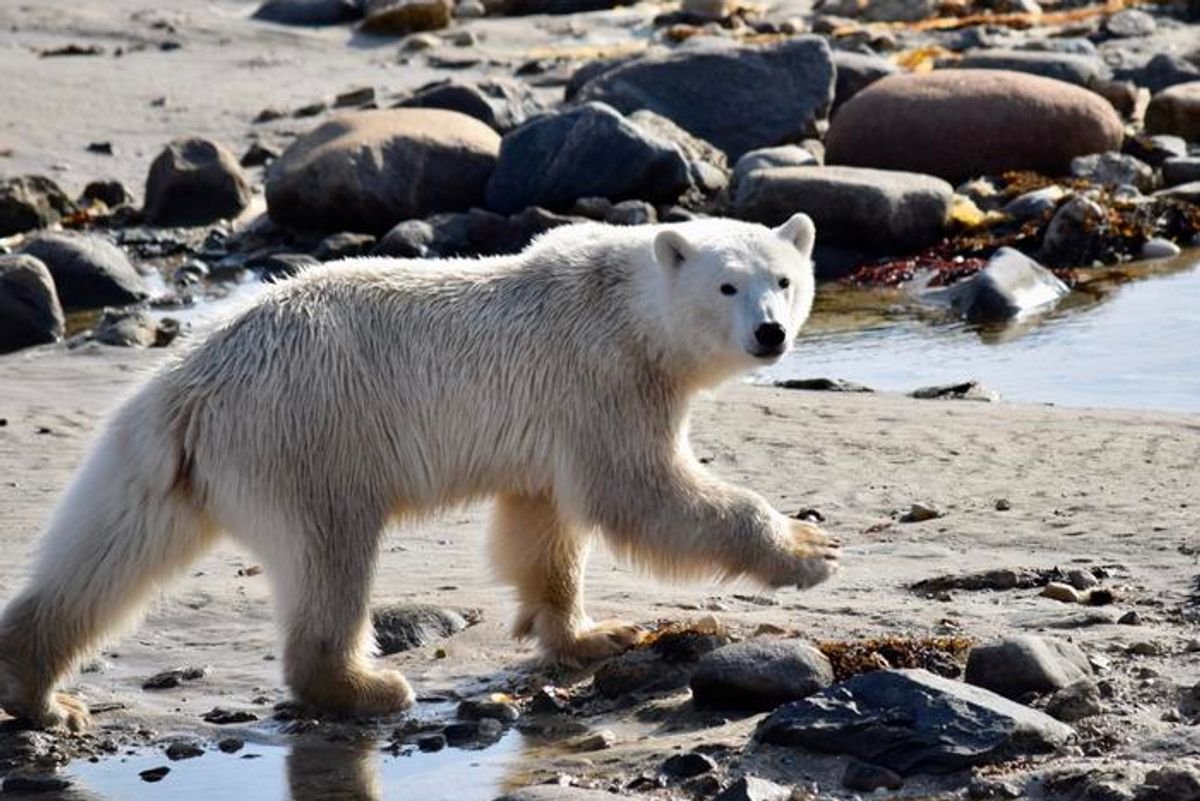
If the Menu Is Just Right, Seals Will Risk Danger From Polar Bears for a Better Meal

How far would you be willing to go to add a little variety to your diet? Some ringed seals may venture into danger.
With food webs being reshaped by climate change in the Arctic, a new study published in Ecology Letters from researchers at the University of British Columbia (UBC) finds that some ringed seals have been swimming into risky polar bear territory in search of certain food sources.
“Climate change is reshaping the Arctic, an area often seen as a foreshadowing of climate changes around the world,” said lead author Katie Florko, who conducted the research as a doctoral student at UBC’s Institute for the Oceans and Fisheries (IOF), in a press release. “It’s not just melting sea ice: climate change is affecting everything: the predators, the prey, and their habitats, effectively reshuffling a complex, intertwined system.”
Read More: Greenland’s Glacier Fronts Are Ideal Feeding Spots for Ringed Seals
Tracking Seals and Polar Bears
For the study, the research team followed 26 ringed seals and 39 polar bears, tracking their locations and dive information with GPS. From the data, the team could analyze how the animals hunted for food or avoided becoming a meal themselves. The team combined the analysis data with sea ice maps.
“Communities across the North rely on healthy seal and fish populations, so more accurate maps of these populations also help support food security and wildlife management,” said senior author Marie Auger-Méthé, UBC professor in the department of statistics and IOF, in a press release.
Using the maps, the team could create yearly models based on the fish species in Hudson Bay and track where bears and seals went to catch prey. The models also revealed when seals dived, how they moved, what their food options looked like, and how the seals reacted when polar bears were nearby.
Taking Chances on a Meal
The research team was rather surprised by the results. They found that the seals typically avoided areas with polar bears and quickly moved through them when necessary. However, if there was a healthy mix of fish in the area, the seals seemed to take a riskier approach and stuck around to hunt longer.
This pattern didn’t appear when seals dove in areas without polar bears, likely because hunting there was safer and easier.
This is what the team refers to as the ‘portfolio effect,’ similar to how investors with a variety of investments reduce their overall risk. In the wild, animals may select a variety of food sources to increase their chances of finding food during a shifting climate.
“The seals aren’t putting all their fish in one basket,” said Florko.
The Consequences of Losing Ice
During the study, the research team also discovered that seals may have developed a tactic for identifying where polar bears tend to hang out. Florko and team wanted to see if the seals may be listening for polar bear paws walking across the ice. Listening for these heavy footprints lets the seals know they need to stay underwater longer until the coast is clear. But the results were inconclusive.
“We didn’t end up finding a relationship, but that may be because it’s a fine-scale event occurring in a matter of seconds that we weren’t able to capture — yet,” Florko said.
Still, the team is trying to understand other predator avoidance tactics that seals may have, especially when it comes to larger predators like killer whales. As more sea ice melts, seals are losing a valuable resource that keeps them safe from killer whales. Less ice also means a more concentrated polar bear population, which also spells more danger for seals.
As the climate continues to change, taking risks for food may only be half of what seals will have to face.
Read More: Male Leopard Seals Sing Underwater Nursery Rhymes For Up to 13 Hours a Day
Article Sources
Our writers at Discovermagazine.com use peer-reviewed studies and high-quality sources for our articles, and our editors review for scientific accuracy and editorial standards. Review the sources used below for this article: