
Icy Moons Orbiting Saturn and Uranus May Hide Boiling Liquid Oceans

Lurking in the shadows of our Solar System’s gas and ice giants are small, frozen moons. Some of these moons contain roiling liquid water oceans bound by a hard icy shell.
A new study, published in Nature Astronomy, has cracked the surface of these moons and revealed what may be happening in the depths of their oceans, which are thought to be excellent candidates for hosting extraterrestrial life.
“Not all of these satellites are known to have oceans, but we know that some do. We’re interested in the processes that shape their evolution over millions of years, and this allows us to think about what the surface expression of an ocean world would be,” said Max Rudolph, an Earth and planetary scientist at the University of California, Davis, in a press release.
Icy Moons in the Solar System
Rather than flowing magma, geological shifts on icy moons are produced by melting ice. The ice shells coating these moons wax and wane in response to forces generated by the planet they orbit and by neighboring moons, which heat or cool these shells.
As Rudolph led the researchers, his team used mathematical models to analyze what happens when the ice sheet melts. The team found that the warming ice sheets lower the pressure on the moon, as dense ice melts into water.
Their calculations suggested that if the moon is small enough, this drop could be enough to hit a “triple point” at which ice, water, and water vapor can all be present on the moon. In short, the frozen oceans will begin to boil. The moons small enough for this to occur on include Miranda, a moon of Uranus, and the Saturnian moons Mimas and Enceladus.
Read More: Hidden Heat on Saturn’s Icy Moon Could Help It Sustain Life
Probe Images Support Ice Analysis
Evidence from space probes also supports the theory. Voyager 2, which flew by Miranda in 1986, took images of coronae — distinctive cliffs and valleys that scar the moon’s surface. Boiling oceans could have formed these marks, the authors say.
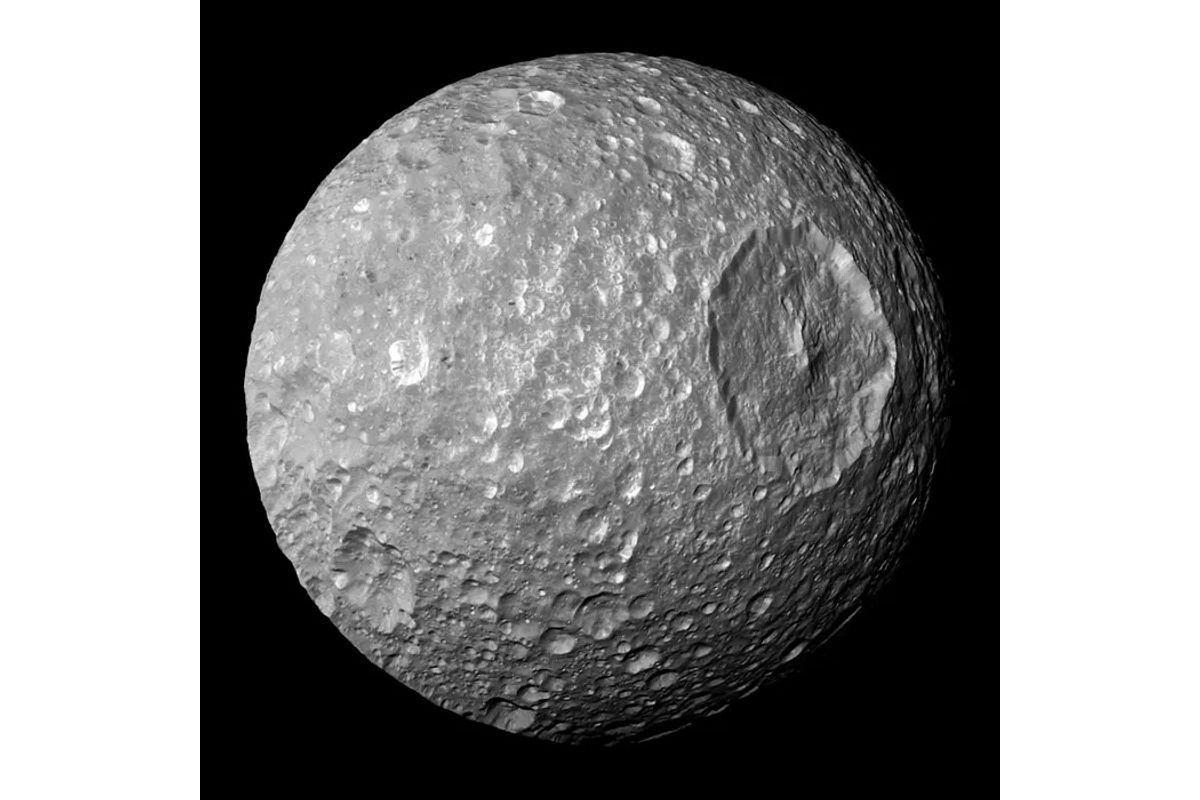
On Mimas, a tiny and crater-pitted moon that is only slightly wider than the distance from New York to Boston, the surface appears geologically inactive. But the ice shell on this moon is not likely to break as it thins. Mimas could therefore have a barren surface with a boiling liquid ocean just underneath. Researchers have noticed the moon “wobbling” slightly, further supporting the presence of an ocean.
On larger moons, pressure drops would likely crack the ice surface before the oceans could boil. These bigger moons include Titania, which also orbits Uranus. Titania’s ridged surface, they wrote, could have been formed by periods of ice-shell thinning and thickening.
The new publication is not Rudolph’s first paper on icy moons. An earlier study explored what might happen when icy moons cool and their surface sheet thickens. This process could also have impacts on the moon’s surface, forming features like the fractured ridges commonly known as “tiger stripes,” which are seen on Enceladus.
What we know about Earth’s geology can help us understand how our planet’s surface has shifted over millions of years. Studying the icy shifts within these distant moons can also help us understand how their distinctive surfaces formed.
Read More: NASA’s Europa Clipper Will Probe for Life in The Plumes of Icy Moons
Article Sources
Our writers at Discovermagazine.com use peer-reviewed studies and high-quality sources for our articles, and our editors review for scientific accuracy and editorial standards. Review the sources used below for this article: