
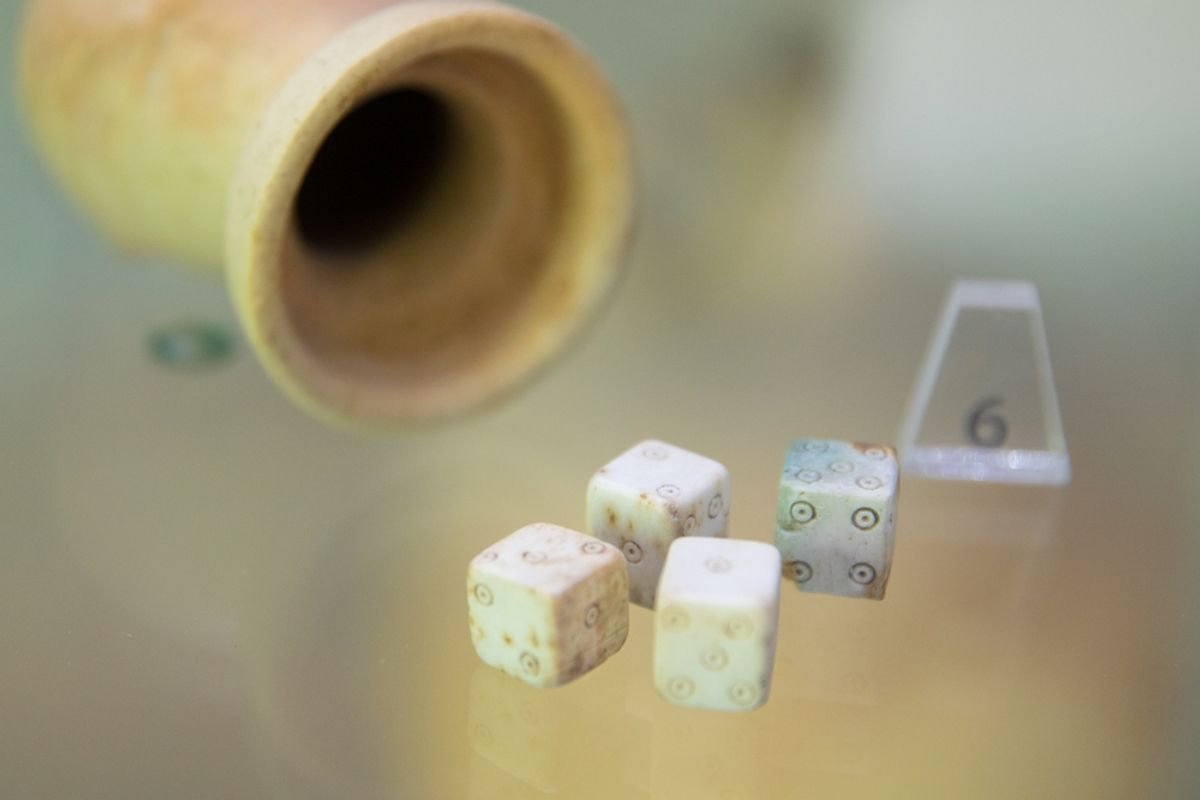
Ice Age Humans Played Dice — And May Have Been Gambling 12,000 Years Ago
At the end of the last Ice Age, on the open plains of the American West, small pieces of bone were shaped, marked on one side, and tossed by hand. More than 12,000 years ago, Native American hunter-gatherers were already using them as dice — objects now turning up at Folsom-period sites in Wyoming, Colorado, and New Mexico.
In a study published in American Antiquity, a team from Colorado State University analyzed artifacts from across the region and found that dice, games of chance, and gambling were established parts of life during the Late Pleistocene.
These early examples date to roughly 12,800 to 12,200 years ago and predate the oldest known dice from Bronze Age societies in the Old World by more than 6,000 years, shifting when and where structured games of chance and gambling first appear in the archaeological record.
“Historians have traditionally treated dice and probability as Old World innovations,” study author Robert Madden said in a press release. “What the archaeological record shows is that ancient Native American groups were deliberately making objects designed to produce random outcomes, and using those outcomes in structured games, thousands of years earlier than previously recognized.”
Read More: The Ancient History of Board Games
How Ice Age Dice Turned Chance Into a Game

Late Pleistocene dice
(Image Credit: Robert Madden)
These were not cubes, but two-sided objects known as binary lots — small pieces of bone designed to produce one of two outcomes when thrown. Each piece had two faces, marked through carving, staining, or surface treatment so they could be easily distinguished, much like heads and tails on a coin.
They weren’t thrown one at a time, but in handfuls. Players watched how many landed with the marked side facing up, turning each toss into something that could be counted, compared, and played again.
“They’re simple, elegant tools,” Madden said. “But they’re also unmistakably purposeful. These are not casual byproducts of bone working. They were made to generate random outcomes.”
A New Way to Recognize Ancient Dice
Rather than relying on visual resemblance or guesswork, the study introduced an attribute-based test: a set of measurable traits used to figure out whether an object functioned as a die. The framework was built from 293 sets of historically documented Native American dice recorded by ethnographer Stewart Culin in the early 20th century.
That standard was then applied across the archaeological record, allowing researchers to reassess artifacts long labeled as “gaming pieces” or left without clear interpretation.
More than 600 diagnostic and probable dice were identified across 57 archaeological sites spanning a 12-state region, from the Late Pleistocene through later periods.
“In most cases, these objects had already been excavated and published,” Madden explained. “What was missing wasn’t the evidence, it was a clear, continent-wide standard for recognizing what we were looking at.”
A 12,000-Year Tradition of Chance and Connection

Pleistocene dice pieces
(Image Credit: Robert Madden)
Historians have linked games of chance to the origins of probabilistic thinking, typically dating that development to Old World societies around 5,500 years ago. This study shows that structured ways of working with chance emerged much earlier, and in very different settings.
“These findings don’t claim that Ice Age hunter-gatherers were doing formal probability theory,” Madden said. “But they were intentionally creating, observing, and relying on random outcomes in repeatable, rule-based ways that leveraged probabilistic regularities.”
The study also shows how dice keep showing up across thousands of years and dozens of sites, suggesting they were more than just a pastime.
“Games of chance and gambling created neutral, rule-governed spaces for ancient Native Americans,” he concluded. “They allowed people from different groups to interact, exchange goods and information, form alliances, and manage uncertainty.
Read More: These 5 Toys and Games Have Been Popular for Millennia
Article Sources
Our writers at Discovermagazine.com use peer-reviewed studies and high-quality sources for our articles, and our editors review for scientific accuracy and editorial standards. Review the sources used below for this article: