
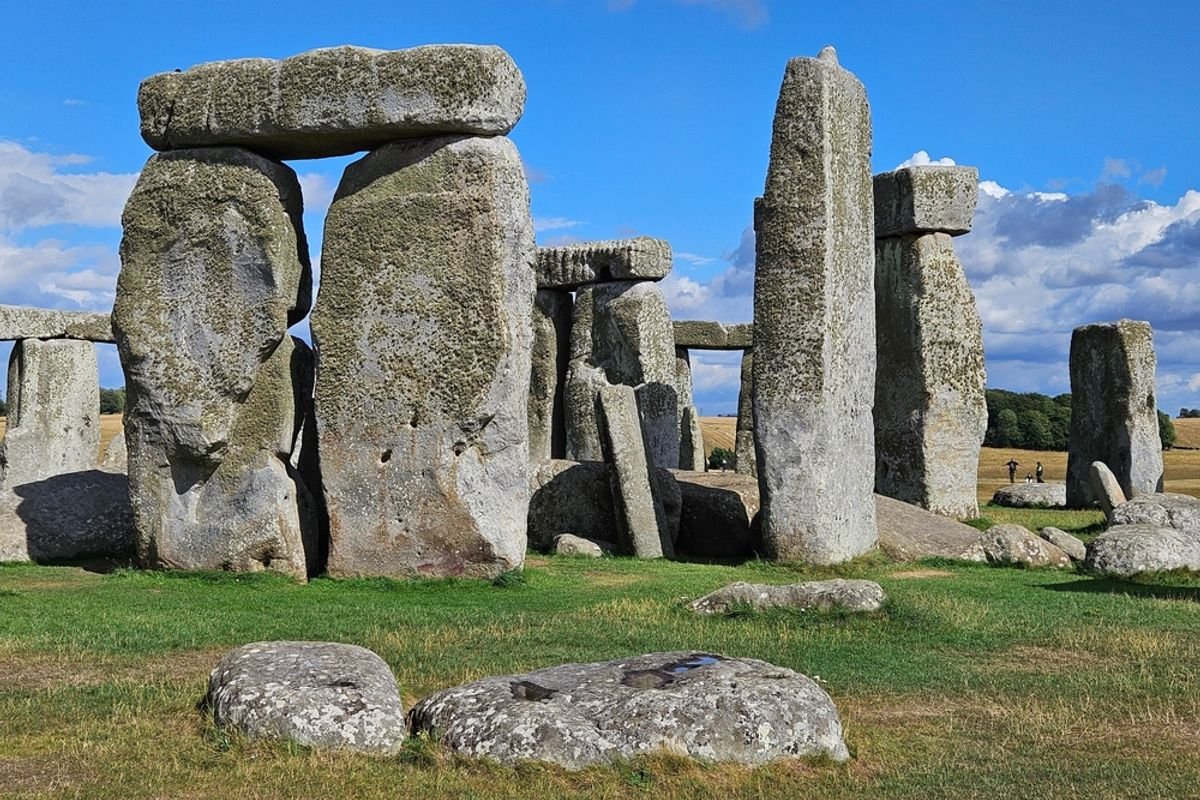
Humans, Not Glaciers, Brought Rocks to Stonehenge — But Why and How Remain a Mystery

The megalith formation at Stonehenge is one of the most enduring mysteries of the Neolithic era. The structure contains large stone slabs from Scotland, Wales, and England, but no written explanation of who created the monument, why, or how.
As for the latter, there has been debate in terms of how exactly these giant stones were transported from the outer corners of the U.K. to their current home on the Salisbury Plain in Wiltshire, England. Specifically, were they moved by people? Or glaciers?
Now, archaeologists writing in Communications Earth and Environment provide more evidence in favor of the human argument. By analyzing tiny grains deposited in rivers near the site, researchers can study how different materials have travelled across the U.K. over extraordinarily long periods. It is not so much what the samples at Stonehenge contained but the absence of certain minerals that point to human transportation.
The absence of these minerals “makes the alternative explanation — that humans moved the stones — far more plausible,” lead author Anthony Clarke, from the University of Curtin’s School of Earth and Planetary Sciences, Australia, said in a statement.
“Stonehenge continues to surprise us,” co-author Professor Chris Kirkland, from the University of Curtin’s School of Earth and Planetary Sciences, Australia, added. “By analysing minerals smaller than a grain of sand, we have been able to test theories that have persisted for more than a century.”
Read More: Archaeologists Propose Stonehenge May Have Unified People in Ancient Britain
Where Did The Stonehenge Stones Come From?
The megaliths at Stonehenge can be split into three groups. The sarsens are larger stones forming the outer circle and inner horseshoe, and were originally sourced from the West Woods, about 15 miles (25 kilometers) away. The bluestones weigh between 2.2 and 5.5 tons (2 and 5 tonnes) and are from the Mynydd Presel, a mountain range in southeast Wales, about 143 miles (230 kilometers) from Stonehenge. The last is the Alter Stone, a 6.6-ton (6-tonne) piece of Palaeozoic Ord Red Sandstone from the Orcadian Basin of northeast Scotland, more than 435 miles (and 700 kilometers) away.
Clarke and Kirkland’s study considers bluestones. While most have suggested that these stones were moved by people, using land and/or sea routes, there is another theory.
And How Did The Stones Get There?
As rock erodes, it creates sediment — tiny grains and larger fragments that have been dislodged from the main body of rock. This sediment contains clues or mineral “fingerprints” that can tell us where it originally came from and where it’s been.
For this particular study, Clarke and Kirkland used apatite and zircon. The latter is, according to the American Museum of Natural History, the oldest mineral on the planet. (Examples found in Australia date back 4.2 billion to 4.3 billion years.) Zircons are exceptionally tough, chemically inert, and rarely ever disappear, making them particularly useful mineral “fingerprints” or geological time capsules.
In this case, the interesting bit was not exactly what they found, but what they didn’t. Had the bluestones been transported by glaciers, the researchers would expect to find substantial amounts of 464-million-year-old zircon, consistent with the age of the bluestones themselves.
Instead, the ages of zircon found in the Salisbury Plain were far older (1.7 million to 1.1 million years old), showing it is derived from more ancient rock. Meanwhile, the apatite discovered was much younger, around 60 million years old. Combined, these match those of nearby rocks in the London Basin and imply the recycling of local sediment rather than an influx of new sediment from Wales during the last Ice Age. In short: “ice almost certainly didn’t move the stones,” said Clarke.
The findings support previous studies, including a paper published in the Journal of Archeological Sciences: Reports last year, which contradicted arguments that the ‘Newall boulder,’ a bluestone, was transported by glacier. But how exactly humans moved these giant stone slabs (and why) remains a mystery.
Read More: The Ancient Burial Site of Flagstones May Have Inspired Stonehenge
Article Sources
Our writers at Discovermagazine.com use peer-reviewed studies and high-quality sources for our articles, and our editors review for scientific accuracy and editorial standards. Review the sources used below for this article: