
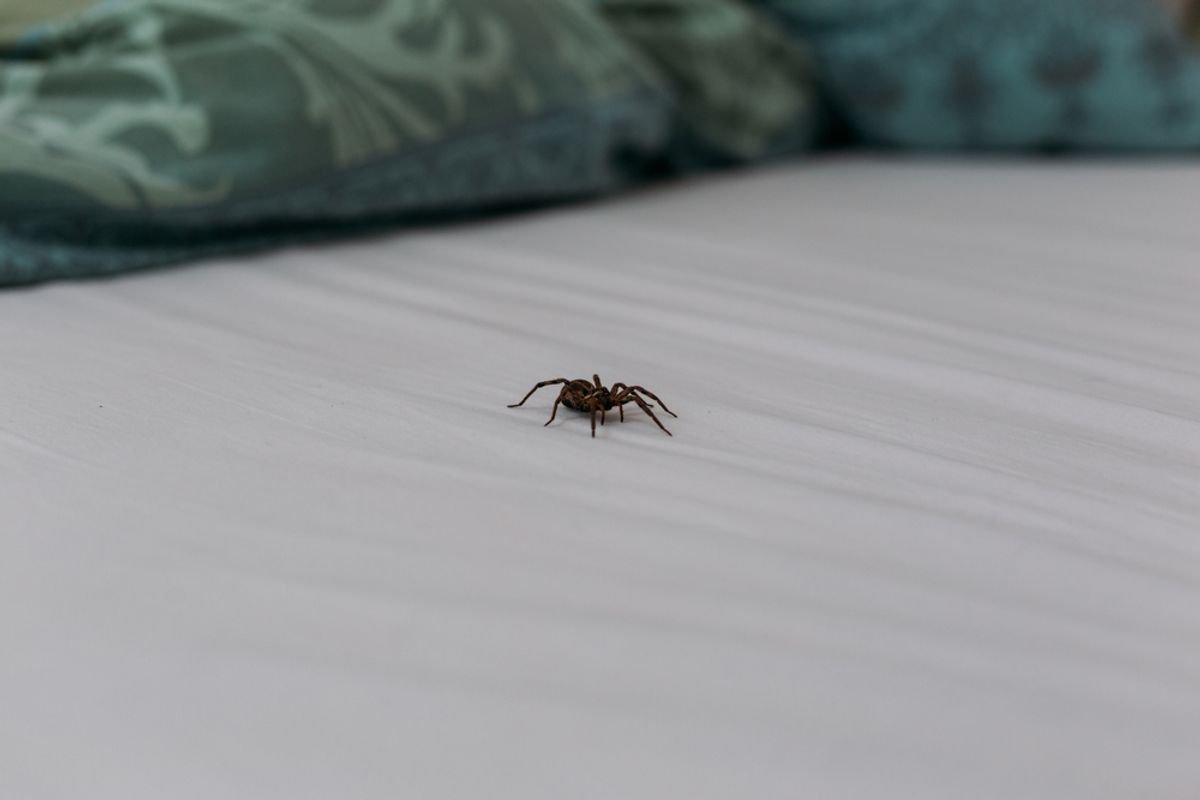
Humans Don’t Eat 8 Spiders Per Year in Their Sleep — Here’s How We’d Know If We Did

Key Takeaways On Eating Spiders While You Sleep
- Do you really eat spiders in your sleep? According to experts, no, we do not. Researchers are unsure where the rumor that we eat 8 spiders per year in our sleep came from.
- Most spiders are not toxic to humans if accidentally swallowed. However, if they leave bites in your mouth before being swallowed, it may be best to contact a medical professional.
- Spiders likely avoid sleeping humans, especially their mouths, because our body temperature and airflow are too high and not ideal places for spiders to hide.
Akin to the irrational fears of sinking into quicksand or diving into a river filled with flesh-eating piranhas, tall tales of people accidentally swallowing spiders while sleeping have long pervaded millennial minds. The creepy, crawly legend is truly the stuff of nightmares, but is there any basis for it?
Discover spoke with not one, not two, but three spider experts who said that this urban legend is just that — the stuff of imagination. No, it is not true that people regularly eat spiders in their sleep.
“Has it possibly happened? Perhaps. Does it happen often? Absolutely not,” says William Heyborne, a professor of biology at Southern Utah University. “This is clearly a myth that has been circulating for a few decades now. Its absolute origin is unknown.”
Read More: Spiders Will Hunt in Groups and Share Meals if They Have Enlarged Brain Structures
Do You Really Eat Spiders In Your Sleep?
Michelle Tremblay is a spider expert at Georgia Southern University. She’s heard variations on this dubious claim for years, suggesting that a person may eat at least eight spiders annually, or up to a pound of spiders over a lifetime.
“But the actual origin? That’s a mystery,” says Tremblay. “I think the myth sticks around because it’s just so wonderfully weird. It paints a vivid image and taps into a lot of people’s fear of spiders.”
Are Spiders Toxic To Eat?
Joyce Fassbender, an entomologist at Florida Gulf Coast University, says that the urban legend is an excellent example of how misinformation spreads.
Heyborne, Tremblay, and Fassbender all agree that there is no evidence to suggest people regularly swallow spiders. If ingesting the arachnids were a common occurrence, there would be documented cases or, at the very least, people would occasionally find spider bites in their mouths.
“It simply doesn’t happen,” says Tremblay.
While most spiders are not toxic if consumed, the Mayo Clinic reports that some insects can bite or sting if accidentally swallowed. In these cases, it may be best to seek advice from a medical professional.
Why Don’t Spiders Crawl In Your Mouth When You Sleep?
Spider behavior further busts this myth. Although people are typically afraid of the eight-legged arachnids — roughly 15 percent of the world’s population, according to the Cleveland Clinic — spiders are more apt to avoid humans entirely.
“Spiders want undisturbed, quiet corners and cracks with the right temperature and humidity and some prey to snack on. Humans (even asleep) are the exact opposite of that. We’re noisy, hot, large, and move too much for a spider’s preference or safety,” says Tremblay.
In other words, spiders are equally as uncomfortable around humans as people are around the arachnids.
“Spiders like quiet, secluded places to hide. An open mouth is definitely neither of these things, where the air movement, moisture, and likelihood of rousing a sleeping individual would make this a very inhospitable environment for a secretive animal like a spider. The wet oral mucosa alone would likely be enough to deter a spider who may be looking for a place to hide,” says Heyborne.
And because there’s typically no prey in a human bed, spiders don’t have much incentive to snuggle up alongside, or inside, a person.
“There’s nothing to attract them to our mouths, and the breath coming from our mouths would more than likely scare them away,” says Fassbender.
Spiders Self Preservation
Human behavior would likely deter a spider. A person would probably feel a spider crawling across their face, even when asleep, and would brush the insect away before it got anywhere near their mouth. People also tend to move while they sleep.
“Spiders have the same self-protective instincts that all animals have, and are very sensitive to vibrations and movement. They would see us as part of the landscape and would avoid the breathing, moving, scary person to avoid the threat of being damaged or crushed,” adds Fassbender.
The legend is just creepy enough to excite the human mind and the desire to share the tall tale. But it’s simply not grounded in truth.
“This is just a fun, creepy rumor. But the reality is that spiders want nothing to do with us or our faces,” says Tremblay.
Read More: Spiders Do Sleep — Some Even Dream While Dangling From Webs
Article Sources
Our writers at Discovermagazine.com use peer-reviewed studies and high-quality sources for our articles, and our editors review for scientific accuracy and editorial standards. Review the sources used below for this article: