
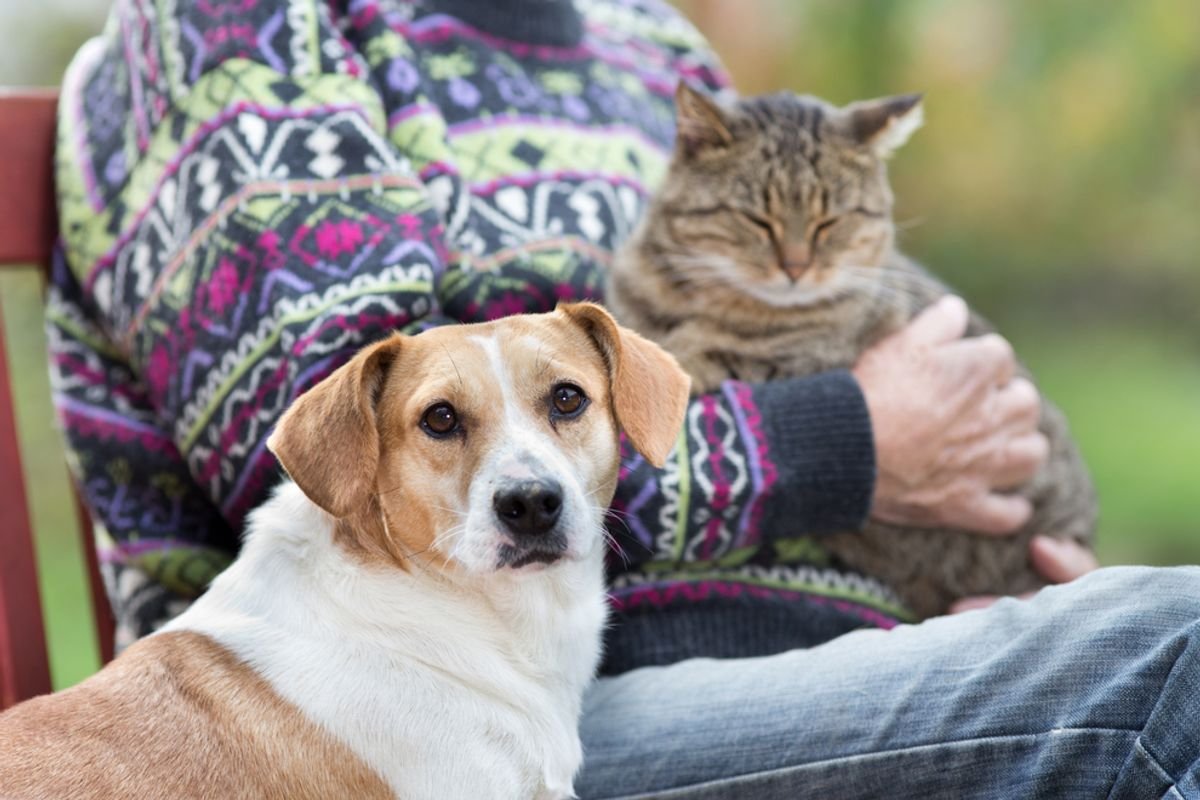
Humans Are Likely the Only Animals That Keep Pets — Here’s Why It’s So Rare in the Wild

In 2004, researchers noticed a baby marmoset living with a group of capuchin monkeys on a wildlife reserve in Brazil. The marmoset — the researchers called her Fortunata — was discovered with the capuchins when she was about two months old, and she stayed with them for over a year. During this time, Fortunata traveled, played, and ate with the group and responded to their alarm vocalizations, according to a study in the American Journal of Primatology.
More recently, in 2015, a bottlenose dolphin adopted a melon-headed whale and nursed it for three years, according to a study in Ethology. In two separate incidents in 2018 and 2020, a female humpback dolphin nursed a calf from another species, the common dolphin, for at least a month, according to a study in Aquatic Mammals.
When it comes to documented examples of animals in the wild adopting and caring for animals of another species — as pets or otherwise for more than a very brief time — that’s about it. Humans may be the only species to keep pets.
Read More: How Does Captivity Affect Wild Animals?
Do Animals Keep Pets?
Of course, if you search the internet, you’ll find a gorilla with a pet kitten, an elephant befriending a dog, and many more charming cases of cross-species friendships, as well as what looks like cross-species pet-keeping.
But as Hal Herzog, one of the leading researchers in the field of human-animal relationships and author of Some We Love, Some We Hate, Some We Eat: Why It’s So Hard to Think Straight About Animals, told Discover, all those animals are in captivity or at least in a situation with some degree of human involvement. (Even the capuchins that adopted Fortunata were being provided food by humans.)
Such relationships seem to be very rare in the wild, though. That’s not surprising. From an evolutionary standpoint, the practice doesn’t make much sense. When an animal adopts a member of another species, it invests time, energy, and resources (food and sometimes its own milk) in an animal that doesn’t share its genes, or even the genes of its species.
Misplaced Parenting Behavior
When it comes to adoption by lactating mothers, it’s not hard to imagine what may be going on. James Serpell, director of the University of Pennsylvania’s Center for the Interaction of Animals and Society and author of In the Company of Animals: A Study of Human-Animal Relationships, told Discover that these cases look something like “misplaced parenting behavior.”
He pointed to a case of a lioness who had just lost her own cubs (they were killed by a male lion) when she found an abandoned baby antelope.
“Instead of reacting to it as prey,” Serpell said, “she reacted to it as a baby.”
This was a very short-lived adoption because, no surprise here, other lions ate the baby antelope.
Serpell mentioned another case in which a leopard killed a mother baboon and briefly took care of the baboon’s baby. These are examples of very short-lived interactions, but they do support the idea that cross-species adoption, when it does happen, is somehow the result of a misplaced drive to nurture one’s young that leads to nurturing the wrong baby. However, when it comes to true pet-keeping, not misplaced parenting, the case of Fortunata may be the only documented example we have.
Why Humans Keep Pets When Other Animals Don’t
So if pet-keeping is so rare among animals, why then do humans do it? Herzog has some ideas about that — and those ideas support his long-held belief that humans are the only animals who keep pets.
One of Herzog’s arguments is that pet-keeping is driven by humans’ unique cultural evolution. He and his colleagues analyzed an American Kennel Club dataset of 50 million dog registrations and found that the popularity of breeds as pets was strongly influenced by culture.
A given breed catches on and is popular for a time, often even when that breed doesn’t make a particularly good pet. This “boom and bust” cycle, Herzog and colleagues found, follows a pattern similar to other fads spread by social contagion.
“In this regard, pets are no different from popular music, athletic shoes, and clothing styles,” Herzog and colleagues wrote in their 2006 paper in WellBeing International. If pet-keeping is driven by human culture, that would explain why we’ve seen so few examples of it in nonhuman animals.
Of course, we can’t be sure that other animals never keep pets; we’re only sure that they don’t do it very often.
“We just don’t know enough about what goes on in these wild animal groups to say for certain that none of them do it,” Serpell said, but there’s certainly not a lot of evidence for it.
Read More: These 5 Ancient Civilizations Treasured Their Pets
Article Sources
Our writers at Discovermagazine.com use peer-reviewed studies and high-quality sources for our articles, and our editors review for scientific accuracy and editorial standards. Review the sources used below for this article: