
Hubble Caught an Accidental Glimpse of a Comet Breakup, Snapping Pictures of Bright Blue Fragments

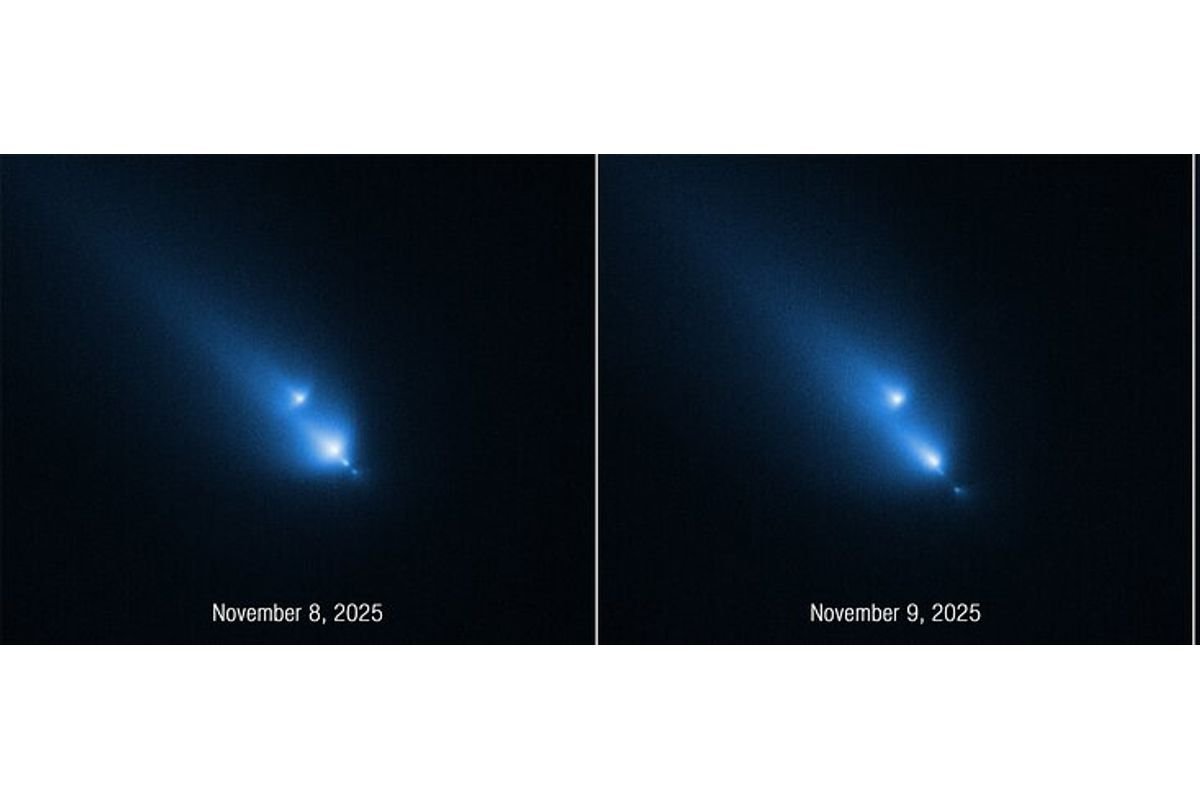
The Hubble Space Telescope caught a rare moment on camera months ago, getting a chance to watch a comet break up as it hurtled through space. By sheer coincidence, Hubble was able to witness comet K1 fragmenting into at least four pieces after it had passed the sun last November. Now, a sequence of extraordinary images depicting this event is shedding light on what happens to comets as they split apart.
Hubble’s observations of K1, detailed in a study published in the journal Icarus, show the comet’s disintegration over three days, from November 8, 2025, through November 10, 2025. During this period, K1 became four distinct pieces, each exhibiting its own bright halo of gas and dust.
Read More: Astronomers Spot a New Sungrazer Comet — Could It be Bright Enough to See in Daylight This Spring?
Spotting Comet K1 By Chance
Comet K1, also known as C/2025 K1 (ATLAS), was first identified in May 2025 by the NASA-funded Asteroid Terrestrial-impact Last Alert System. The comet later reached its perihelion, or its closest approach to the sun, in October 2025, experiencing intense heat as it passed by.
Then, in November 2025, Hubble caught K1 breaking up into the four fragments. Its sighting of the comet, however, was a complete accident. At the time, Hubble was meant to observe a different comet entirely.
“Sometimes the best science happens by accident,” said study author John Noonan, a professor at Auburn University, in a statement. “This comet got observed because our original comet was not viewable due to some new technical constraints after we won our proposal. We had to find a new target — and right when we observed it, it happened to break apart, which is the slimmest of slim chances.”
From One Comet to Four Fragments
For each day that Hubble watched K1, it took a 20-second image to capture the progress of the breakup. Together, the three images show four objects — the fragments of K1 — shrouded in blue light. By the final image, taken on November 10, 2025, the two small pieces that have separated from the largest object appear to be moving farther away.
Hubble was able to distinguish details that ground-based telescopes weren’t able to see, allowing astronomers to figure out when K1 went from a single comet to four smaller pieces; the research team believes the comet began to disintegrate eight days before Hubble viewed it, likely a result of the stress and heat it endured while passing the sun.
A Bright Mystery
One mystery about K1 has come up, however, following Hubble’s observation. Astronomers aren’t sure why there was a significant delay between the comet breaking up and bright outbursts being visible from the ground.
The researchers behind the recent study think it has something to do with the way that dust needs to accumulate on the comet (a comet’s brightness mainly comes from sunlight reflected off dust grains). They theorize that a layer of dust might need to form over the pure ice within the fragmented comet before blowing off, or that a shell of dust is expelled from within the comet due to heat that builds pressure beneath the surface.
“Never before has Hubble caught a fragmenting comet this close to when it actually fell apart. Most of the time, it’s a few weeks to a month later. And in this case, we were able to see it just days after,” said Noonan. “This is telling us something very important about the physics of what’s happening at the comet’s surface. We may be seeing the timescale it takes to form a substantial dust layer that can then be ejected by the gas.”
K1’s fragments are now 248 million miles from Earth and will likely never return to the Solar System; astronomers will continue using prior observations of the comet to learn about its composition, which may provide insight into materials from the early solar system that were eventually shaped into comets like K1.
Read More: Interstellar Comet 3I/ATLAS Is Packed With Alcohol — Indicating That It Formed Beyond Our Solar System
Article Sources
Our writers at Discovermagazine.com use peer-reviewed studies and high-quality sources for our articles, and our editors review for scientific accuracy and editorial standards. Review the sources used below for this article: