
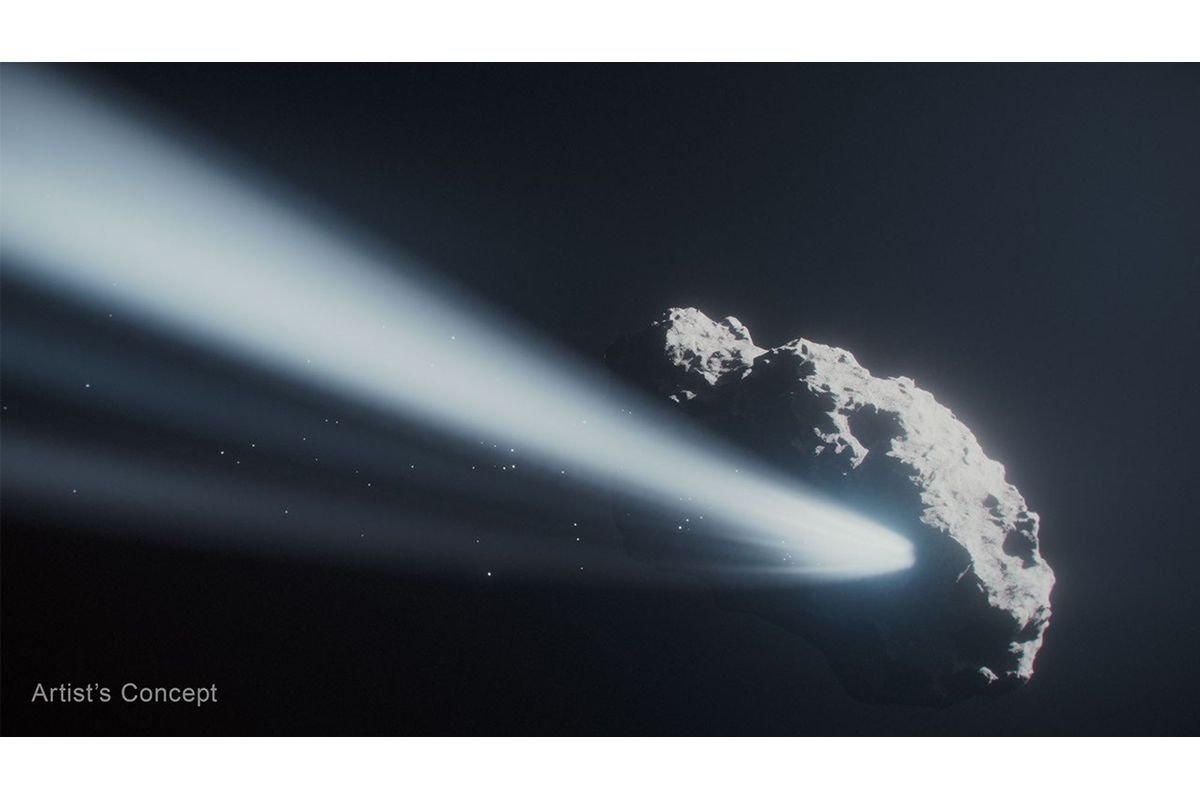
Hubble Captured Comet 41P Reversing Its Spin — and Twisting the Other Way — After Passing the Sun

A tiny spinning comet that commutes between Jupiter and the sun has reversed its spin, an unprecedented turn of events seen by the Hubble Space Telescope. This unusual change in comet 41P/Tuttle-Giacobini-Kresák — usually shortened down to just 41P — took shape in 2017, when it dramatically slowed down and then sped back up over the course of the year.
A new study published in The Astronomical Journal has determined that the slowdown and speedup of 41P were actually signs that the comet had begun rotating in a different direction. Taking a closer look at Hubble observations from 2017, astronomers realized that intense heat from the sun had forced 41P to reverse its spin.
Comet 41P’s Record-Breaking Slowdown
Back in May 2017, astronomers noticed that comet 41P was exhibiting unexpected behavior: it had started to spin three times more slowly than it had in March 2017, as reflected in data from NASA’s Neil Gehrels Swift Observatory. At the time, according to a NASA press release from 2018, it was the most dramatic change ever seen in a comet’s rotation.
The slowdown of a comet’s spin wasn’t a new concept to astronomers; another comet, 103P/Hartley 2, had previously been observed slowing its rotation from 17 to 19 hours over 90 days. But 41P’s spin slowed down by more than 10 times as much in just 60 days, setting a shocking new record.
Oddly enough, Hubble images from December 2017 showed that 41P had resumed spinning fast. From slow to speedy, what exactly had happened to 41P’s rotation that year?
Read More: The Remarkable Hubble Space Telescope: 35 Years Observing the Unknown in Space
A Comet Reversing Rotation
Fast forward to today, and astronomers now have an answer for what 41P was experiencing in 2017. They say the comet likely continued to slow until it almost stopped, then began spinning in the near-opposite direction, according to a NASA press release on the new study.
41P, a Jupiter-family comet, orbits the sun every 5.4 years. When it makes a close approach to the sun, the ice on its surface sublimes due to the heat, causing gas to vent out. This process is what altered 41P’s rotation, the study authors believe.
“Jets of gas streaming off the surface can act like small thrusters,” said study author David Jewitt, an astronomer at the University of California at Los Angeles, in the new press release. “If those jets are unevenly distributed, they can dramatically change how a comet, especially a small one, rotates.”
The jets of gas from 41P began pushing against its original motion, causing it to eventually spin in a different direction. The small size of 41P would’ve made it easy for the jets to influence its spin (The comet’s nucleus is approximately 0.6 miles across, about three times the height of the Eiffel Tower. For a Jupiter-family comet, this is especially small.)
“It’s like pushing a merry-go-round,” said Jewitt. “If it’s turning in one direction, and then you push against that, you can slow it and reverse it.”
An Unstable Future
The new study also found that 41P’s activity has significantly diminished over the years. When the comet approached the sun in 2001, it was unusually active for its size, according to the study authors. Its gas production has since decreased, which could indicate that near-surface volatile materials on the comet are possibly becoming depleted or covered by insulating dust layers.
Comets typically experience changes in their structure over centuries or longer, but the quick spin reversal of 41P may give researchers a unique chance to see how a comet evolves in a much shorter timeframe.
Based on 41P’s measured torques and mass loss rates, the comet could start to become unstable if its current behavior continues. And if the comet keeps spinning faster and faster, it may someday split apart or disintegrate.
Read More: How NASA Is Adapting To An Aging Hubble Telescope
Article Sources
Our writers at Discovermagazine.com use peer-reviewed studies and high-quality sources for our articles, and our editors review for scientific accuracy and editorial standards. Review the sources used below for this article: