
How Index Fossils Help Reconstruct Earth’s Ancient and Mysterious Past

In the late 1700s, while inspecting a coal mine in southwest England, a young surveyor named William Smith noticed a surprising pattern: from one location to the next, rock layers (or “strata”) were arranged predictably, always in the same positions relative to each other.
What’s more, the fossils within each layer were also consistent — you could identify any given stratum just by the preserved remains of plants and animals it contained.
It was no quirk of that particular mine, either. Smith and others soon found that sedimentary rocks far and wide showed reliable ordering of fossils, a phenomenon Smith termed “faunal succession” (another half century would pass before Charles Darwin explained this biological changing of the guard in terms of evolution).
Geology was just beginning to take shape as a scientific discipline, and this was one of its first crucial discoveries. It gave the field an indispensable tool: index fossils.
Strata-Specific Fossils
The epiphany came when geologists realized that certain fossils were unique to specific strata, appearing nowhere else in the rock record. That meant that whenever they found the same fossil in a new location, it served as an index telling them precisely where that layer belonged in the scheme of things — even if the rock was unfamiliar, they could link it to other known strata, tying together far-flung regions of the world (along with their long-dead inhabitants) to create a unified timeline.
More than two centuries later, scientists still use index fossils to refine our understanding of the past. One of them is Spencer Lucas, a paleontologist and stratigrapher — meaning he studies rock strata — at the New Mexico Museum of Natural History and Science.
“We’re trying to reconstruct Earth’s history,” he says, “as precisely as we can.”
Read More: New Evidence Debunks the Theory That Dinosaurs Were Declining Before the Asteroid
How Index Fossils Are Used
Although our planet’s saga stretches back an unwieldy 4.5 billion years, stratigraphers have managed to impose order on deep time by splitting it up into eons, eras, periods, epochs, and, finally, ages — so, so many ages. This daunting system is called the geologic timescale. Each division captures the defining features of that moment: the types of rock forming and the living organisms proliferating across various parts of the world.
Much of the geologic timescale is built on index fossils. Because each is characteristic of a specific span of geologic time, they offer a convenient way to demarcate all those spans.
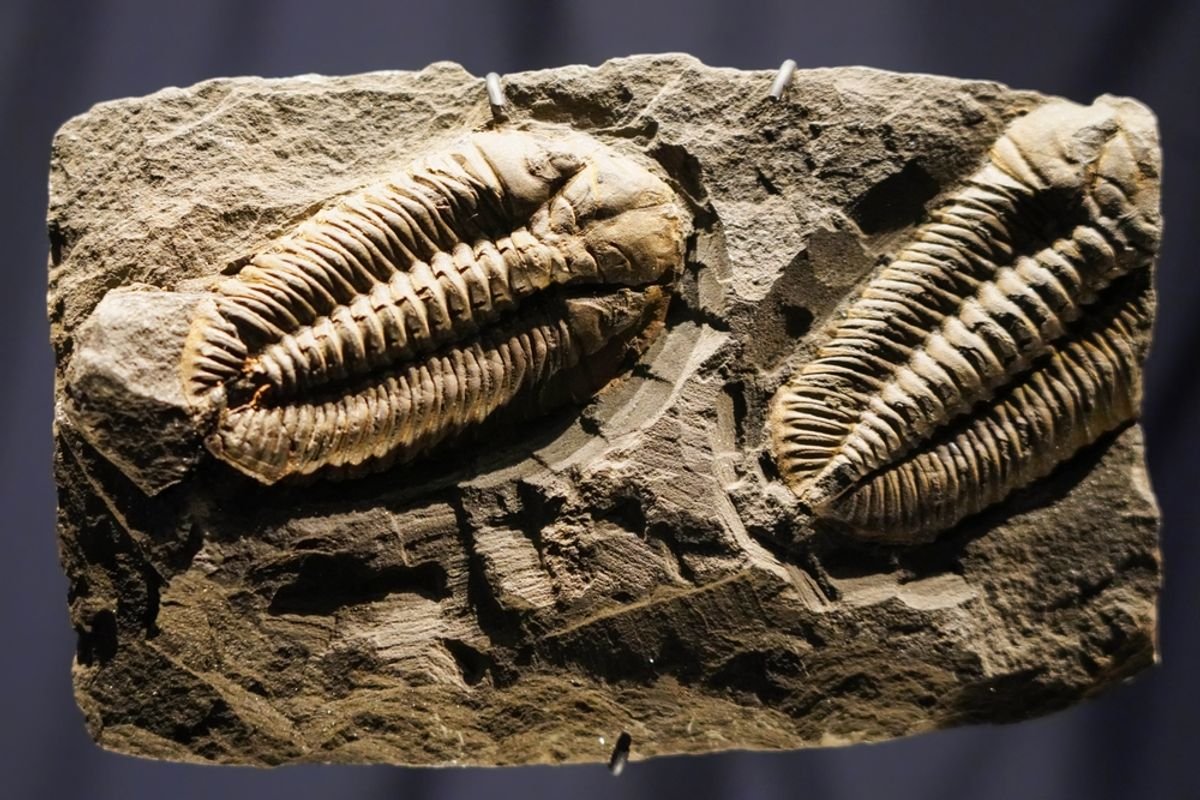
For example, according to a study in Encyclopedia of Geology, strata from the Cambrian period (the time when most major animal groups first appeared) are brimming with all sorts of weird and wonderful trilobites, a long-extinct class of marine arthropods; that distinct set of species enabled 19th-century geologists to connect Cambrian rocks in England to others in continental Europe, North America, and beyond. Similar breakthroughs occurred for other periods — the Ordovician, the Silurian, the Cretaceous — and a global tale of Earth history began to unfold.
Determining The Age Of Rocks
Back then, however, the best that geologists and paleontologists could do was to place rock layers and fossils in relation to one another; they had no idea how old the materials really were. Then, at the turn of the 20th century, New Zealand physicist Ernest Rutherford discovered a way to determine the age of rocks: radiometric dating.
Many rocks contain unstable atoms called radioactive isotopes, which decay at a fixed rate into stable isotopes. If you know what that rate is — and for many isotopes we do — you can date rocks simply by measuring the proportion of decayed isotopes in a sample. Thanks to this numerical precision, modern stratigraphers generally view radiometric dating as the gold standard. Though some still prefer to use fossils, Lucas jokes that “we’re going extinct.”
Nevertheless, he sees a place for the old-school methods, at least in the foreseeable future. For one thing, rocks can’t always be dated using radioactive isotopes, and even when they can, the process isn’t foolproof. Lucas argues that the best policy is to use both approaches — index fossils and radiometric dating — so each can fact-check the other. “There’s a huge amount of effort to try to integrate them,” he says.
A Fossil Record In Flux
Index-fossil status isn’t available to just any organism; the best ones are geographically widespread and easy to identify, and they belong to species that existed for a relatively short time. But so long as a candidate fossil meets those criteria, stratigraphers aren’t picky: coil-shelled ammonites, eel-like conodonts, turtles, dinosaurs, and mammals have all enjoyed the honor of serving as our guides to geologic time. “People like me are using them day in and day out,” Lucas says, “usually with pretty good reliability.”
But the problem with index fossils is that, occasionally, even the most promising ones go bad. That last criterion — species that existed for a relatively short time — is always subject to revision as paleontologists uncover new fossils. Indeed, so-called index fossils sometimes appear where no one expected them — in rock layers too old or too young. When this happens, their title must be revoked.
One ongoing controversy centers on the king of all fossils: Tyrannosaurus rex. Unmistakable and ranging from Montana to Texas, “T. rex looked like a pretty good index fossil,” Lucas says. But, according to a study in scientific reports, while experts once believed it lived only in the last 2 million years of the Cretaceous period, right up until the asteroid struck, the recent discovery of a much older tyrannousaur — which may or may not represent a different species — muddies the waters.
If T. rex loses index fossil status, it would be the latest in a long line of such casualties; in fact, Lucas bets the majority of index fossils ever proposed turned out to be impostors. In reality, there are no definitive index fossils — only hypotheses waiting to be refuted by the next dig.
Like any science, stratigraphy progresses one discovery at a time, with new evidence overturning old theories. And for all we’ve learned so far, the story of Earth’s strata is far from complete. As Lucas put it, “There are a few centuries of work ahead, easy.”
Read More: Eggshells Fill a 30-Million-Year Fossil Record Gap for Dinosaur Migration
Article Sources
Our writers at Discovermagazine.com use peer-reviewed studies and high-quality sources for our articles, and our editors review for scientific accuracy and editorial standards. Review the sources used below for this article: