
How Does the Brain Turn an Internal Need into a Focused Craving?

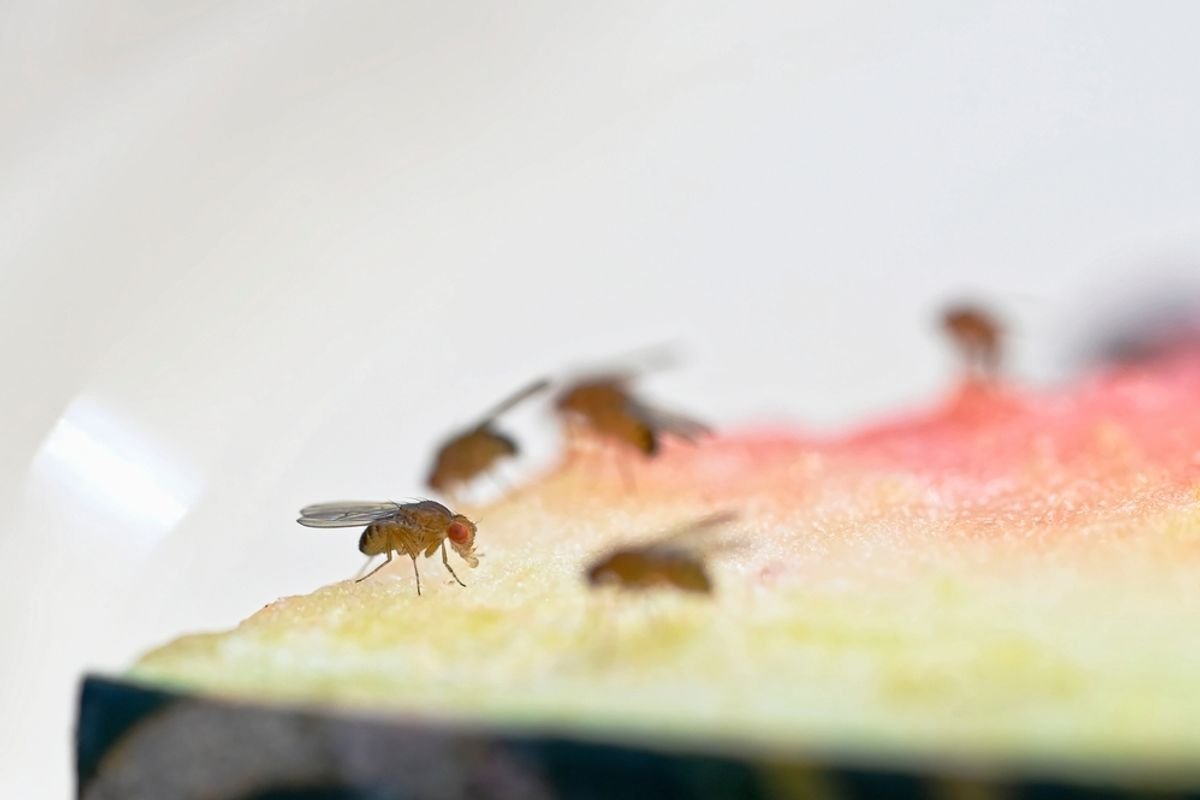
To a fruit fly running on empty, the scent of chocolate isn’t a dessert, it’s a lifeline. Flies, and all animals, instinctively sense when something’s missing from their diet and adjust their eating habits to restore balance. What remains undetermined is how the brain turns that internal signal — the body’s quiet “I need this” — into a focused craving. In other words, how a physiological need becomes a sensory want.
New research from the Champalimaud Centre reveals how missing even one essential amino acid can reshape a fruit fly’s brain, sharpening its nose for microbial allies that offer a nutritional boost.
“By following their nose towards bacteria, it seems the flies have evolved to use microbes as allies, seeking out partners that increase their chances of survival when challenged by amino-acid deprivation,” said Sílvia Henriques, the studies’ co-first author, in a press release.
How the Brain Turns Nutrient Needs Into Cravings
To explore this link, researchers examined essential amino acids; the protein building blocks animals can’t produce themselves and must get from food. Even a single missing amino acid throws the body off balance, slowing metabolism and triggering the brain to seek protein-packed food.
Researchers fed fruit flies controlled diets, each missing one of 10 essential amino acids, and analyzed which genes switched on in their heads. Each deprivation left its own genetic fingerprint, but some responses were universal. Two smell-related genes — Or92a and Ir76a — consistently activated whenever an amino acid was lacking, revealing a shared molecular pathway linking nutrient need to sensory change.
Read More: These Fruit Flies Aged Faster After Seeing Death
Hunger Tunes the Senses Toward Yeast and Microbes
The two genes proved central to how hunger alters behavior. The Or92a receptor detects diacetyl, a buttery compound released by fermenting yeast — the flies’ main protein source. When this receptor was disabled, the insects could still find yeast but ate less, showing that smell not only locates food but helps determine how rewarding it seems.
The second receptor, Ir76a, responded to PEA, a molecule made by bacteria that ferment foods like cheese and chocolate.
“That’s when things clicked,” said Henriques in the press release. “The flies weren’t being attracted to the chocolate itself — they were responding to the bacteria growing in those foods. And those bacteria are also natural residents of the fly microbiome.”
When deprived flies encountered live Lactobacillus and Acetobacter — the same microbes responsible for fermentation — their neurons fired more strongly, and they fed eagerly. Dead bacteria, however, held no appeal.
“This was the most surprising finding,” added Gili Ezra-Nevo, the study’s first author. “It showed that the flies’ sense of smell was literally tuned to detect bacteria, and that this tuning depended on their internal nutritional state.”
By reprogramming their sense of smell, the flies weren’t just searching for food; they were homing in on microbial partners that could help them recover.
What We Can Learn About Human Appetite
The research broadens a key question in biology: how our internal state reshapes what we perceive. It shows that when nutrients run low, the brain doesn’t just react — it rewires its sensory machinery, altering how information from the world is processed.
In these flies, hunger wasn’t a signal but a switch, changing how they experienced their surroundings to meet their needs. It’s a reminder that the line between body and brain isn’t fixed — it shifts with every signal of need.
Read More: Scientists Share Mind-Boggling Insights About Human Memory by Mapping Fly Brains
Article Sources
Our writers at Discovermagazine.com use peer-reviewed studies and high-quality sources for our articles, and our editors review for scientific accuracy and editorial standards. Review the sources used below for this article: