
How AI Is Solving Some of Paleontology’s Biggest Dinosaur Footprint Mysteries
A new artificial intelligence tool can help identify dinosaur footprints that have been difficult to pin to a specific animal, including tracks that may belong to some of the earliest birds. By comparing the shapes of nearly 2,000 fossil footprints, the system offers a new way to determine who made these ancient traces.
Reported in PNAS, the work uses a form of artificial intelligence that looks for patterns on its own, rather than relying on human labels. The results mostly match expert judgments, but also highlight footprints that fall between familiar categories.
In particular, several bird-like tracks more than 200 million years old closely resemble those of fossil and modern birds, while disputed footprints from Scotland align with early plant-eating dinosaurs. The findings show how a data-driven approach can clarify why some footprints are hard to interpret and what they reveal about dinosaur evolution.
“We bring a mathematical unbiased point of view to the table to assist human experts for interpreting the data,” says lead author, Gregor Hartmann. “Our hope is that Dinotracker will be used by paleontologists for analyzing footprints and that its functionality and data pool grows with contributions from the community as we plan to actively continue its development in the future.”
How AI Is Rethinking Dinosaur Footprints
Most machine-learning efforts in paleontology rely on supervision, with researchers labeling fossils before training algorithms, a step that can reinforce long-standing assumptions. DinoTracker takes a different approach, allowing patterns in footprint shape to emerge without prior classification.

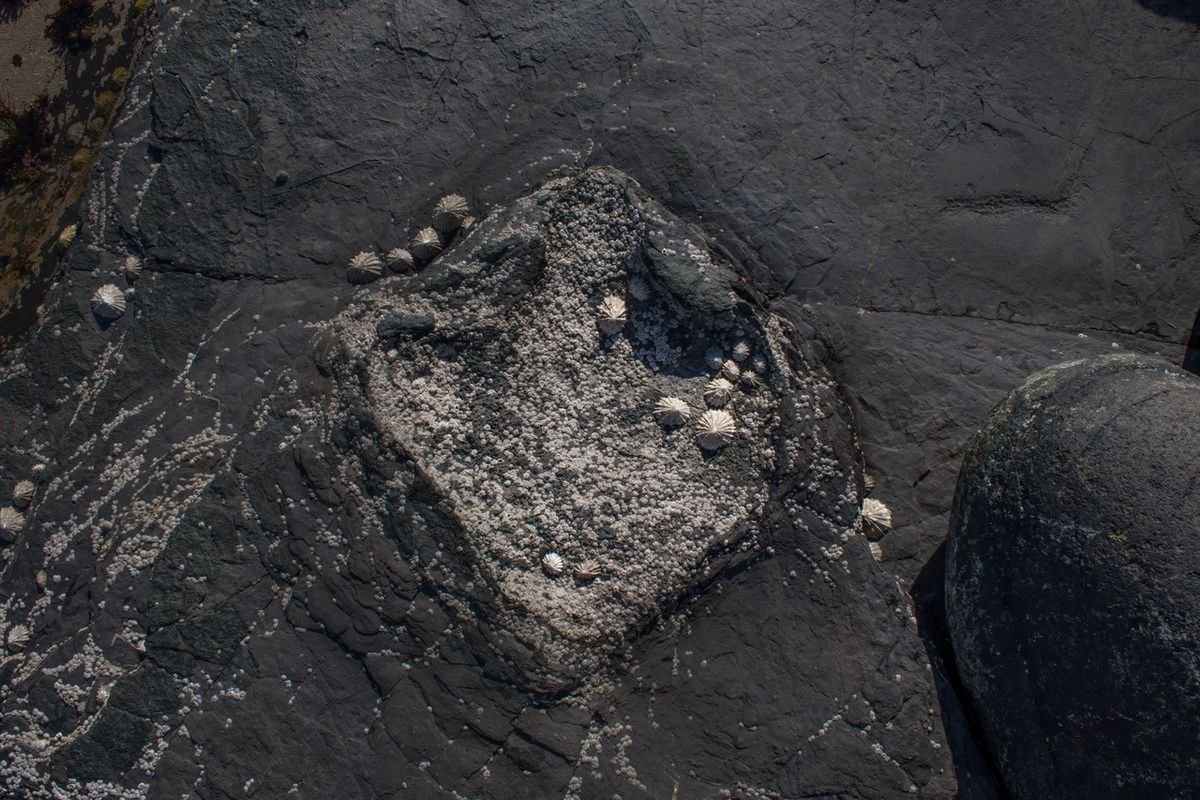
A pair of Middle Jurassic-aged theropod footprints on the Isle of Skye, Scotland, represents one of the regionally most dominant trackmakers. Some three‑toed footprints, however, can resemble those of ornithopod dinosaurs, also present on Skye in scarcer numbers. Distinguishing between such tracks provided the basis for the study in Hartmann et al. (2026).
(Image Courtesy of Tone Blakesley)
The algorithm identified eight key features that explain most variation among tracks, including toe spread, heel loading, pressure distribution, and overall ground contact. When expert identifications were later mapped onto this shape space, the AI largely aligned with human judgments while also exposing where traditional labels overlap or break down.
Read More: Tyrannosaurus Rex Took 40 Years to Grow Up, Fossil Bones Reveal
Bird-Like Tracks and a Scottish Mystery
Those ambiguous cases proved the most revealing. Several three-toed footprints more than 200 million years old clustered with fossil and modern birds rather than with non-avian dinosaurs. If true birds made those tracks, they would push the origin of birds tens of millions of years earlier than the oldest known bird skeletons.
The results may show that some early dinosaurs had feet or modes of walking that closely resembled those of birds, producing nearly indistinguishable tracks long before birds evolved. Either way, the findings suggest that the transition toward bird-like feet began earlier and more gradually than the body fossil record alone indicates.
The system also clarified a separate mystery. Footprints from Scotland’s Isle of Skye, preserved in lagoon mud about 170 million years ago, grouped most closely with plant-eating ornithopods. If correct, those tracks may represent some of the earliest evidence yet of the lineage that later gave rise to duck-billed dinosaurs.
What AI Can — and Can’t — Resolve
Despite these insights, the researchers stress that footprints remain an imperfect record. Track shape reflects not only anatomy, but also movement, sediment conditions, and what happens to impressions long after they are made.
For that reason, the authors are cautious about what the results can ultimately prove. As Hartmann explains, “A skeleton of a true bird of this age” would be required to confirm an earlier origin for birds. “It is essential to keep in mind that over these millions of years, lots of different things can happen to these tracks starting from the moisture level of the mud where it was created over the substrate it was created on up to erosion later on.”
Rather than offering final answers, DinoTracker provides a new way to test assumptions and narrow possibilities. The team has also made the tool publicly available through a mobile app called DinoTracker.
Read More: Thousands of Dinosaur Footprints Found Close to Where Italy Will Host Winter Olympics
Article Sources
Our writers at Discovermagazine.com use peer-reviewed studies and high-quality sources for our articles, and our editors review for scientific accuracy and editorial standards. Review the sources used below for this article: