
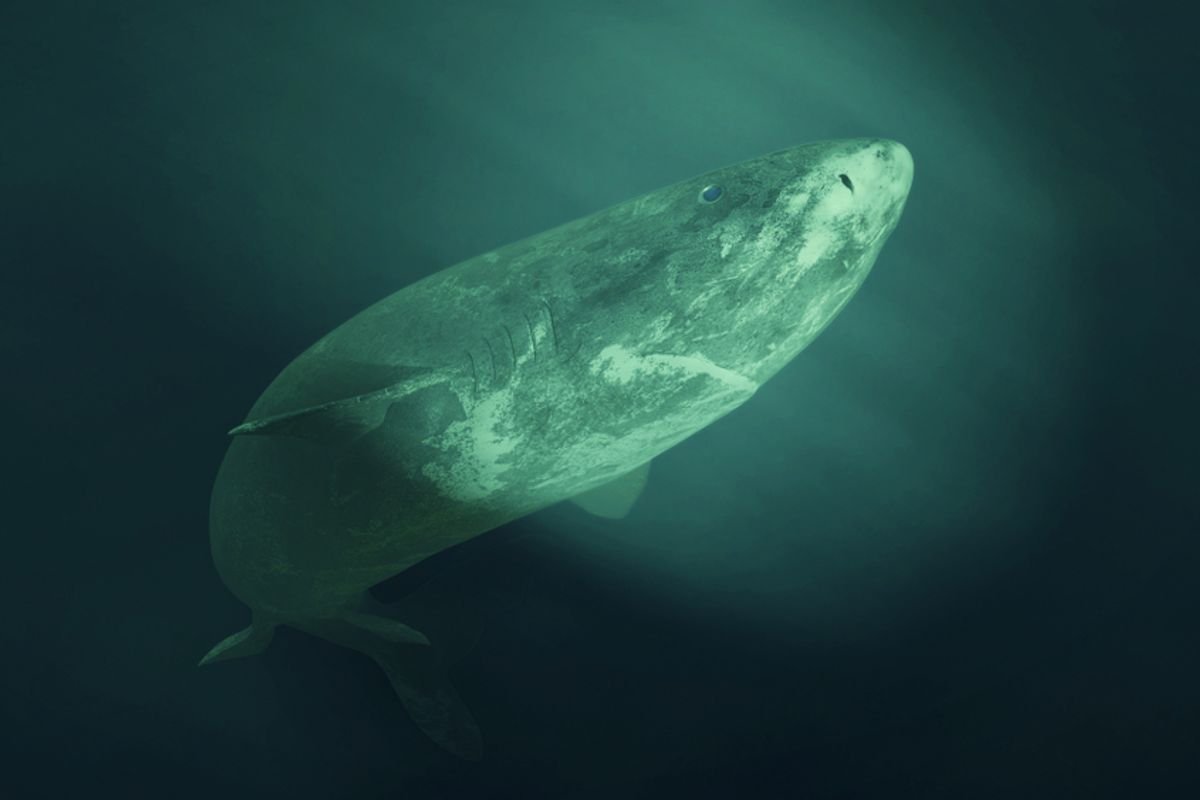
How a 400-Year-Old Shark Keeps Its Vision From Breaking Down

Greenland sharks are among the longest-lived vertebrates ever identified, with some individuals estimated to be several centuries old. They inhabit some of the darkest waters on Earth, deep in the Arctic, where light is scarce, and visibility is poor. Many also carry a parasite attached to the surface of the eye — a detail that helped fuel the assumption that vision plays little role in their lives.
New research challenges that view. A study published in Nature Communications finds that Greenland sharks retain functional vision even at extreme ages, with no signs of the retinal degeneration typically associated with aging. The work suggests that these sharks are not only able to see in dim conditions but are biologically equipped to preserve that ability over centuries.
Read More: Sharks Began Roaming the Oceans 400 Million Years Ago as Deep-Sea Bottom-Dwellers
Shark Vision Built for the Dark
To understand what was happening inside the eye, researchers examined preserved eyeballs from Greenland sharks caught between 2020 and 2024 near Disko Island, off the coast of Greenland. The samples allowed for detailed analysis of retinal tissue — a unique opportunity in animals that live for hundreds of years.
Even in sharks estimated to be centuries old, the retina showed no widespread cell death or structural breakdown. Key cellular layers remained intact, indicating that vision had not deteriorated with age in the way it does in most vertebrates.
The structure of the retina helps explain how that vision is possible. Rather than the usual mix of rods and cones, Greenland sharks have a retina built almost entirely from rods — densely packed photoreceptors specialized for dim light. This configuration is common in deep-sea species, where capturing scarce photons matters more than color or fine detail.
Other features appear tuned to the same challenge. The membranes of retinal cells are rich in long-chain polyunsaturated fatty acids, which help rhodopsin — the light-sensing pigment — function efficiently in cold, low-light conditions. Measurements of the cornea also showed that enough light still reaches the retina to stimulate vision, even when parasites are attached to the eye’s surface.
A Retina That Doesn’t Wear Out
The team also analyzed rhodopsin itself, a protein essential for vision in dim environments. In Greenland sharks, rhodopsin remained active and was tuned to blue wavelengths — the type of light that penetrates deepest in Arctic waters. This tuning suggests that the sharks’ visual systems are not only preserved but also finely adapted to their environment.
At the molecular level, the findings point to mechanisms that protect retinal cells from cumulative damage. Rather than slowing aging across the entire body, Greenland sharks appear to maintain specific repair and maintenance systems that keep critical tissues functional for far longer than expected.
This distinction matters. Aging is often framed as an unavoidable, uniform decline, but the Greenland shark points to a different model — one in which certain organs resist breakdown entirely, even across centuries.
What a 400-Year-Old Shark Can Tell Us About Aging
The study does not suggest that humans could achieve similar lifespans or directly borrow shark biology. But it does raise questions about why age-related vision loss is so common — and whether it has to be.
By studying species that preserve sensory function over extraordinary timescales, researchers can begin to separate which aspects of aging are truly inevitable from those shaped by long-term repair and adaptation. In that sense, the Greenland shark is less a biological curiosity than a case study in how aging does not always mean decline.
Read More: Rare and Elusive CookieCutter Shark Leaves a Round Wound in Its Prey
Article Sources
Our writers at Discovermagazine.com use peer-reviewed studies and high-quality sources for our articles, and our editors review for scientific accuracy and editorial standards. Review the sources used below for this article: