
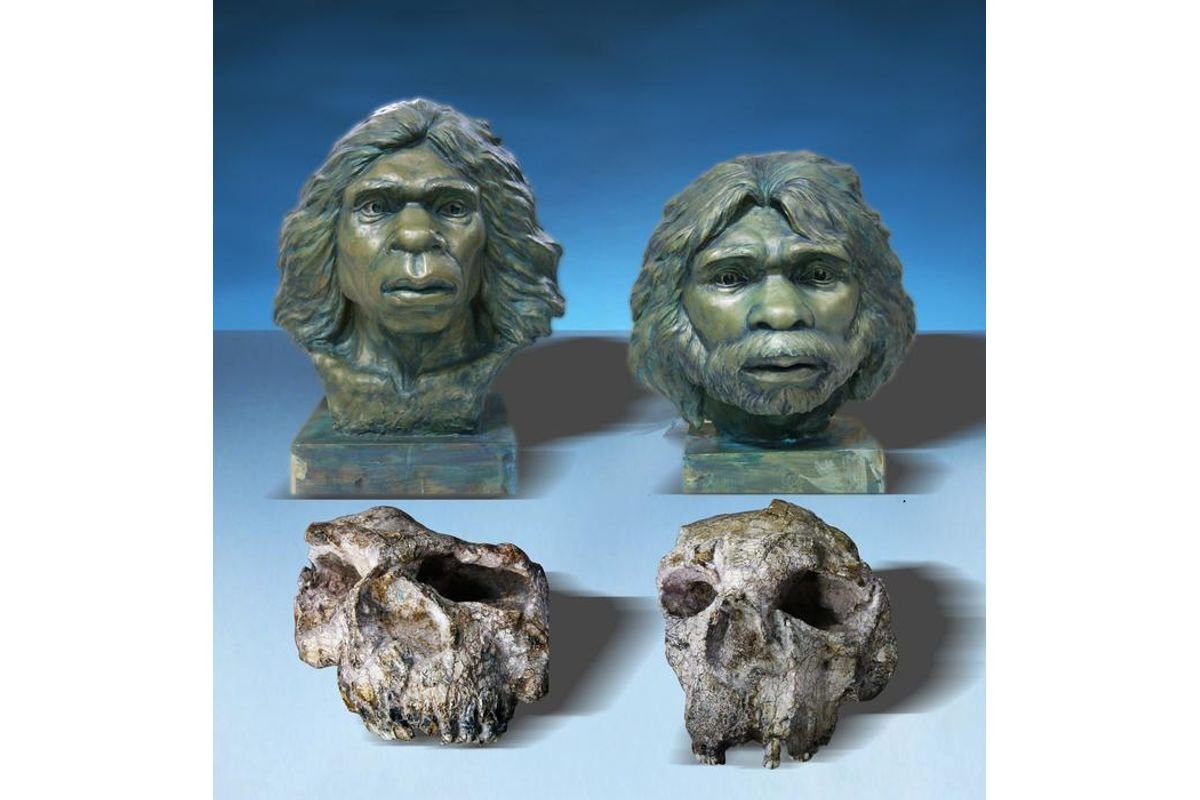
Homo Erectus Could Have Arrived In Asia 600,000 Years Earlier Than Previously Thought

A new analysis could reshape the timeline of early human dispersal. An interdepartmental and international research team recently found that our ancient ancestors, Homo erectus, likely appeared in Yunxian, China, about 1.7 million years ago — about 600,000 years earlier than previously thought.
The new study, published in Science Advances, highlights a more accurate timeline of the dispersal of our direct ancestor.
“While Homo erectus, our distant ancestor, is widely recognized to have originated in Africa before dispersing into Eurasia, the precise timeline of its arrival in eastern Asia was unknown,” said Christopher J. Bae, a corresponding author from the University of Hawaiʻi at Mānoa, in a press release.
Read More: Modern Humans May Have Lived Alongside an Extinct Human Species in Ancient Indonesia
Rewriting the Homo Erectus Timeline in Asia
According to the Natural History Museum, H. erectus was the first of our ancient human ancestors to have human-like body proportions and is the first known hominin to migrate beyond Africa.
These migrations led H. erectus to other parts of the world, including Asia. After the discovery of three nearly complete H. erectus skulls in Yunxian, the area became a crucial spot for early human fossil evidence. According to prior research, the oldest-known H. erectus fossil found in Yunxian is about 1.1 million years old.
“Using the combination of the Yunxian H. erectus fossils and burial dating data, we have now been able to recreate a fairly robust dating reconstruction of when these hominins appeared in eastern Asia,” Bae said in the release.
A More Accurate Dating Method
For the study, the research team, which included a team of geoscientists and anthropologists funded by the National Natural Science Foundation of China and the U.S. National Science Foundation, determined the age of the H. erectus fossils by using Aluminum-26 (Al-26) and Beryllium-10 (Be-10) burial dating.
According to Hua Tu, the lead study author, the team dated the beryllium and aluminum isotopes in the sediment found at the same level as the fossils.
“Al-26 and Be-10 isotopes are produced when cosmic rays hit quartz minerals,” Tu, who is from the Institute of Marine Sciences, Shantou University, and College of Geographical Sciences, Nanjing Normal University, said in a press release. “Once buried deeply underground, isotope production stops and radioactive decay takes over. By using aluminum’s and beryllium’s known decay rates, and comparing the ratio of the two types of atoms left in sediment samples surrounding a fossil, researchers can calculate how long a fossil has been buried.”
Another Puzzle Piece in the Early Human Mystery
After dating the isotopes within the sediment, the research team determined that the fossils were likely around 1.7 million years old, about 600,000 years older than previous research suggested.
This new information is a vital piece in understanding early human evolution and the routes or locations of our ancient ancestors’ migrations. These findings are helping to narrow the gap between the evolution of H. erectus and Homo sapiens.
“These findings challenge long-held assumptions regarding when the earliest hominins are thought to have moved out of Africa and into Asia. While these results are significant, the mystery of exactly when H. erectus first appeared and last appeared in the region remains. If H. erectus was not the earliest occupant to reach Asia, alternative species must be considered. The updated chronology for Yunxian is a critical step toward resolving these debates,” Bae concluded in the press release.
Read More: A 2-Million-Year-Old Skeleton Shows Early Humans Were Still Built for the Trees
Article Sources
Our writers at Discovermagazine.com use peer-reviewed studies and high-quality sources for our articles, and our editors review for scientific accuracy and editorial standards. Review the sources used below for this article: