
Hidden Clues on Dark Matter Come into Sight With a New High-Resolution Map of the Sky

Dark matter keeps everything in the whole universe tethered together, acting like a cosmic glue. Although it plays such a pivotal role, scientists haven’t even scratched the surface of this mystifying force. Unlike normal matter — from the atoms within us to entire planets in space — dark matter doesn’t emit or absorb light, making it invisible. Fortunately, it does have mass; this allows us to roughly estimate dark matter based on its interactions with normal matter.
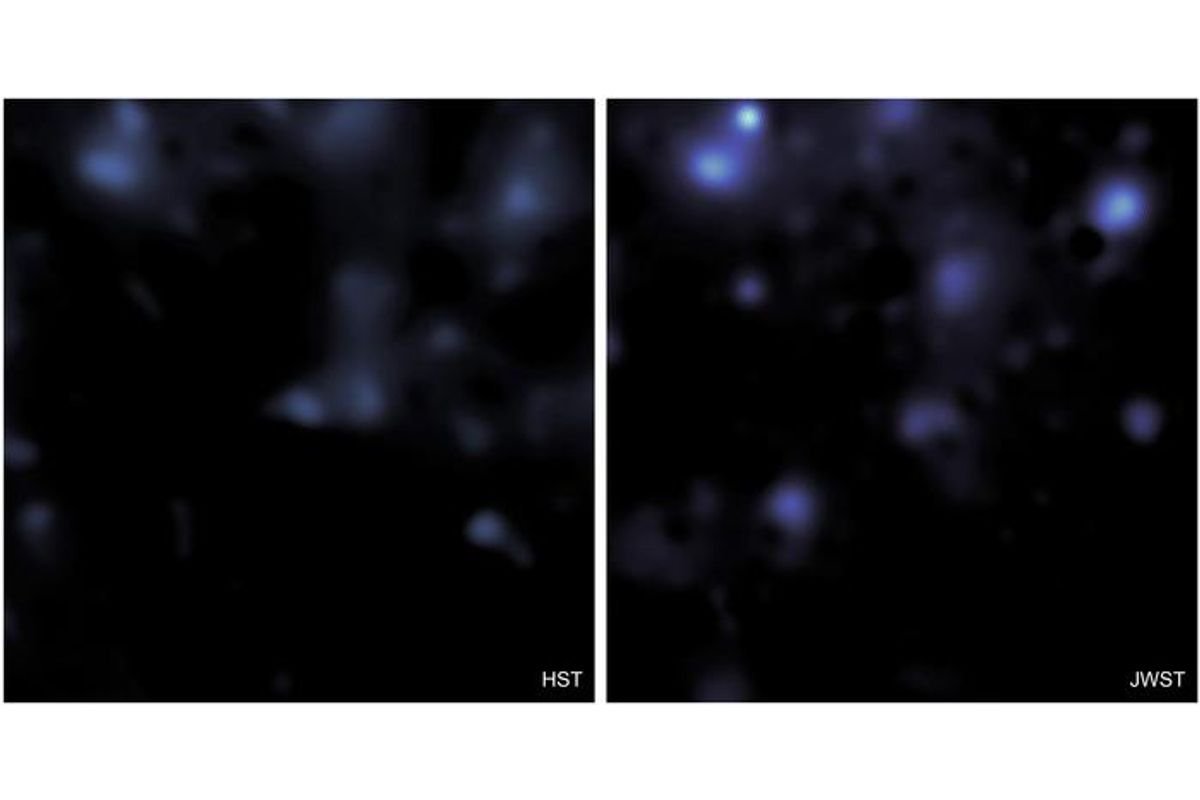
A new study published in Nature Astronomy has unveiled the highest-resolution map of dark matter to date, making progress in solving one of the universe’s great puzzles. NASA’s James Webb Space Telescope (JWST) managed to capture images revealing dark matter in a section of the sky, identifying nearly 800,000 galaxies in the process. The map shows how dark matter warps light from these galaxies, providing key clues on its structure and influence.
Read More: Stars Can Form In Dark Matter Halos Up to 10 Times Smaller Than Previously Thought
Propping Up the Universe
Dark matter’s existence was first proposed in 1933 by Swiss-American astronomer Fritz Zwicky, who knew a peculiar process was afoot while studying the Coma cluster of galaxies (located around 320 million light-years from Earth).
Zwicky found that the galaxies in this cluster were moving at such high speeds that it should’ve been impossible for visible matter to hold them together. There was something else, Zwicky suspected, that bound these galaxies together, according to NASA.
American astronomer Vera Rubin saw a similar phenomenon within spiral galaxies in the 1970s; the stars at the edge of these galaxies didn’t move slower as expected, meaning an unseen force — which would come to by known as dark matter — was adding mass to the galaxies, according to Carnegie Science.
Since then, scientists have proposed that dark matter is an essential, unifying component of the universe.
“Wherever you find normal matter in the universe today, you also find dark matter. Billions of dark matter particles pass through your body every second,” said co-author Richard Massey, a professor at the Institute for Computational Cosmology, in a statement. “There’s no harm, they don’t notice us and just keep going. But the whole swirling cloud of dark matter around the Milky Way has enough gravity to hold our entire galaxy together. Without dark matter, the Milky Way would spin itself apart.”
Mapping Dark Matter
Studies on dark matter have attempted to understand how it’s distributed throughout the universe. The new map represents a major step forward in achieving that goal.
The map covers a section of the sky in the constellation Sextans, which the JWST observed for a total of 255 hours. When looking at the map, researchers watched for light coming from galaxies, which was bent by curved regions of space; these regions themselves were curved by the mass of dark matter.
The map confirms that dark matter and normal matter have had an intertwined relationship throughout cosmic history. Clumps of dark matter, the researchers believe, initially pulled in normal matter to create regions where the first stars and galaxies were born. It also set the stage for planets to form; in a way, dark matter was necessary for the dawn of life on Earth.
“By revealing dark matter with unprecedented precision, our map shows how an invisible component of the universe has structured visible matter to the point of enabling the emergence of galaxies, stars, and ultimately life itself,” said the study’s co-lead author Gavin Leroy, a researcher at Durham University’s Institute for Computational Cosmology.
An Ongoing Mystery
The high resolution of the new map has allowed researchers to clearly see dark matter’s gravitational sway over normal matter in space.
There’s still much more to uncover about dark matter, however. More information will come to light with the launch of NASA’s Nancy Grace Roman Space Telescope, which researchers plan to use alongside the European Space Agency’s Euclid telescope to map dark matter across the universe.
Read More: Is Dark Matter Real? Most Experts Say Yes, but Its Still Hotly Debated
Article Sources
Our writers at Discovermagazine.com use peer-reviewed studies and high-quality sources for our articles, and our editors review for scientific accuracy and editorial standards. Review the sources used below for this article: