
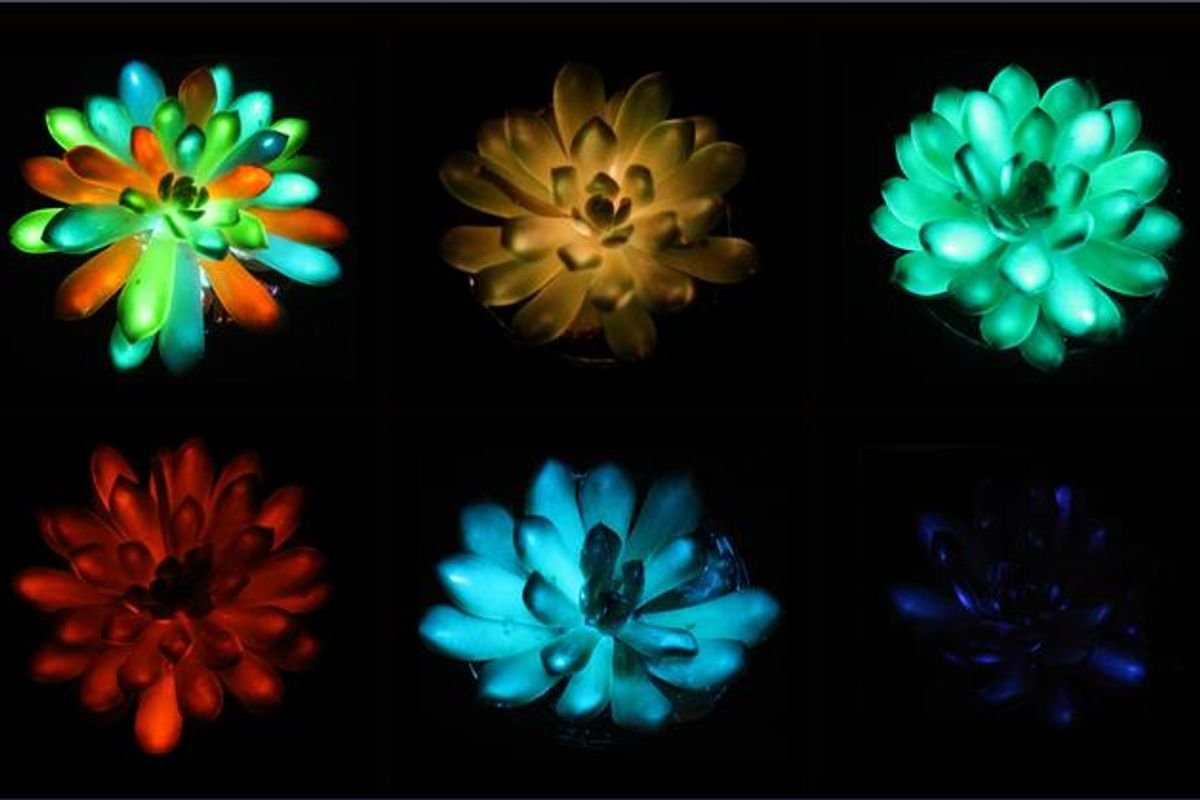
Glow-in-the-Dark Succulent Plants May Lead to Glowing Trees Replacing Streetlights

A garden full of glowing plants sounds like the perfect backdrop for a fairy tale. But thanks to science, this scene is becoming a reality. Researchers have found a way to make succulent plants double as natural night lights with a helping of light-emitting compounds.
A new study published in the journal Matter describes how the plants were tailored to become phosphorescent, being imbued with the same particles that make some toys and decorations glow-in-the-dark. These powered-up plants, able to recharge via sunlight, could set a shining example for the future of sustainable lighting systems.
“Picture the world of Avatar, where glowing plants light up an entire ecosystem,” said first author Shuting Liu of South China Agricultural University, in a statement. “We wanted to make that vision possible using materials we already work with in the lab. Imagine glowing trees replacing streetlights.”
Bioluminescence in Nature
When day turns to night, the darkest corners of nature are lit up by bioluminescent creatures. Most people probably picture a firefly’s glow, but the world of bioluminescence features many more spectacular organisms, from plankton colonies that create a blue sheen over ocean water to over 100 fungi species that can emit light.
However, plants haven’t been naturally blessed with the same bioluminescent traits as some animals. Genetic engineering advancements have driven scientists to insert genes from fireflies and mushrooms into plants, giving them the opportunity to glow.
Glowing plants that arise from these experiments have even reached the consumer market; Idaho-based startup Light Bio has begun to sell its genetically engineered “Firefly Petunias,” embedded with DNA obtained from the Neonothopanus nambi mushroom to glow at night.
Read More: From Glowing Corals To Vomiting Shrimp, Bioluminescence Has Appeared For Millions of Years
Making Succulents Glow in the Dark
In the new study, researchers have introduced a simple and low-cost method to produce glow-in-the-dark succulents without the need for genetic engineering. The researchers say that genetic engineering efforts to create this effect in plants can have limited results, leading to faint glows that are typically only available in green.
Rather than modify any genes, they injected afterglow phosphor particles into the plants. Phosphors — also used in the production of LED lights, TVs, and X-ray screens — emit light when exposed to radiation, like ultraviolet light.
To get the particles to travel through leaf tissues, the researchers had to make them roughly the width of a red blood cell, around 7 micrometers. The particles were injected into several plant species, including succulents and non-succulents like golden pothos and bok choy.
Only the succulents, though, had a strong glow because of the dense and compact microstructure of their leaves, allowing for the particles to disperse through evenly distributed channels. The airy tissue structure of non-succulents, which researchers initially thought would be a more effective route for the particles, ended up promoting rapid aggregation of particles, blocking them from moving any further.
A Greener Option for Lighting
The succulents were able to glow for up to two hours after being exposed to sunlight or indoor LED light.
The plants come in a variety of color choices, glimmering in shades of red, green, and blue. The researchers also built a plant wall made of 56 succulents and tested its effect on visibility; the light from the wall was enough to illuminate text, images, and facial features up close.
The researchers cite the quick preparation and low cost of this process as major perks; each plant only takes around 10 minutes to prepare and costs about $1.4, not including labor. With these benefits in mind, the plants could offer a more sustainable option for low-intensity lighting both indoors and outdoors.
“I just find it incredible that an entirely human-made, micro-scale material can come together so seamlessly with the natural structure of a plant,” said Liu in the release. “The way they integrate is almost magical. It creates a special kind of functionality.”
Read More: Humans and All Living Things May Emit a Glow in Life, but Not Death
Article Sources
Our writers at Discovermagazine.com use peer-reviewed studies and high-quality sources for our articles, and our editors review for scientific accuracy and editorial standards. Review the sources used below for this article: