
Gigantic Hot Rock Blobs Have Impacted Earth’s Magnetic Field For Over 200 Million Years

The depths of Earth pose numerous questions about the planet’s ancient past, but digging for answers hasn’t exactly been easy. Scientists aren’t yet certain about what goes on at the boundary between Earth’s mantle and the core that lies underneath; a recent discovery at this mysterious region, however, could now revolutionize our perception of the planet’s magnetic activity.
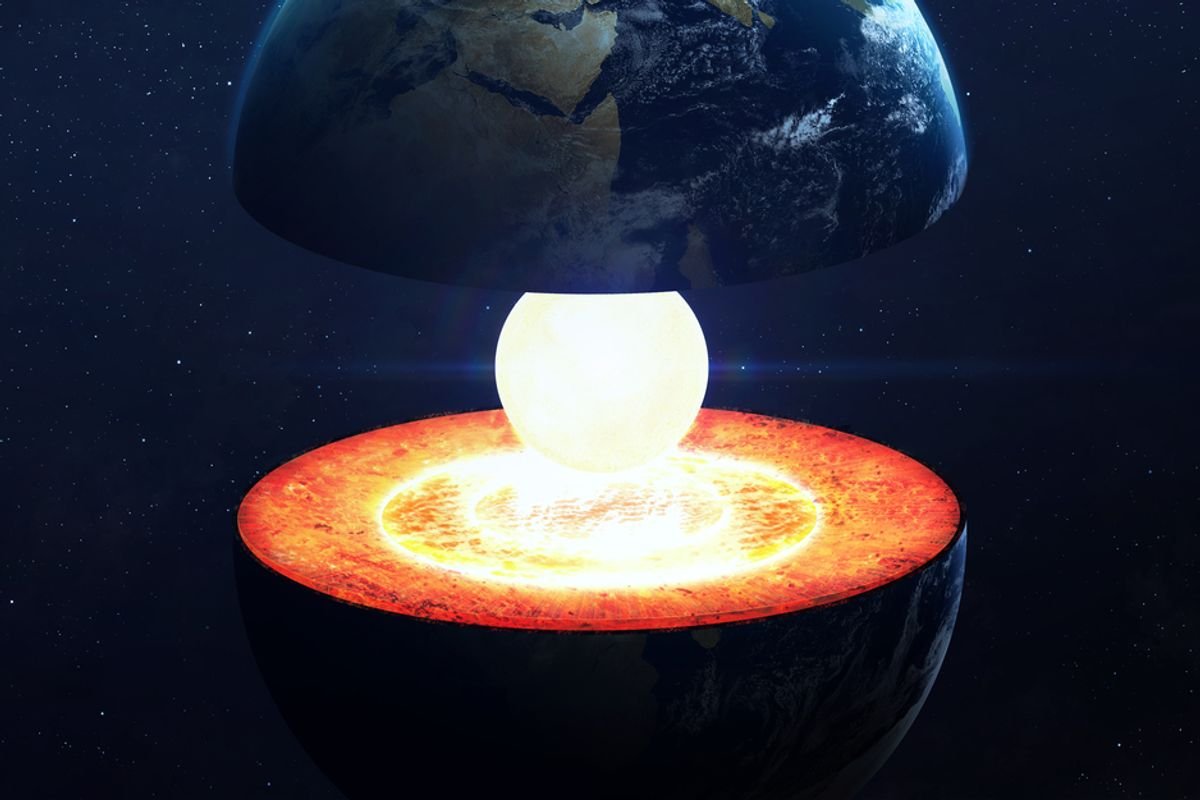
A new study published in Nature Geoscience has unearthed evidence of two gigantic, superheated rock structures at the base of Earth’s mantle, buried around 1,800 miles (about 2,900 kilometers) beneath Africa and the Pacific Ocean. Researchers have determined that these rock blobs have influenced Earth’s magnetic field for millions of years. The magnetic history of Earth, it turns out, could be a lot more complex than previously believed.
Read More: Hidden Clues on Dark Matter Come into Sight With a New High-Resolution Map of the Sky
Earth’s Magnetic Shield
Earth’s magnetic field has safeguarded the planet for most of its existence, acting as a shield against space radiation and solar wind that’s capable of breaking down planetary atmospheres. The oldest evidence of the magnetic field dates back 3.7 billion years, the same age as iron-containing rocks in Greenland that recorded the magnetic field strength of the distant past, according to the University of Oxford.
For most of Earth’s history, the magnetic field has been dipolar, forming a North Pole and a South Pole — it’s like there’s a giant bar magnet at the center of Earth, a common analogy used to describe the phenomenon.
Hot Rocks at the Mantle
According to the new study, the dipolar magnetic field that Earth developed has been swayed by the pair of hot rock structures at the base of the mantle, which are enveloped by a pole-to-pole ring of cooler rock.
To study the rocks, researchers combined paleomagnetic observations with computer simulations of the geodynamo, which is the flow of liquid iron in the outer core that powers the magnetic field. This allowed them to understand how the magnetic field has behaved over the past 265 million years.
The findings show that the continent-sized rocks are linked to thermal contrasts that exist at the outer core’s upper boundary; the boundary varies in temperature, with particularly hot regions lying below the rock structures. These hotter regions, researchers think, could be causing altered patterns in the geodynamo.
“These findings suggest that there are strong temperature contrasts in the rocky mantle just above the core and that, beneath the hotter regions, the liquid iron in the core may stagnate rather than participate in the vigorous flow seen beneath the cooler regions,” said study author Andy Biggin, a professor of geomagnetism at the University of Liverpool, in a statement.
In addition, the study indicates that tectonic shifts beneath the Earth’s surface may have been related to the ancient magnetic field’s behavior.
“These findings also have important implications for questions surrounding ancient continental configurations — such as the formation and breakup of Pangaea — and may help resolve long-standing uncertainties in ancient climate, paleobiology, and the formation of natural resources,” said Biggin.
Rethinking the Magnetic Field
While the magnetic field has been dipolar for a long time, there may have been a period when it wasn’t so neatly aligned. This is because early in Earth’s history, the inner core was likely liquid rather than solid.
Before the core solidified around 0.5 billion to 1.5 billion years ago, the magnetic field might have experienced a period of major fluctuation during which the field was weaker and originated from multiple poles. Then, the solidification of the core would’ve prompted a transition into the strong, two-pole magnetic field that Earth has today, according to Carnegie Science.
The researchers behind the new study similarly suggest that throughout ancient history, the magnetic field may not have always acted like a perfect bar magnet aligned with the planet’s rotational axis.
Read More: What Happens When Magma and Earthquakes Align in Yellowstone National Park?
Article Sources
Our writers at Discovermagazine.com use peer-reviewed studies and high-quality sources for our articles, and our editors review for scientific accuracy and editorial standards. Review the sources used below for this article: