
Giant Galaxies Emerged Just 1.4 Billion Years After the Big Bang

Just 1.4 billion years after the Big Bang, galaxies were expected to be small, chaotic, and still forming stars. Instead, astronomers have found enormous, mature-looking systems that appear to have assembled far earlier than current theories predict.
Standard models say large galaxies grow gradually, merging with smaller ones over billions of years. These massive early galaxies point to a much faster process.
New observations published in The Astrophysical Journal from the Atacama Large Millimeter/submillimeter Array (ALMA) suggest how that may have happened. By studying cold gas in a distant cluster known as SPT2349-56, researchers appear to be watching dozens of galaxies collapse together.
“Instead of slowly assembling mass throughout 14 billion years, a massive elliptical galaxy might swiftly emerge in just a few hundred million years,” said Nikolaus Sulzenauer, first author leading the analysis, in a press release.
Read More: JWST Spots Unexpected Abundance of Organic Molecules in Nearby Ultra-Luminous Galaxy
Record Star Formation in Early Galaxy Cluster
SPT2349-56 sits in the constellation Phoenix and is one of the most extreme galaxy clusters ever observed. At its center, at least four massive galaxies are tightly tangled together, forming stars at the rate of roughly one new star every 40 minutes. For comparison, our home galaxy, the Milky Way, forms only a few stars per year.
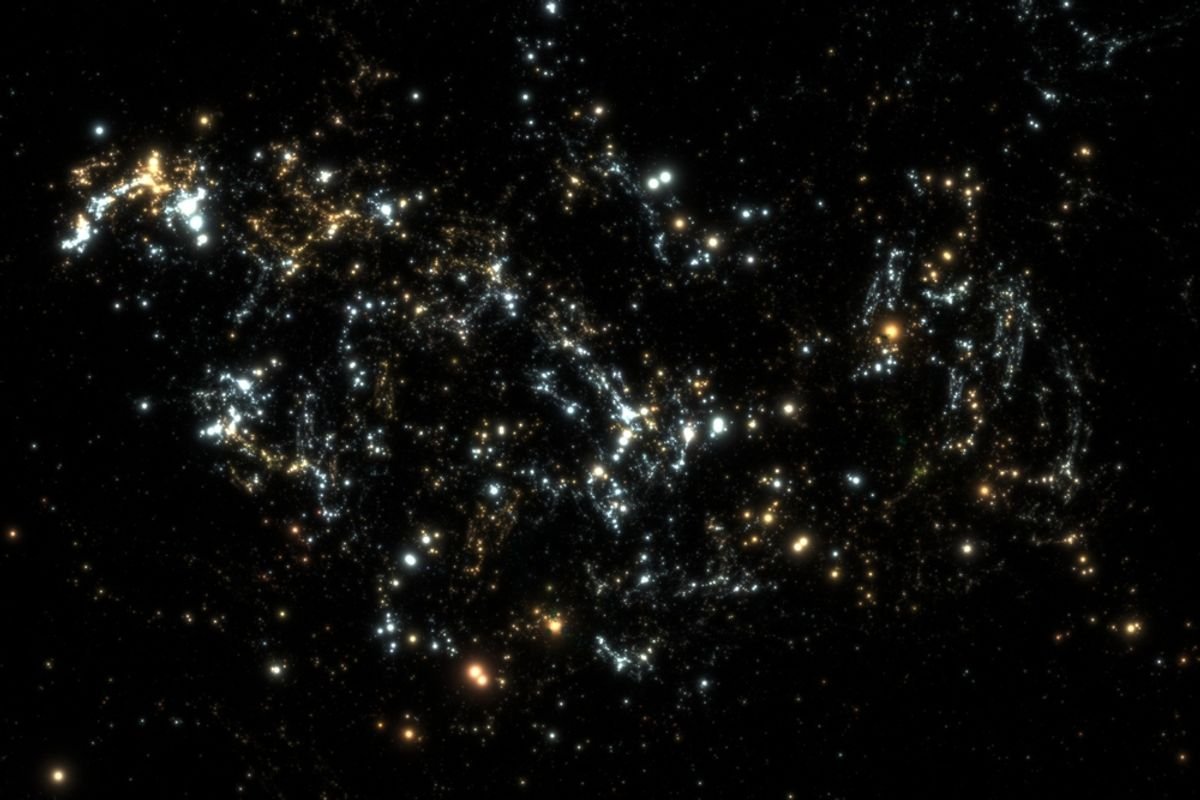
Using ALMA, the team tracked the movement of cold gas and dust, the raw materials for star formation. They observed streams of gas stretching outward from the cluster’s core at speeds of about 300 kilometers per second. These glowing arcs are shaped by gravitational forces as galaxies pull and tear at one another.
These streams appear to connect to about 20 additional galaxies farther out. Altogether, around 40 gas-rich galaxies are caught in what looks like a chain reaction of mergers. Instead of growing gradually, this cluster seems to be collapsing inward all at once.
How Giant Ellipticals Form
This observation points to a new path for how giant elliptical galaxies form. Rather than assembling slowly over billions of years, the densest regions of the early universe may have broken away from cosmic expansion early on. Gravity then pulled everything together in a dramatic collapse. In less than 300 million years (a blink of an eye in cosmic terms), dozens of galaxies could merge into one enormous structure.
Computer simulations run by researchers at the University of British Columbia helped confirm the idea. When they modeled how such dense clusters evolve, the results closely matched ALMA’s observations of SPT2349-56.
If this scenario is correct, most of the galaxies currently seen in the cluster’s core will eventually disappear as separate systems. Their stars, gas, and dark matter will combine into a single giant elliptical galaxy, the kind commonly found in the centers of galaxy clusters today.
The findings also raise new questions. As galaxies collide, shock waves heat the surrounding gas, and growing supermassive black holes may pump even more energy into their surroundings. That extra heat can stop new stars from forming. But scientists still don’t know exactly which process plays the biggest role, or how quickly star formation shuts down during these rapid mergers.
Watching a Transformation in Real Time
SPT2349-56 may represent a stage when many young galaxies merge into a single giant elliptical. These rapid collapses could explain why some massive galaxies already appeared mature early in the universe’s history. The findings also show how elements like carbon were heated and spread through early galaxy clusters.
“It might be too early to claim a full understanding of the ‘early childhood’ of giant ellipticals, but we have come a long way in linking tidal debris in protoclusters to the formation process of massive galaxies located in today’s galaxy clusters,” coauthor Scott Chapman said in a press release.
Read More: A Dead Galaxy From the Early Universe Succumbed to Starvation Due to its Own Black Hole
Article Sources
Our writers at Discovermagazine.com use peer-reviewed studies and high-quality sources for our articles, and our editors review for scientific accuracy and editorial standards. Review the sources used below for this article: