
Giant Dragonflies With 2-Foot Wingspans Ruled the Skies 300 Million Years Ago — But Oxygen May Not Explain Why
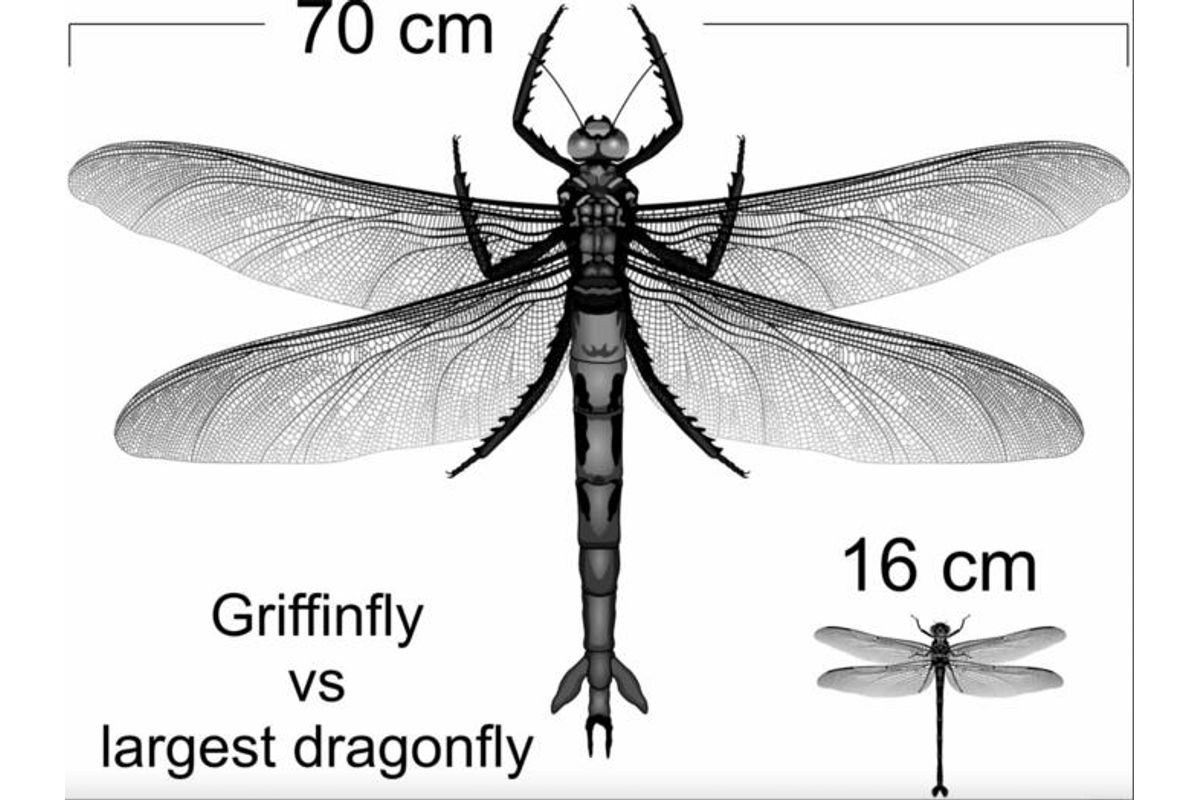
Before birds or bats took flight, the skies were filled with insects, and some of them were enormous. Around 300 million years ago, dragonfly-like creatures with wingspans reaching 27 inches (70 centimeters) — nearly the width of a modern hawk — flew above swampy forests. These “griffinflies” lived in a world shaped by coal swamps, frequent wildfires, and much higher oxygen levels than today.
Those elevated oxygen levels have long been thought to explain how insects reached such massive sizes. But new research, published in Nature, is challenging that idea, suggesting these giants may not have depended on oxygen as much as researchers once believed.
“If atmospheric oxygen really sets a limit on the maximum body size of insects, then there ought to be evidence of compensation at the level of the tracheoles”, said lead author Edward Snelling in a press release.
Read More: Fossilized Resin Reveals a Wet Forest Full of Insects and Spiders 112 Million Years Ago
How Oxygen Levels Were Thought to Drive Giant Insect Size

Comparison of the insect flight muscle (left) with mammalian cardiac tissue (right).
(Image Credit: Antoinette Lensink and Edward Snelling)
The oxygen theory made intuitive sense. Insects don’t breathe the way mammals do. Instead of lungs, they rely on a branching network of air-filled tubes called tracheae, which deliver oxygen directly to their tissues. At the smallest scale, oxygen diffuses through even finer tubes — tracheoles — into muscle cells, including those that power flight.
Because this system depends on diffusion, researchers assumed it would struggle to deliver enough oxygen to support very large bodies, especially for energy-intensive flight.
That idea began to take shape in the 1980s, when new techniques allowed geochemists to reconstruct the composition of ancient atmospheres. Their findings showed that oxygen levels were significantly higher around 300 million years ago — about 45 percent higher than today.
In the 1990s, researchers connected those elevated oxygen levels to fossil evidence of giant insects, proposing that larger bodies would require more oxygen to fuel flight. The timing lined up, and the idea quickly became the leading explanation for why insects once reached such massive sizes.
Under that framework, insects the size of griffinflies shouldn’t be able to exist today.
A Closer Look Inside Flight Muscles
The new study revisits that assumption by examining how oxygen is actually delivered within insect flight muscles.
Using high-powered electron microscopy, researchers measured how much space tracheoles take up inside muscle tissue across a range of insect sizes, and extended those findings to the griffinflies of the past.
What they found was that tracheoles occupy about 1 percent or less of the space inside flight muscles, even in large insects.
That means there is considerable unused space that could, in theory, be filled with additional oxygen-delivering structures if needed. By comparison, capillaries in the heart muscles of birds and mammals occupy roughly 10 times as much space.
“There is some compensation occurring in larger insects, but it is trivial in the grand scheme of things,” Snelling said.
In other words, insects don’t appear to be pushing up against a hard oxygen limit, at least not within their flight muscles.
If Not Oxygen, Then What?
The findings don’t completely rule out oxygen as a factor. Some scientists suggest that limitations elsewhere in the body, such as the way oxygen moves through the larger airways, could still play a role.
But the new data show that diffusion within flight muscle tracheoles is unlikely to be the bottleneck researchers once assumed.
That opens the door to other explanations for why ancient insects grew so large, and why modern ones do not.
One possibility is structural. As insects grow, their exoskeletons must support greater weight, which can impose physical limits on size. Another is ecological: the rise of vertebrate predators may have made being large more of a liability than an advantage.
For now, the insects of the Paleozoic remain something of a mystery. But the long-standing explanation that they simply needed more oxygen is beginning to look less certain.
Read More: These Amber Fossils Offer a “Snapshot of Life on Earth Millions of Years Ago”
Article Sources
Our writers at Discovermagazine.com use peer-reviewed studies and high-quality sources for our articles, and our editors review for scientific accuracy and editorial standards. Review the sources used below for this article: