
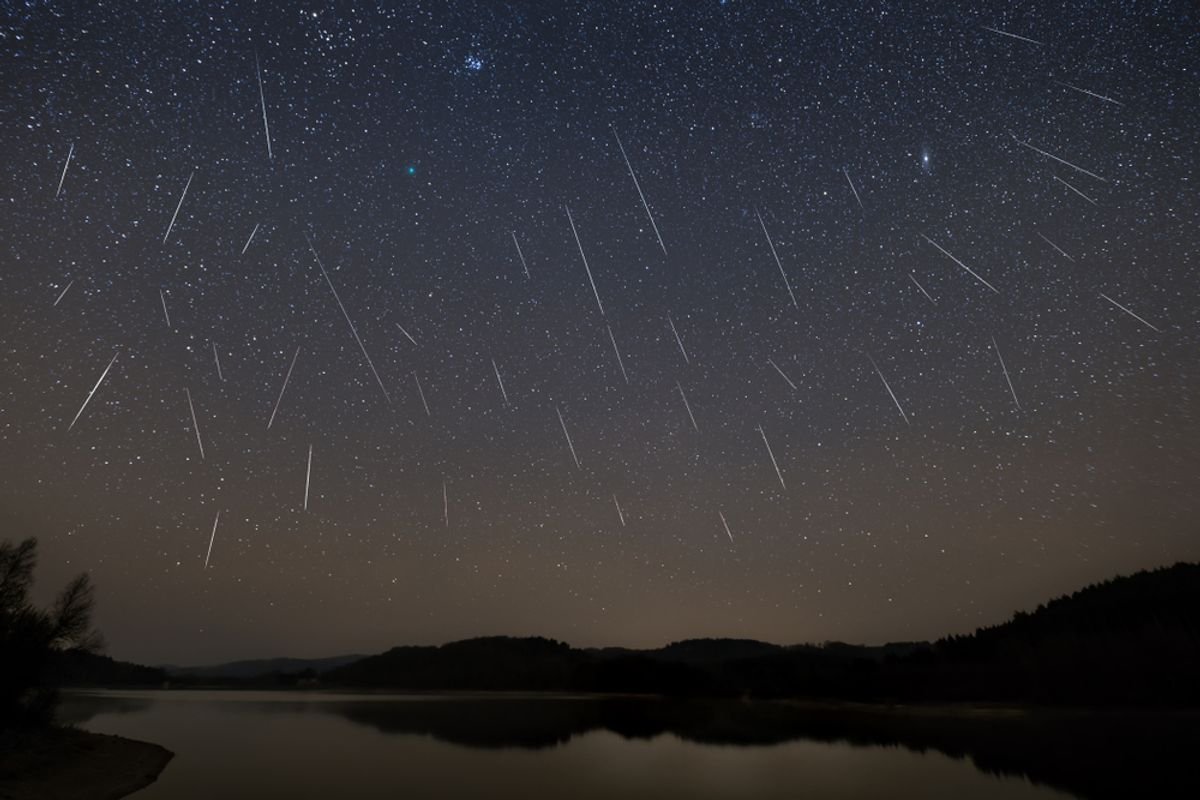
Geminid Meteor Shower Could Display 100 Meteors Per Hour as Last Event of 2025

If you need an excuse to bundle up, sip hot chocolate, and stare at the sky for a few hours, the Geminid meteor shower delivers. Every December, this reliable shower turns the night sky into a flickering light show with bright, colorful streaks flying from the direction of the Gemini constellation.
Unlike most major showers that make you stay up until after midnight, the Geminids start early, making it a great event for younger sky-watchers or anyone who prefers to be in bed before 2 a.m. With darker skies this year, you could see more than 100 meteors an hour. Not bad for a winter night.
Read More: Shooting Stars Could Just Be Space Debris Moving at 100,000 Miles Per Hour
How to Watch the Geminids
The Geminids peak on the nights of December 13 and 14, 2025, and this year’s timing is especially friendly. The shower usually becomes active around 9 or 10 p.m., which means you don’t have to wait until the middle of the night to see something. Start by looking toward the eastern sky, near the visible Jupiter. Once they start flying, you’ll see meteors streak across the whole dome, not just one area.
To enjoy it properly, get away from light pollution, dress for long, cold stillness, and let your eyes adapt to the darkness. Under perfect conditions, you might see up to 120 meteors an hour, most of them bright and often yellowish in color. The Geminids move at a medium-slow speed in meteor terms, so they rarely leave long glowing trails.
In contrast to last year, in 2025 the moon will be a waning crescent on peak nights and won’t rise until around 2 a.m., which means early evening viewing is moon-free, according to the American Meteor Society. After moonrise, you can still keep watching by facing west with the moon behind you.
Geminids Originate From Asteroid, Not Comet
The Geminids are one of the most dependable annual meteor showers, but they weren’t always a big deal. When people first recorded them in the mid-1800s, only 10 to 20 meteors an hour were visible. Over time, the debris stream thickened, and today three-digit hourly counts are possible under dark skies, according to NASA.
Meteors are created when Earth travels through leftover dust and debris that orbit the sun. When these bits hit our atmosphere, they burn up and create the familiar bright streaks. Most showers come from comet debris, but the Geminids are different: they come from an asteroid called 3200 Phaethon, which orbits the sun every 1.4 years.
Phaethon might be a “rock comet,” or even a “dead comet,” based on its strange orbit and behavior. It doesn’t grow a tail like comets do, yet it sheds dense particles that create the Geminids.
Ancient Greek Demigods Provide Their Names
All meteor showers are named after the part of the sky they seem to radiate from. For the Geminids, that point is the constellation Gemini. While the constellation isn’t the source of the meteors, it’s helpful for identifying the shower. In reality, you’ll see Geminids from all over the sky.
As for their source, another name from ancient Greek mythology came in handy. Asteroid 3200 Phaethon was discovered in 1983 and named after the Greek character who tried to drive the sun god’s chariot — a fitting name for something that swings so close to the sun.
Read More: 2032 and 2036 Taurid Meteor Showers Could Bring Larger Halloween Fireball Debris to Earth
Article Sources
Our writers at Discovermagazine.com use peer-reviewed studies and high-quality sources for our articles, and our editors review for scientific accuracy and editorial standards. Review the sources used below for this article: