
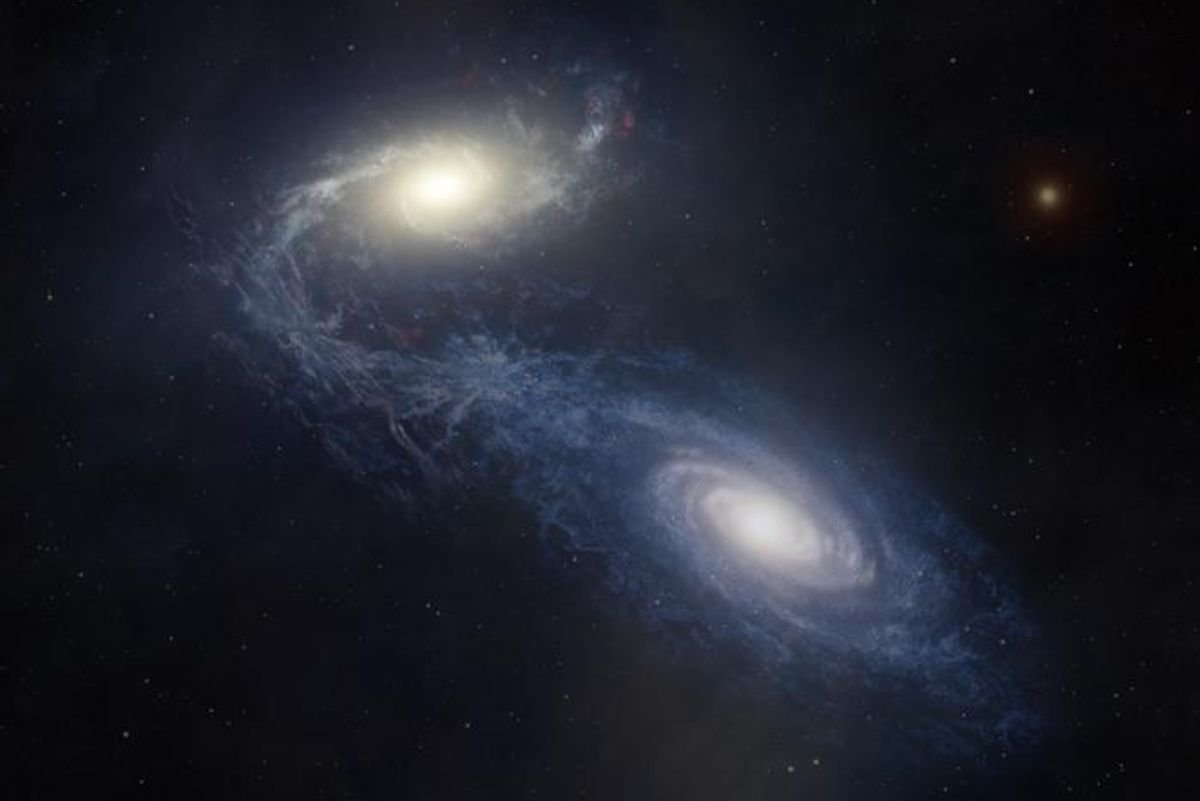
Galactic Archaeology Reveals How a Galaxy Formed Over 12 Billion Years

Astronomers can now do what wasn’t possible before: reconstruct the life story of a galaxy outside the Milky Way using chemical clues embedded in its gas. In research published in Nature Astronomy, a team applied a technique known as galactic archaeology to a galaxy outside our own for the first time.
By mapping the distribution of elements like oxygen within a nearby spiral galaxy, the researchers traced how it assembled and evolved over more than 12 billion years.
“We want to understand how we got here,” said Lisa Kewley, lead author, Harvard professor, and director of the Center for Astrophysics, in a press release. “How did our own Milky Way form, and how did we end up breathing the oxygen that we’re breathing right now?”
Read More: The Size of Our Galaxy Stretches Tens of Thousands of Light Years Across, But Its Height Is Rather Small
Using Galactic Archaeology to Trace Galaxy Formation
The team focused on NGC 1365, a large spiral galaxy positioned so its disc faces Earth. That orientation allowed researchers to examine its structure in detail, separating individual regions where stars are actively forming.
Using observations from the Las Campanas Observatory, the team measured the light emitted by gas clouds throughout the galaxy. Young, hot stars emit ultraviolet radiation that energizes nearby gas, causing elements like oxygen to glow at specific wavelengths. These emissions act as chemical markers, revealing the gas’s composition and how it has changed over time.
Astronomers have known that galaxies tend to show chemical gradients, with heavier elements concentrated near their centers and lighter material farther out. Those patterns reflect a galaxy’s past, including when stars formed and exploded, how gas moved through the system, and past mergers with other galaxies.
What sets this study apart is the level of resolution. The team was able to isolate individual star-forming regions in a galaxy beyond the Milky Way, allowing them to trace those chemical patterns with greater precision than before.
Reconstructing 12 Billion Years of Growth
To translate those patterns into a history, the researchers compared their observations with simulations from the Illustris Project, which models how galaxies evolve from shortly after the Big Bang to the present day.
After searching roughly 20,000 simulated galaxies, the team identified one that closely matched NGC 1365’s structure and chemistry, allowing them to reconstruct how it assembled over time.
The results suggest NGC 1365 began as a much smaller system. Its central region formed early and became enriched with heavier elements as generations of stars lived and died. Over billions of years, the galaxy expanded outward through repeated mergers with smaller dwarf galaxies. Its spiral arms appear to have formed more recently.
“This study shows really well how you can produce observations to be directly aided by theory,” Kewley said. “I think it’s also going to impact how we work together as theorists and observers, because this project was 50 percent theory and 50 percent observations, and you couldn’t do one without the other. You need both to come to these conclusions.”
What NGC 1365 Reveals About the Milky Way
One of the most important implications of the study is how it reframes our understanding of our own galaxy.
Because NGC 1365 shares key features with the Milky Way, tracing its history offers a point of comparison — a way to test whether our galaxy followed a typical evolutionary path or something more unusual. Expanding this approach to other galaxies could reveal just how many different paths spiral galaxies can take.
“Do all spiral galaxies form in a similar way?” asked Kewley. “Are there differences between their formation? Where is their oxygen distributed now? Is our Milky Way different or unique in any way? Those are the questions we want to answer.”
Read More: Giant Galaxies Emerged Just 1.4 Billion Years After the Big Bang
Article Sources
Our writers at Discovermagazine.com use peer-reviewed studies and high-quality sources for our articles, and our editors review for scientific accuracy and editorial standards. Review the sources used below for this article: