
Fossils Show Pronghorn Speed Predates the American Cheetah by 5 Million Years

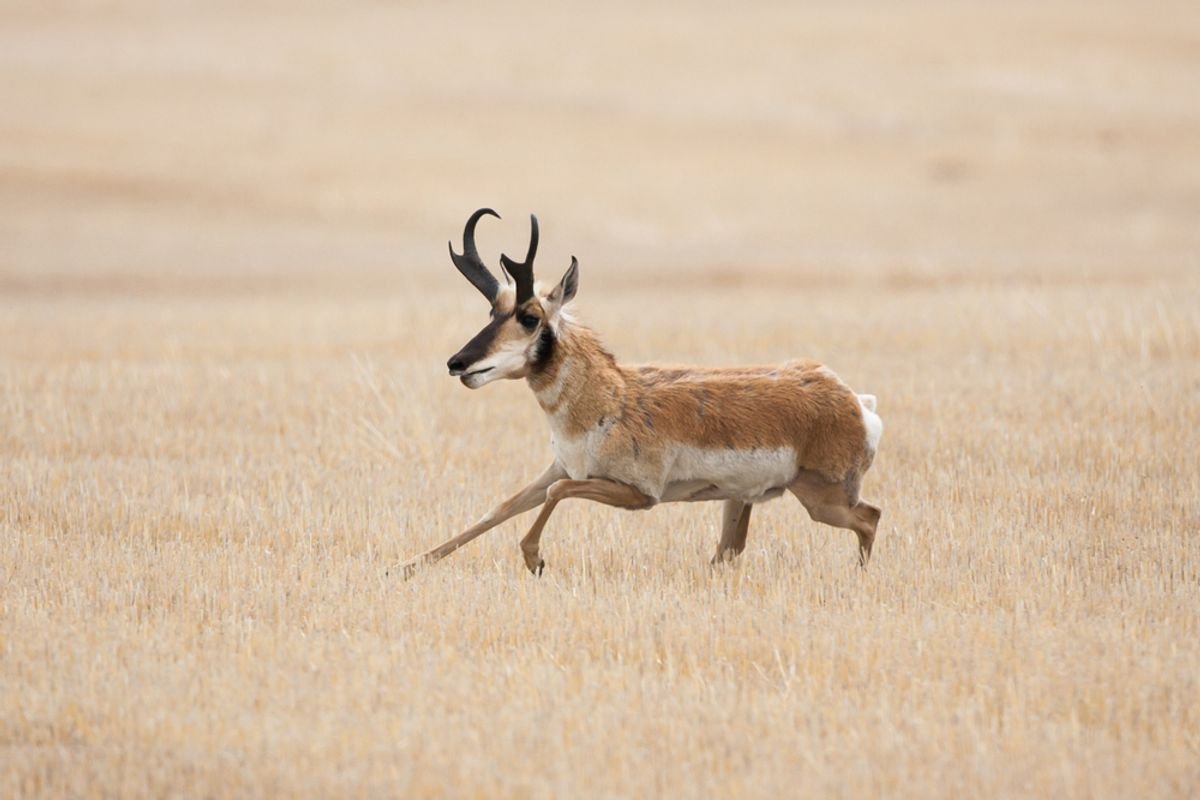
The American pronghorn can outrun every land predator in North America. Its speed has often been linked to the now-extinct American cheetah, based on the idea that only a predator just as fast could have driven the pronghorn to evolve such extreme endurance.
Fossils complicate the story. A study published in the Journal of Mammalogy shows that early relatives of the pronghorn were already built for running millions of years before the American cheetah appeared on the continent. The evidence indicates that the pronghorn’s speed developed well before any high-speed predator arrived, shaped instead by earlier environmental pressures that favored efficient, long-distance movement.
“What our work was able to add to this story was that not only was the American cheetah not as cheetah-like as previously thought, but that pronghorn have this build for running that existed well before the American cheetah came about,” said co-author Anne Kort in a press release.
Mojave Desert Fossils Reveal Early Pronghorn Evolution
The study examined fossils from the Dove Spring Formation in California’s Mojave Desert, dating from about 8 million years to 12.5 million years ago. During that stretch of the Miocene, the region shifted from a more continuous forest to a mosaic of woodland and expanding dry grasslands.
Researchers focused on the astragalus, a blocky ankle bone that helps determine how efficiently hoofed mammals move. In animals such as deer, antelope, camels, and cows, the proportions of this bone often reflect running ability. Species that live in more open habitats tend to show ankle shapes suited for sustained speed. The team expected to see those proportions change over time as the environment opened.
“We expected to see longer astragali in the beginning, and then it would transition to more running-adapted astragali in the end. But we did not find that,” Kort said.
Instead, the ankle structure remained consistent throughout the fossil record examined. Early pronghorn relatives already possessed ratios similar to those of modern pronghorn.
Read More: Ancient Mummified Cheetahs Found in Saudi Caves Rewrite the Species’ History — And Its Future
Pronghorn Speed Predates the American Cheetah
These fossils long predate the American cheetah’s arrival in North America. That timeline makes a simple predator-driven explanation unlikely.
Rather than evolving speed in response to a single fast hunter, early pronghorn may have relied on mobility as forests broke apart and dry areas expanded. Animals capable of moving efficiently between habitat patches likely had an advantage in a landscape that demanded travel.
“From about 30 million years ago to present, we see mammals becoming increasingly cursorial, which means they’re adapted to running,” Kort said.
Early pronghorn relatives fit within that broader trend. They measured roughly the size of a slender, long-legged beagle, and their ankle structure shows they already had the mechanics needed for sustained running.
Survival in Changing Landscapes
Modern pronghorn still travel long distances across western North America, covering open terrain with sustained speed. Their mobility may help them navigate fragmented habitats and expanding development.
“This tells us something about what animals are going to succeed going forward,” said first author Fabian Hardy.
The fossil record, however, shows that long-term stability does not guarantee permanence. Although pronghorn relatives maintained similar running adaptations for millions of years, they eventually disappeared near the end of the Miocene, possibly after ecological change crossed a threshold.
“It’s easy to expect evolution and this gradual change over time, but I think this idea that you might not even see a problem until it’s too late is a good reminder of how these things work,” Kort said.
The ankle bones preserved in the Mojave Desert show that pronghorn speed reflects a deep evolutionary history tied to environmental change. They also serve as a reminder that adaptation can sustain species for long stretches, but not indefinitely.
Read More: Think You Could Outrun a T. rex? Here’s How Fast Dinosaur Predators Ran
Article Sources
Our writers at Discovermagazine.com use peer-reviewed studies and high-quality sources for our articles, and our editors review for scientific accuracy and editorial standards. Review the sources used below for this article: