
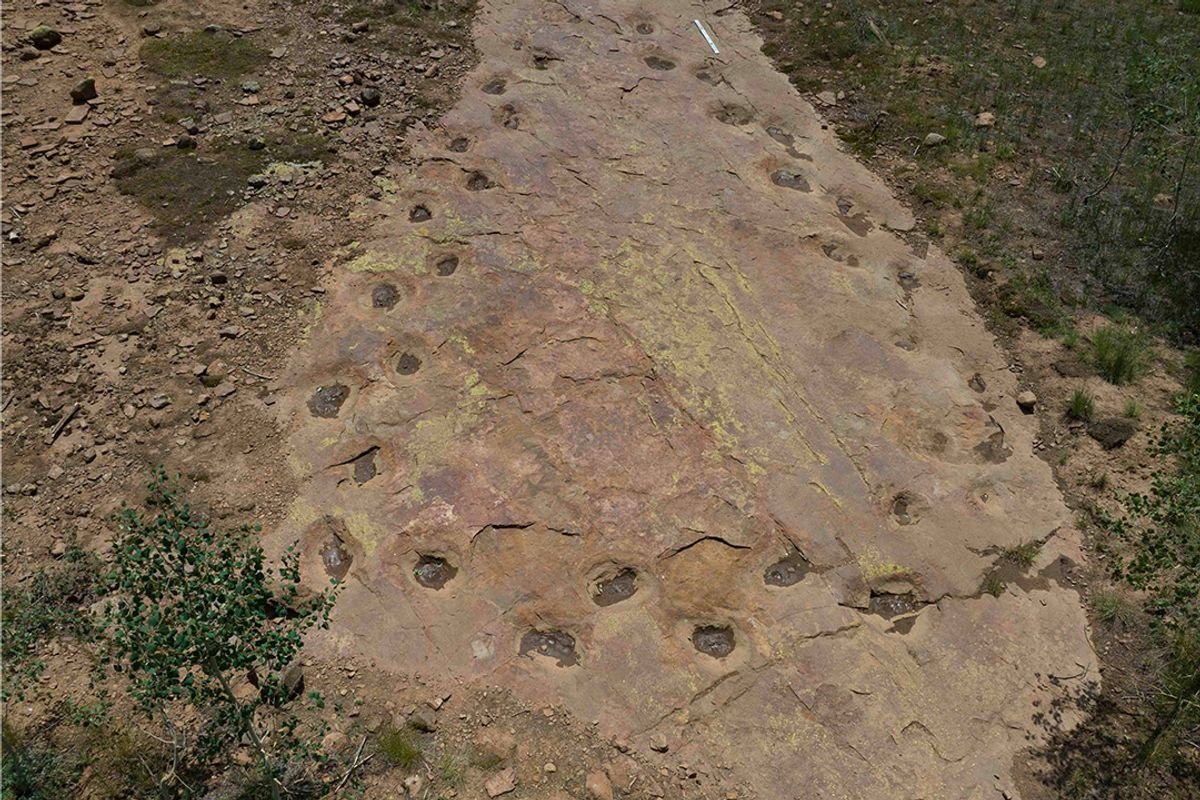
Footprints From Around 150 Million Years Ago Reveal the Strange Stomp of a Looping Sauropod
The sauropod dinosaurs were many things. They were large, they were long, and they were especially enthusiastic plant-eaters. But they certainly weren’t agile. At around 80 tons, the most massive sauropods were slow and steady meanderers — much more suited to a loosely curving course than a tightly curving one.
A new analysis of a trail of fossilized footprints has found evidence of the closest thing to sauropod agility, however. Published in Geomatics, the analysis recreates the movement of a single sauropod along a long, looping trackway from around 150 million years ago. According to the authors, the trail is about 313 feet in length and features about 130 footprints, making it the largest and tightest trackway from a sauropod ever recorded.
“This trackway is unique because it is a complete loop,” said Anthony Romilio, a study author and a paleontologist at the University of Queensland, according to a press release. “While we may never know why this dinosaur curved back on itself, the trackway preserves an extremely rare chance to study how a giant sauropod handled a tight, looping turn before resuming its original direction of travel.”
Read More: Dinosaur Highway of Sauropod Footprints Provides Snapshot of Middle Jurassic Life
A Tight Turn for a Lumbering Sauropod
Around 150 million years ago, more than 20 sauropod species trampled through the North American terrain, including such icons as the 100-foot-long Diplodocus and the 80-foot-long Apatosaurus. Although none of these extreme plant-eaters were especially nimble, a single sauropod from the period left a record of footprints from a particularly tight turn, which it took in what is now the West Gold Hill Dinosaur Tracksite in Ouray County, Colorado.
Stored in the sediment for all this time, the dinosaur’s turn is still set in stone. But only a small portion of the trail has been thoroughly documented and described by scientists, leaving a number of unanswered questions about the dinosaur’s movement and agility.
“It has been challenging to document these footprints from the ground,” said Paul Murphey, another study author and a paleontologist at the San Diego Natural History Museum, according to the press release, “because of the size of the trackway.”
To solve this issue, the researchers turned to drones, taking aerial images of the trackway and then turning the images into a high-resolution virtual model. This model allowed them to retrace the full sequence of the sauropod’s footsteps, helping explain how these cumbersome creatures moved through the North American landscape.
Read More: Theropod Dinosaurs Met to Dance, Mate, and Nest in Colorado About 100 Million Years Ago
Analyzing the Sauropod Stride

Overhead views of the 130-plus fossil footprints, shown as (A) a stitched photographic model and (B) as a false-color height map, where changes in elevation highlight the footprints by their depth. The arrows indicate the dinosaur’s turning path as it walked across the site.
(Image Credit: Dr Anthony Romilio)
Specifically, the model revealed that the sauropod was traveling northeast when it opted to turn toward the west, then toward the south, in a counterclockwise loop. “It was clear from the start that this animal began walking toward the northeast, completed a full loop, and then finished facing the same direction again,” Romilio said in the release.
Not only that, but the researchers also spotted slight changes in the sauropod’s footsteps over the course of the loop — a characteristic of the sauropod’s stride that’s only apparent in longer trackways.
“One of the clearest patterns was a variation in the width between left and right footprints, shifting from quite narrow to distinctly wide,” Romilio added in the release. “This shift from narrow to wide step placement shows that footprint width can change naturally as a dinosaur moves, meaning short trackway segments with seemingly consistent widths may give a misleading picture of its usual walking style.”
Surprisingly, the study authors also observed that the length of the sauropod’s steps was about 4 inches longer on one side than they were on the other, suggesting that the herbivore might have had a limp, or at least a strong preference for some of its legs.
Taken together, the study authors stress that their imaging and modeling techniques could assist in the analysis of other tracksites, even those that were not made by a tightly turning, limping sauropod.
“There are many long dinosaur trackways around the world where this method could be applied to extract [behavioral] information that was previously inaccessible,” Romilio concluded in the release.
Article Sources
Our writers at Discovermagazine.com use peer-reviewed studies and high-quality sources for our articles, and our editors review for scientific accuracy and editorial standards. Review the sources used below for this article: