
First Map of the Sun’s Outer Edge Demystifies the Escape Route of Solar Wind

The sun keeps a tight rein on everything in the Solar System, but it isn’t always the best at keeping the material in its own atmosphere under control. Wayward solar wind constantly breaks free from our host star, blowing past every planet until it’s halted by opposing wind generated by stars beyond the Solar System.
A new study published in the Astrophysical Journal Letters has mapped the outer edge of the sun’s atmosphere for the first time, shedding light on the boundary where solar wind escapes the sun’s magnetic influence.
Data from NASA’s Parker Solar Probe has now allowed astronomers to trace the exact limits of this boundary and understand its ever-changing nature throughout the solar cycle.
Read More: Neptune Is the Furthest Planet From the Sun, But It Still Experiences Auroras
The Journey of Solar Wind
The sun is always churning out streams of charged particles (or plasma) from the corona, its outermost atmospheric layer. The corona — sizzling at upwards of 2 million degrees Fahrenheit — heats and accelerates the particles, which start to move at such high speeds that they become capable of escaping the sun as solar wind.
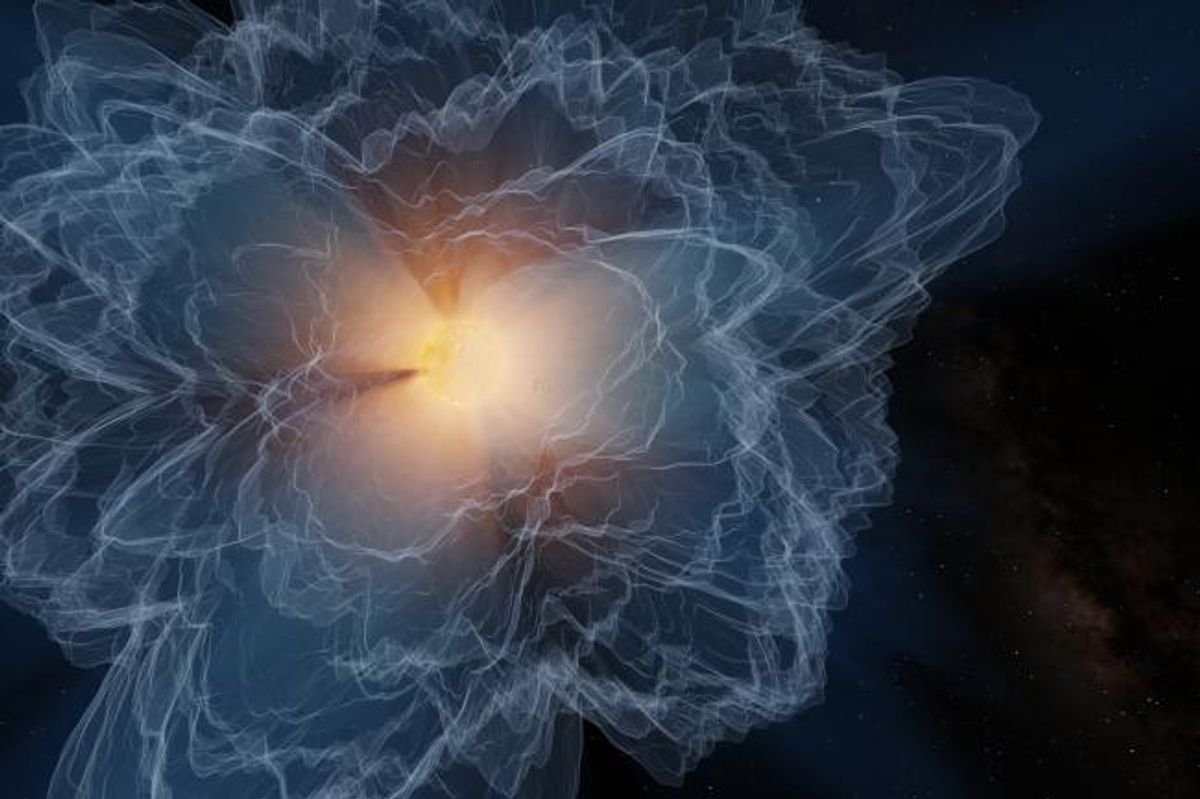
Eventually, the energized particles break through the Alfvén surface, the boundary of the sun where solar wind becomes faster than magnetic waves. The solar wind then embarks on a journey across the Solar System, carrying with it a portion of the sun’s magnetic field that has been embedded in plasma.
At this point, the solar wind has no chance of being brought back in by the sun’s gravity, racing past planet after planet. Earth’s magnetosphere blocks most of the wind as it flies by, but some solar storms are powerful enough to create auroras or interfere with satellites.
Solar wind reaches the end of its journey at the heliopause, an area that borders the vast expanse of interstellar gas and dust. Here, solar wind isn’t strong enough to counter the pressure of wind from other stars in our galaxy, according to NASA.
Mapping the Sun’s Boundary
The Parker Solar Probe, which was launched in 2018 to study the sun, has now confirmed how the Alfvén surface changes over time. Researchers involved in the new study examined data collected by the probe’s Solar Wind Electrons Alphas and Protons (SWEAP) instrument, enabling them to observe the structure of the sun’s outer boundary.
“Before, we could only estimate the sun’s boundary from far away without a way to test if we got the right answer, but now we have an accurate map that we can use to navigate it as we study it,” said lead author Sam Badman, an astrophysicist at the Harvard & Smithsonian Center for Astrophysics, in a statement.
“And, importantly, we also are able to watch it as it changes and match those changes with close-up data. That gives us a much clearer idea of what’s really happening around the sun,” Badman added.
Scientists have known that the shape and size of the Alfvén surface change based on the sun’s 11-year solar cycle; it grows during a solar maximum (the period of peak solar activity), and conversely, shrinks during a solar minimum (the period of lowest solar activity). The Parker Solar Probe data, however, have made it clear what happens as the boundary expands.
“As the sun goes through activity cycles, what we’re seeing is that the shape and height of the Alfvén surface around the sun is getting larger and also spikier. That’s actually what we predicted in the past, but now we can confirm it directly,” said Badman.
Answers to Solar Mysteries
According to the researchers, these maps of the Alfvén surface could unlock solar secrets that still haven’t been answered. It may help astronomers grasp the processes happening in the sun’s atmosphere; one of the key questions they currently have is why the corona is so hot.
The maps could also lead to more accurate models of solar wind, explaining how space weather affects Earth and other planets.
The researchers’ work isn’t over; when the next solar minimum begins around 2030, they plan on returning to the sun’s corona to see what happens during the other half of a solar cycle.
Read More: 2,700-Year-Old Total Solar Eclipse Observations Give Insight to Our Ancient Solar System
Article Sources
Our writers at Discovermagazine.com use peer-reviewed studies and high-quality sources for our articles, and our editors review for scientific accuracy and editorial standards. Review the sources used below for this article: