
First Fossilized Egg From a Mammal Ancestor Confirmed After 250 Million Years
In 2008, a small rock nodule revealed only a few flecks of bone. As the rock was chipped away, a perfectly curled Lystrosaurus embryo began to emerge, a fossil that would take nearly two decades and new technology to fully understand.
Now, high-resolution scans show the embryo died before hatching, still enclosed within an egg, making it the first confirmed therapsid egg from the lineage that gave rise to mammals. Described in PLOS ONE, the roughly 252-million-year-old fossil captures Lystrosaurus, a species that went on to dominate ecosystems after the End-Permian mass extinction, which wiped out around 90 percent of species on Earth, and provides direct evidence that mammal ancestors laid eggs.
“This discovery breaks entirely new ground,” said one of the study authors, Jennifer Botha, in a press release.
For over 150 years of South African paleontology, no fossil had ever been conclusively identified as a therapsid egg. This is the first time we can say, with confidence, that mammal ancestors like Lystrosaurus laid eggs, making it a true milestone in the field.”
X-Ray Scans Reveal Fossilized Mammal Ancestor Egg

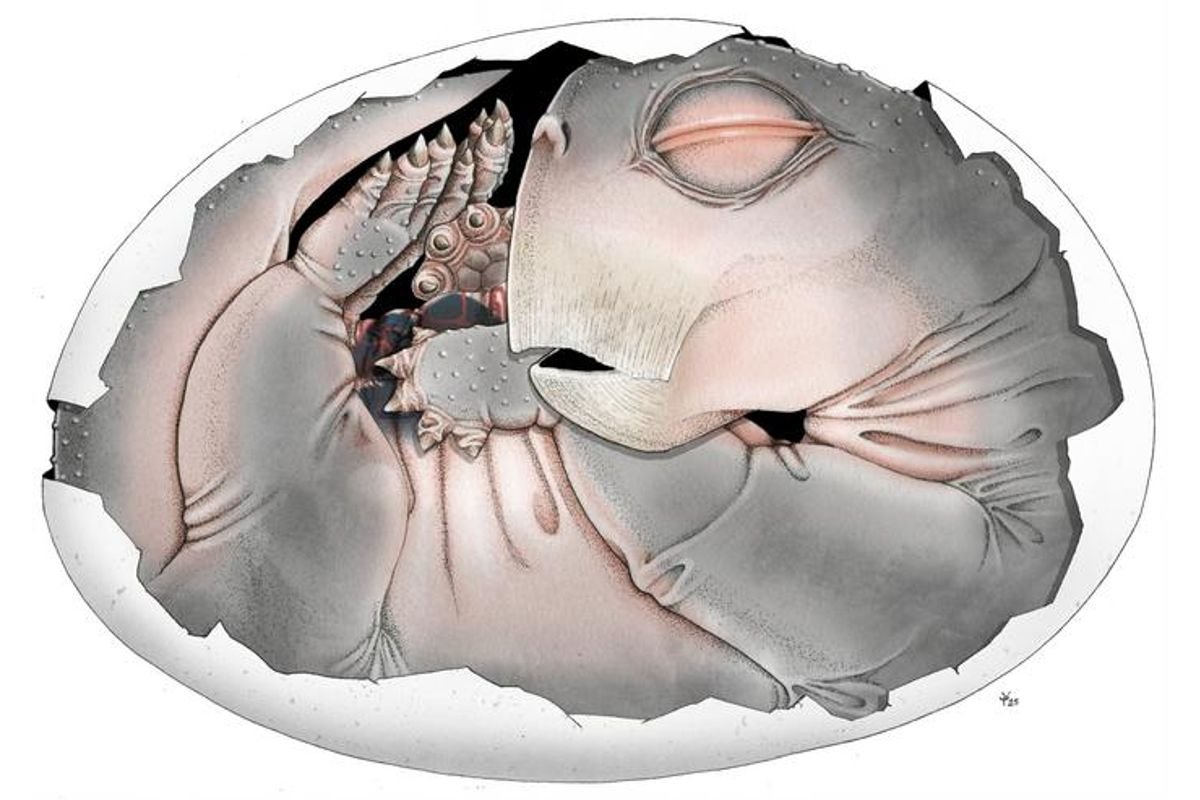
Reconstruction of the Lystrosaurus skeleton in an egg
(Image Credit: Professor Julien Benoit)
When the fossil was first uncovered, the embryo was clearly visible inside the rock, but there was no preserved eggshell to confirm whether it had died before or after hatching. Researchers suspected early on that it had died within an egg, but the tools available at the time could not confirm it.
That changed with synchrotron X-ray imaging, which produces highly detailed 3D scans using intense X-ray beams. The technique allowed researchers to look at the fossil at a microscopic level without damaging it.
The scans showed that the lower jaw had not yet fused, a developmental step required before the animal could feed. Without that fusion, the embryo would not have been capable of surviving outside the egg.
“When I saw the incomplete mandibular symphysis, I was genuinely excited,” said co-author Julien Benoit. “The individual would have been incapable of feeding itself.”
The imaging also made it possible to separate and identify individual bones, giving the team a clearer picture of how far the embryo had developed and confirming that it had not yet reached a stage where hatching was possible.
Read More: 70-Million-Year-Old Dinosaur Egg Reveals Ancient Nesting Clues
Egg-Based Reproduction in Lystrosaurus

Photograph of the fossilized egg
(Image Credit: Julien Benoit)
The fossil also clarifies how Lystrosaurus reproduced at a time when survival was not guaranteed. The animals laid relatively large eggs for their size, rich in yolk that supported full development without parental feeding after hatching. Unlike modern mammals, Lystrosaurus did not produce milk for its young.
The eggs were likely soft-shelled, which helps explain why there has been so little evidence. Unlike the hardened shells of dinosaurs, soft shells rarely preserve in the fossil record, meaning similar fossils may have been overlooked or never fossilized at all.
Egg size may have also played a role in survival. Larger eggs retain moisture more effectively, an advantage in the hot, drought-prone conditions that followed the End-Permian mass extinction.
The young were likely precocial, meaning they hatched at an advanced stage of development and could move, feed, and avoid predators soon after hatching. That reduced reliance on parental care may have allowed populations to recover quickly in unstable environments.
Filling a Gap in Mammal Evolution
For more than a century, there was no direct evidence of eggs from mammal ancestors. By taking another look at a fossil that had remained unresolved for years, this study shows what newer imaging techniques can uncover.
The findings also reach beyond paleontology, helping explain how species respond to extreme environmental change.
“This work is highly impactful because it offers a deep-time perspective on resilience and adaptability in the face of rapid climate change and ecological crisis. Understanding how past organisms survived global upheaval helps scientists better predict how species today might respond,” Benoit explained.
Read More: Established Science Is Wrong About Mammalian Evolution, Study Claims
Article Sources
Our writers at Discovermagazine.com use peer-reviewed studies and high-quality sources for our articles, and our editors review for scientific accuracy and editorial standards. Review the sources used below for this article: