
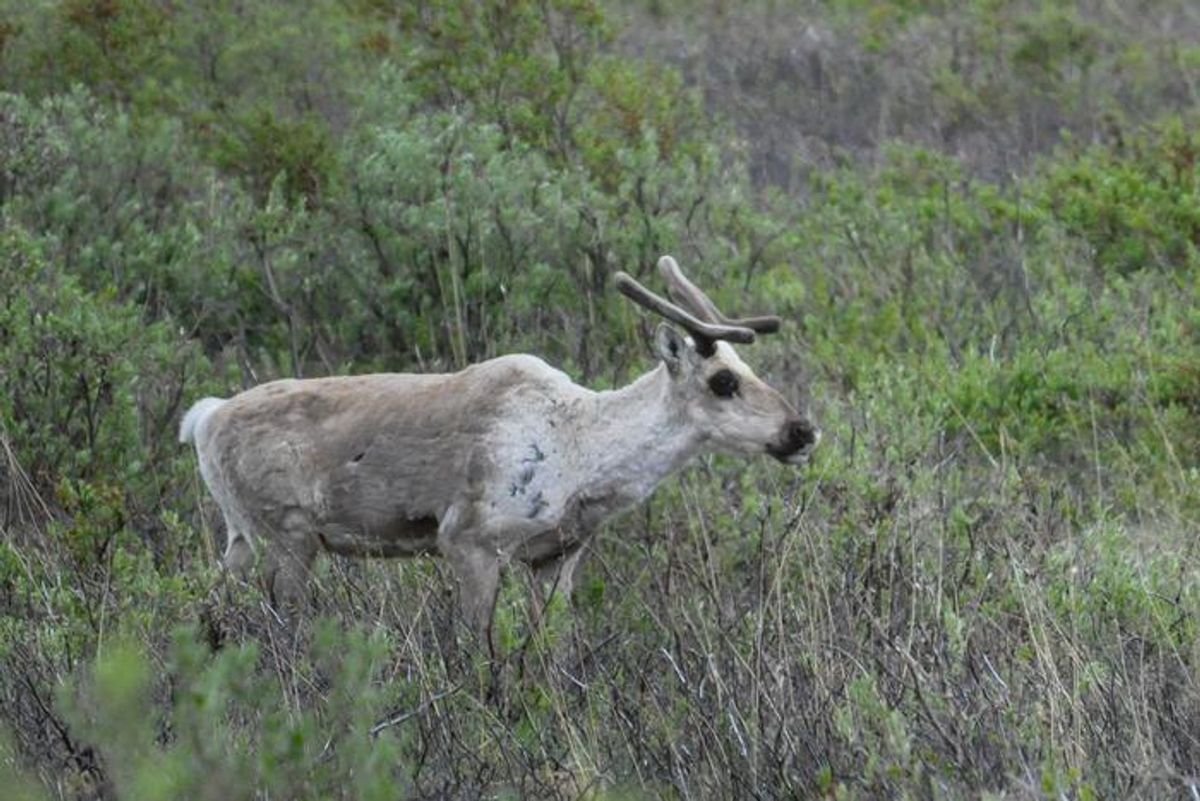
Female Caribou Eat Their Own Antlers Possibly to Survive Childbirth
For decades, researchers have puzzled over the biological oddity of female caribou. Unlike all other deer species, female caribou have antlers, just like the males. Explanations have ranged from defense against predators to dominance at feeding sites. But new research suggests the answer may be far less about fighting and far more about feeding.
A study published in Ecology and Evolution offers a fresh perspective, showing that female caribou — especially new mothers — depend on antlers as a crucial nutritional resource during one of the most demanding moments of their lives.
By analyzing hundreds of shed antlers from Arctic calving grounds, researchers uncovered evidence that antlers are not just grown and discarded, but actively recycled into the caribou diet.
“We knew that animals gnawed on these antlers, but everyone assumed they were mostly rodents. Now we know it’s really caribou,” said Joshua Miller in a press release. “My jaw dropped when our results started to become clear.”
Read More: Deer May Leave Glowing Scent Marks to Find a Potential Mate
Why Do Female Caribou Have Antlers?
Caribou calving grounds are places where migratory females give birth each year, and where they also shed their antlers. That timing turns out to be more relevant than previously believed.

Shed caribou antlers.
(Image Credit: Colleen Kelley)
After completing epic migrations of up to 1,500 miles round-trip, pregnant females arrive in the Arctic tundra nutritionally depleted. Giving birth and producing milk only intensifies the demand for minerals like calcium and phosphorus.
Antlers, made of bone that grows directly from the skull, are packed with those very nutrients. In the cold, dry conditions of the Arctic, shed antlers can remain intact for hundreds of years, forming a kind of mineral bank embedded in the landscape. According to the study, caribou gnaw on antlers dropped years earlier, supplementing their diets precisely when other nutrient sources are scarce.
In this way, females effectively carry their own nutritional supplements to the calving grounds, shedding antlers right where and when they will be most useful.
Analyzing Chew Marks on Shed Antlers
The research team examined antlers and bones collected during scientific expeditions to the Arctic National Wildlife Refuge between 2010 and 2018. The area is home to the Porcupine Caribou Herd, one of the most famous migratory herds on Earth.
Many of the antlers showed clear signs of chewing, but researchers weren’t sure which animals were responsible. To find out, they analyzed tooth marks left behind on 1,567 antlers. The results showed that 86 percent of the antlers had evidence of gnaw marks, and 99 percent of those marks were made by caribou themselves.
Other Theories About Female Caribou Antlers
Biologists have long suggested that female antlers help caribou defend prime grazing spots or ward off predators. But the new findings complicate that story.
Female caribou often rely on their hooves, rather than their antlers, when threatened, and their antlers tend to be relatively small.
“Female caribou shed their antlers right around when they give birth. That means they are antlerless when it would be most crucial to have antlers to defend a young calf if they were a defense mechanism,” said Madison Gaetano.
The likeliest answer is that female antlers may serve multiple roles across time, even when they aren’t consumed. After they are shed, their minerals seep back into the soil, fertilizing sedges, grasses, and lichens that sustain future caribou generations.
“They’re engineering this habitat, seeding the landscape with these super-important minerals that can be quite hard for animals to get enough of,” concluded Miller. “Phosphorus in particular is very important for new mothers trying to produce high-quality milk for feeding their young. Caribou bring literally tons of phosphorus to their calving grounds every year.”
Read More: Could Zombie Deer Disease Transfer to Humans?
Article Sources
Our writers at Discovermagazine.com use peer-reviewed studies and high-quality sources for our articles, and our editors review for scientific accuracy and editorial standards. Review the sources used below for this article: