
Fatal Fungus Turns Beetles’ Chemical Shields Into a Deadly Weakness

Far from being defenceless, plants have acquired all kinds of weird and wacky ways to protect themselves against pests and predators. Some, according to a study in the Journal of Chemical Ecology, release latex to trap unsuspecting insects. Others recruit “bodyguards” to dispatch enemies on their behalf, according to a study in Scientific Reports. Spruce trees, however, release antimicrobial compounds (phenolic glucosides) that inhibit the growth of pathogenic fungi.
Researchers writing in PNAS have shown that spruce bark beetles (Ips typographus) are able to hijack these chemical defences to produce their own toxins. The toxins undergo yet another transformation thanks to Beauveria bassiana, an insect-killing fungus, which is able to infect (and kill) the beetles by bypassing their defences.
“We have demonstrated that a bark beetle can co-opt a tree’s defensive compounds to make defenses against its own enemies,” lead author Jonathan Gershenzon, a professor at the Max Planck Institute for Chemical Ecology, said in a statement.
“However, since one of the enemies, the fungus Beauveria bassiana, has developed the ability to detoxify these antimicrobial defenses, it can successfully infect the bark beetles and thus actually help the tree in its battle against bark beetles.”
Read More: Mold Is Feasting on Radiation in Chernobyl’s Abandoned Nuclear Plants
Beetles Exploit The Defences Of Spruce Trees
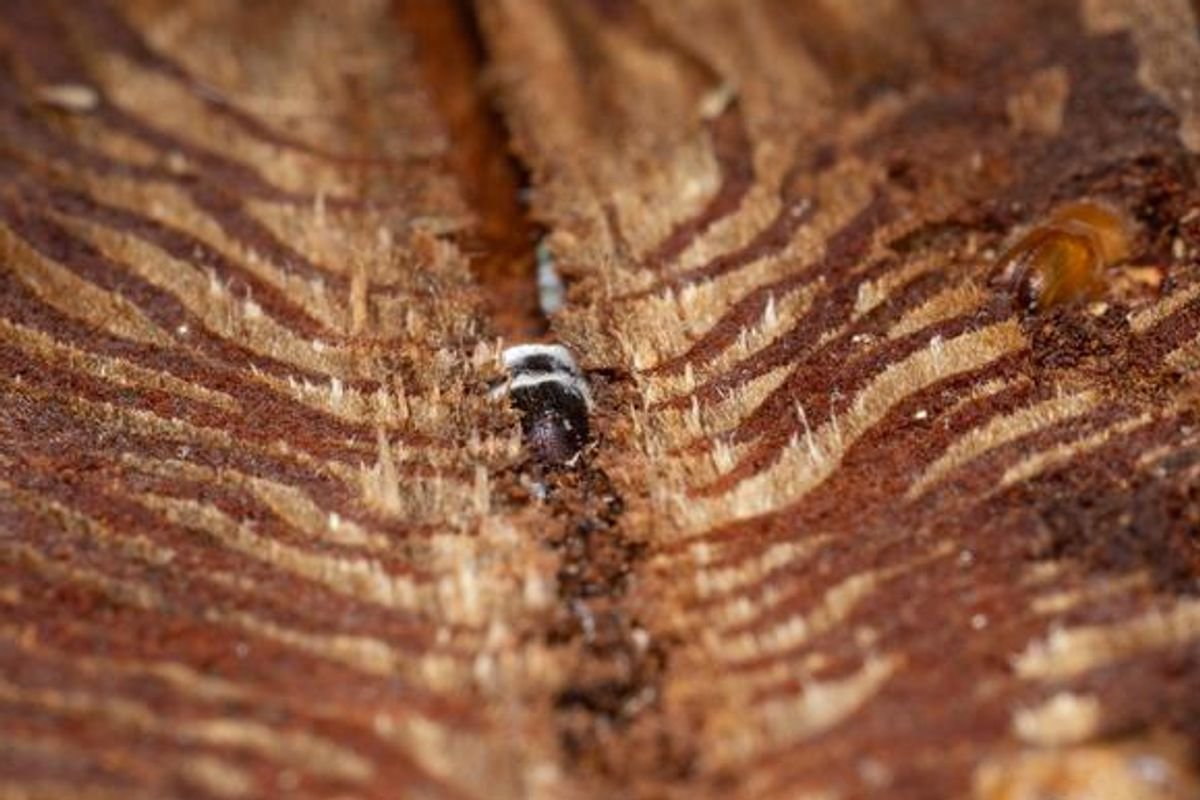
The Eurasian spruce bark beetle is a small brown insect no bigger than a pea. The pest is found across Europe and northern Asia, and can seriously damage pine trees if infestations are left to fester.
It is known that they consume vast quantities of spruce tree tissue, which contains high concentrations of microbial compounds, like stilbenes and flavonoids, that protect the host against pathogenic fungi. However, until now, it was unknown whether these compounds conferred resistance to the fungi on the beetles.
To find out, Gershenzon and the research team employed various chemical analysis techniques, including mass spectrometry and nuclear magnetic resonance. The results suggest that consuming these compounds not only provides the beetle with defence against fungi, but that additional processes occur after ingestion to increase the toxins’ potency, making them even more effective at warding off pathogens.
This is because the beetle can break down the plant-derived compounds (phenolic glucosides) via a water-mediated process called hydrolysis, thereby separating the non-sugar, more potent component of a glycoside (aglucones) from the sugar component.
Fungus Exploits The Defences Of Beetles
But just as the spruce bark beetle is able to manipulate the chemicals produced by spruce trees, the fungus B. bassiana is able to exploit those ingested and converted by the beetles.
Noting that B. bassiana had naturally infected and killed spruce tree beetles in the past, the team decided to investigate how this occurred. Using additional analyses and enzyme assays, the researchers discovered a two-step detoxification process.
Step one: sugar is reattached to the aglucones (a process called glucosylation). Step two: a methyl group is joined to the sugar (a process called methylation), producing a methylglycoside that is nontoxic to the fungus and resistant to beetle enzymes, effectively enabling it to bypass the insect’s defences.
The researchers confirmed the bug-busting power of B. bassiana by removing the genes that enable the two-step process, showing that those that had been modified were less successful at infecting the insects.
A Biological Control Against Spruce Bark Beetles
These beetles are not the only insects known to “self-medicate” using plant-derived compounds — moths, ants, and fruit flies do it too, according to a study in Science. But how exactly they are able to do so is less well-understood, according to research published in Biological Reviews of the Cambridge Philosophical Society.
Understanding the underlying mechanisms involved in spruce bark beetles’ conversion of phenolic glucosides into aglucones, and B. bassiana’s later conversion of aglucones into methylglycosides, may support the production of more effective biological controls against spruce bark beetle infestations, which are growing thanks to rising global temperatures.
“Now that we know which strains of the fungus tolerate the bark beetle’s antimicrobial phenolic compounds, we can use these strains to combat bark beetles more efficiently,” lead author Ruo Sun, a postdoc from the Max Planck Institute’s Department of Biochemistry, said in a statement.
Read More: The World’s Largest Organism Is a 35,000-Ton Fungus – At Least, For Now
Article Sources
Our writers at Discovermagazine.com use peer-reviewed studies and high-quality sources for our articles, and our editors review for scientific accuracy and editorial standards. Review the sources used below for this article: