
Evolving Plankton May Have Kicked Off Life’s Comeback After the Dinosaur-Killing Asteroid Impact

While dinosaurs stood no chance when a massive asteroid hit Earth 66 million years ago, microscopic plankton bounced back surprisingly fast. The Cretaceous-Paleogene (K-Pg) extinction event devastated ecosystems, wiping out around 75 percent of all life on the planet, but it wasn’t long after this catastrophe that biodiversity began to make a surprise comeback.
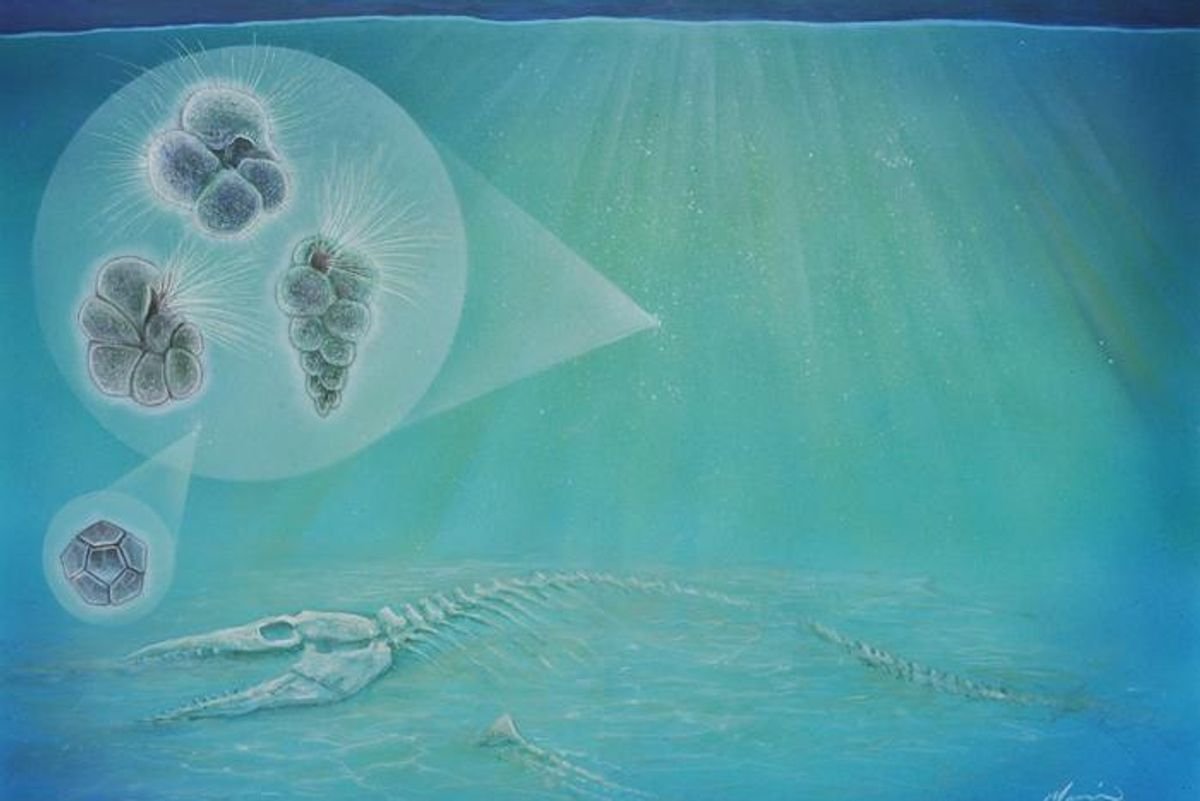
A new study published in the journal Geology has come upon evidence that life rebounded just 2,000 years after the K-Pg extinction event, which is when new species of plankton emerged. Although the asteroid impact destroyed so much life, it also set up conditions on Earth that helped plankton evolve rapidly, marking the first step in the rejuvenation of global biodiversity.
Read More: 444-Million-Year-Old Microscopic Fossils Reveal Early Seafloor Recovery After Mass Extinction
Getting Life Back on Track
The asteroid impact that caused the K-Pg extinction event left a massive crater — the Chicxulub crater — in Mexico’s Yucatan Peninsula. When it crashed down, it sent an overwhelming amount of debris into the air, reducing the amount of sunlight that reached the surface. This led to a massive reduction in plant life, which prompted a disastrous domino effect up the food chain, according to the Natural History Museum.
Some animals and plants, however, survived these trying times: Small mammals, frogs, avian dinosaurs (which would become birds), and angiosperms (flowering plants) continued living despite the bleak conditions, according to the American Museum of Natural History.
But the true sign of recovery wouldn’t arrive until new species of plankton began to appear. It was previously assumed that it took tens of thousands of years for the first new species to emerge after the impact, but the new study reframes that timeline; in reality, it actually took just a few thousand years for new plankton species to arrive.
“It’s ridiculously fast,” said lead author Chris Lowery, a research associate professor at the University of Texas Institute for Geophysics, in a statement. “This research helps us understand just how quickly new species can evolve after extreme events and also how quickly the environment began to recover after the Chicxulub impact.”
Plankton’s Rapid Recovery
The researchers behind the study recognized that sediment accumulation was a major factor in the evolution of life after the K-Pg extinction event. Sediments didn’t accumulate the same way before and after the impact, as was once believed; sediments piled up much differently in various places afterwards, due to the drop in calcareous plankton that sank to the bottom of the seafloor and increased erosion of land after the death of most vegetation.
The researchers set out to establish more accurate readings of sediment accumulation by looking at the isotope marker Helium-3 across six sites in Europe, North Africa, and the Gulf of Mexico. They matched up the age of sediments to the first appearance of a plankton species called Parvularugoglobigerina eugubina, commonly used as a marker of recovery following the impact.
They found that this specific plankton species evolved between 3.5 thousand and 11 thousand years after the impact, with the timing varying across sites. The researchers also found that some new species of plankton were cropping up even earlier, just 2,000 years after the impact. They say that between 10 and 20 species of foraminifera — single-celled organisms that float in water — appeared within about 6,000 years of the impact.
Healing Global Biodiversity
The new study shows the remarkable resilience of life, which was beginning to evolve mere thousands of years after the extinction event. Before this, plankton typically gained energy from sunlight, but when Earth entered a period of global darkness after the asteroid impact, plankton adapted by capturing and eating food in addition to using photosynthesis for sustenance, according to a 2020 study in Science Advances.
“The speed of the recovery demonstrates just how resilient life is; to have complex life reestablished within a geologic heartbeat is truly astounding,” said co-author Timothy Bralower, a professor of geosciences at Penn State University. “It’s also possibly reassuring for the resiliency of modern species given the threat of anthropogenic habitat destruction.”
Read More: Mass Extinction 445 Million Years Ago Paved the Way for Jawed Fishes to Take Over
Article Sources
Our writers at Discovermagazine.com use peer-reviewed studies and high-quality sources for our articles, and our editors review for scientific accuracy and editorial standards. Review the sources used below for this article: