
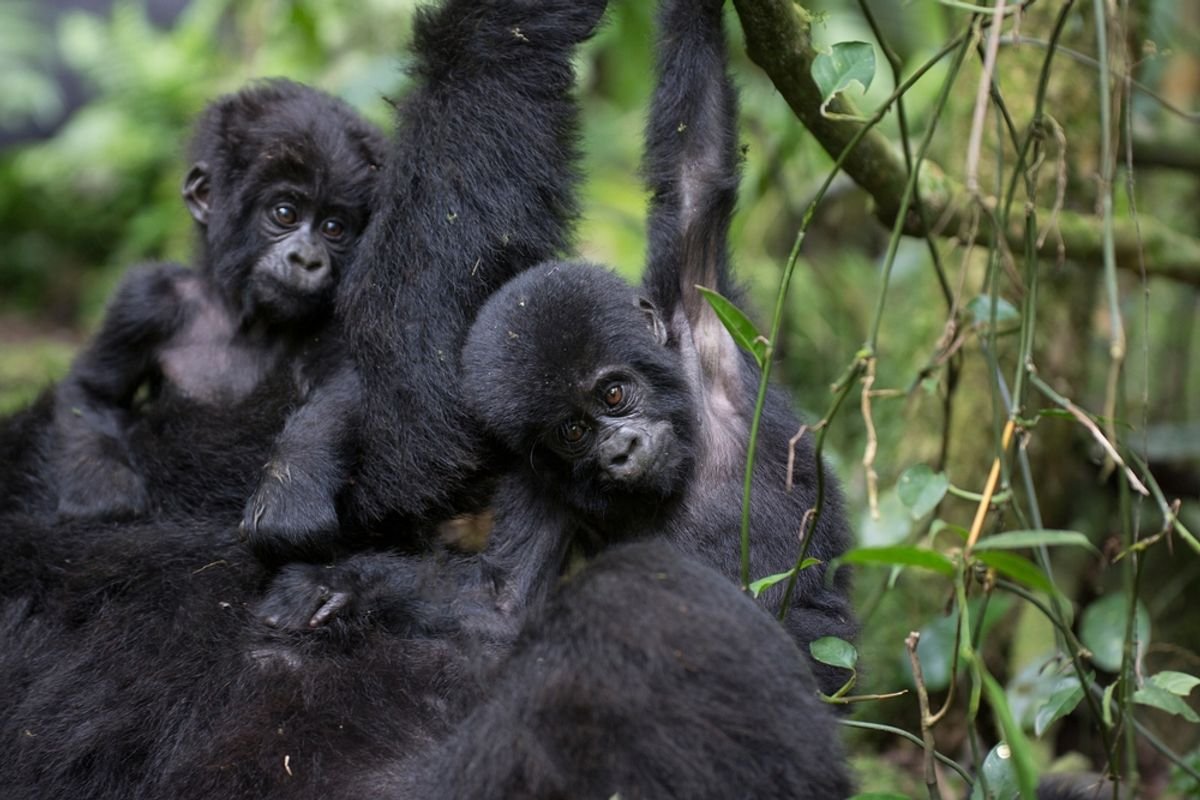
Endangered Mountain Gorillas See Rare Twin Birth in Congo’s Virunga Park

With only about 1,000 mountain gorillas left on Earth, every birth matters. But in early January, trackers in Virunga National Park in the Democratic Republic of the Congo witnessed something far more extraordinary than a single new arrival: a set of newborn twin mountain gorillas — a phenomenon seen in roughly 1 percent of gorilla births.
The twin males, born into Virunga’s Bageni family, mark the park’s first recorded births of 2026 and one of the rarest reproductive events for a species still fighting for survival. While any infant offers hope for a population rebounding from decades of poaching, conflict, and habitat loss, twins pose a unique challenge.
Read More: Scientists Are Trying to Save These Animals From Extinction
Twin Mountain Gorillas Born Into Virunga’s Largest Family
With the arrival of the twin males, the Bageni family now includes 59 members, making it the largest mountain gorilla group currently known in the park. For a species that reproduces slowly — with females carrying their young for nearly nine months and typically giving birth only every several years — group size and stability can play an important role in infant survival and long-term population growth.
Twin births, however, are especially demanding. After a long pregnancy, newborn gorillas rely entirely on their mother for nursing, warmth, and transport, remaining in near-constant physical contact during their first months of life. Carrying a single infant already requires substantial energy; supporting two while continuing to forage and keep pace with a mobile group can severely strain a mother’s strength and nutritional reserves.
Recognizing the heightened risk, Virunga’s conservation teams have intensified monitoring of the Bageni family during this critical early period.
Meet Mafuko, the Mother of the Gorilla Twins
The twins’ mother, Mafuko, was born in 2003 into the Kabirizi group. Her early life was disrupted when her mother was killed by armed individuals, after which Mafuko remained with her family alongside her sister before later joining the Bageni group in 2013.
Now 22 years old, Mafuko is an experienced mother, having given birth seven times. That includes a previous set of twins born in 2016 who survived only briefly — a reminder of how narrow the margin for success can be in twin gorilla births. Early observations suggest the new twins are healthy, but their survival will depend on maternal endurance, group stability, and uninterrupted protection during the months ahead.
Where Mountain Gorillas Live — and Why Their Habitat Is Under Threat
Mountain gorillas occupy one of the most restricted ranges of any great ape. They are found in just two regions: the Virunga Mountains, spanning parts of the Democratic Republic of Congo, Rwanda, and Uganda, as well as Uganda’s Bwindi Impenetrable National Park. This long geographic separation has left the populations largely cut off from one another, a vulnerability for a species with already low numbers and slow reproduction.
Life in these high-altitude forests is demanding. Mountain gorillas are adapted to cold, damp conditions, with thick, shaggy fur that helps them withstand temperatures that can drop below freezing. As human activity pushes farther into forested areas, gorillas are increasingly confined to higher elevations, where conditions are harsher, and food can be harder to access.
Within these environments, mountain gorillas live in close-knit social groups led by a dominant silverback. Strong social bonds help coordinate movement, feeding, and protection, while their largely plant-based diet depends on the availability of dense vegetation at lower slopes.
Despite recent population gains, mountain gorillas remain under constant pressure. Habitat loss driven by charcoal production, agriculture, and expanding settlements continues to shrink their forest range. Gorillas are also frequently injured by wire snares set for other wildlife and are highly vulnerable to human disease.
Their survival depends on intensive, daily conservation work by rangers, trackers, and veterinarians who monitor individuals, remove snares, and intervene when gorillas are sick or injured. These efforts have helped push population growth beyond the species’ natural rate, but mountain gorillas remain conservation-dependent — requiring sustained protection to ensure decades of progress are not undone.
Read More: Climate Change is Making Mountain Gorillas Thirstier
Article Sources
Our writers at Discovermagazine.com use peer-reviewed studies and high-quality sources for our articles, and our editors review for scientific accuracy and editorial standards. Review the sources used below for this article: