
Elephants Have 1,000 Delicate Whiskers on Their Trunks, and They May Transform Robotics
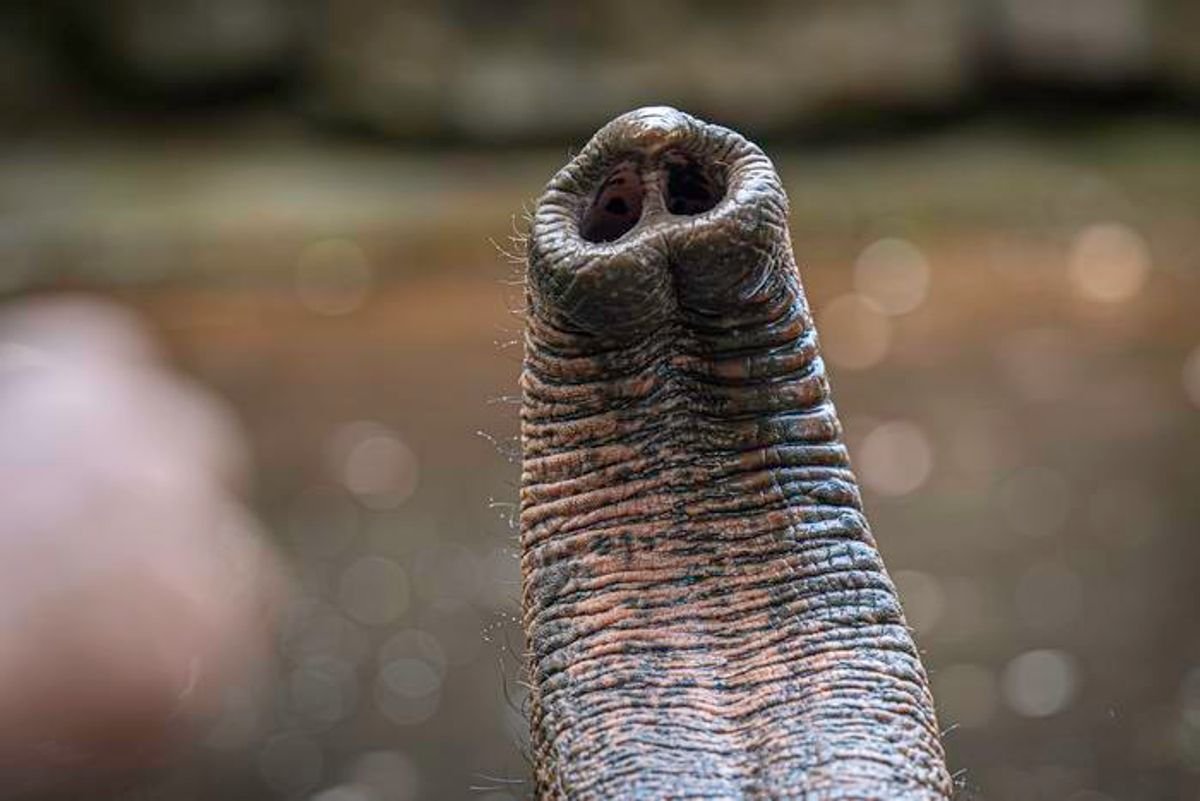
When you think of elephants, the first thing that comes to mind is likely not their whiskers. But these whiskers play a major role in the dexterity of an elephant’s trunk, and may give elephants the ability to nimbly hold a peanut without crushing it.
Scientists once believed elephant whiskers were similar to those of rats or mice, which are solid throughout and can move independently; however, researchers from the Haptic Intelligence Department at the Max Planck Institute for Intelligent Systems (MPI-IS) have found that elephant whiskers are much more complex than initially thought — a feature engineers are now exploring for use in tactile robotics.
“I came to Germany as an elephant biomechanics expert who wanted to learn about robotics and sensing. My mentor, [Professor] Kuchenbecker, is an expert on haptics and tactile robotics, so a natural bridge was for us to work together on touch sensing through the lens of elephant whiskers,” Andrew K. Schulz from the Haptic Intelligence Department at MPI-IS, said in a press release.
Read More: Elephants Ask Humans for Food Using Non-Verbal Gestures — A First in Non-Primates
Elephant’s Stiff and Soft Whiskers
According to recent findings published in Science, elephants have about 1,000 whiskers covering their trunks, and if they fall out, they often won’t grow back. The study authors found that elephant whiskers exhibit unusual material properties that enable elephants to have a heightened sense of touch despite their thicker skin.
Similar to cat whiskers, elephant whiskers are stiff at the base and gradually transition into a soft, rubbery tip. This is the opposite of mouse and rat whiskers, which are stiff all the way. This stiff-to-soft gradient, known as a functional gradient, allows elephants to pass by objects without breaking their whiskers and know where contact is precisely being made among the 1,000 whiskers.
The research team believes this functional gradient allows elephants to pick up something as small as a peanut or as delicate as a tortilla chip without breaking it.
Shrinking Elephant Whiskers Down
With this new understanding of how elephant whiskers work, the research team believes they can apply these findings to a new form of robotics — particularly in sensing technologies.
Schulz and Katherine J. Kuchenbecker — also from the Haptic Intelligence Department — along with the rest of the research team, analyzed the whiskers’ porosity, shape, and softness. Using micro-CT imaging, electron microscopy, and other techniques, the team imaged a 5-centimeter (about 2-inch) elephant whisker and scaled it down to one nanometer — 1 billionth of a meter. From there, the team created a 3D rendering of elephant whiskers and found that they are actually thick, blade-like structures with a hollow base and a flattened cross-section. The whiskers’ interior channels also resembled the structure of a horse hoof or a sheep horn.
Elephant Whisker Consistency
Further analysis also revealed that elephant whiskers are highly porous, which helps reduce their mass and prevents breakage while eating. To test the whisker’s hardness, the team used a diamond cube indenter — the size of a single cell — and found that the whisker’s base was stiff and hard as plastic, while its tip was soft and rubbery.
“The hairs on the head, body, and tail of Asian elephants are stiff from base to tip, which is what we were expecting when we found the surprising stiffness gradient of elephant trunk whiskers,” Schulz added in the press release.
Elephant Whiskers and Robotics

of. Katherine J. Kuchenbecker (left) and Dr. Andrew K. Schulz (right) with the 3D “whisker wand.”
(Image Credit: MPI-IS/W. Scheible)
Overall, these were not the results the team had expected when they first began their research. To better understand the unique properties of the elephant’s whisker, the team created a scaled-up 3D printed model. With what the team called the “whisker wand,” Kuchenbecker would carry it through the hallways of the institute and hit it on beams or railings.
“I noticed that tapping the railing with different parts of the whisker wand felt distinct — soft and gentle at the tip, and sharp and strong at the base. I didn’t need to look to know where the contact was happening; I could just feel it,” Kuchenbecker said in the press release.
To test this theory, the team created a simulation that revealed that the stiff-to-soft gradient makes it easier to feel where something is touching along the length of the whisker.
“It’s pretty amazing! The stiffness gradient provides a map to allow elephants to detect where contact occurs along each whisker. This property helps them know how close or how far their trunk is from an object…all baked into the geometry, porosity, and stiffness of the whisker. Engineers call this natural phenomenon embodied intelligence,” Schulz said.
From here, the team hopes to continue working on how these findings could be applied to robotics.
Read More: Elephants Travel Smart to Conserve Energy on Their Journeys
Article Sources
Our writers at Discovermagazine.com use peer-reviewed studies and high-quality sources for our articles, and our editors review for scientific accuracy and editorial standards. Review the sources used below for this article: