
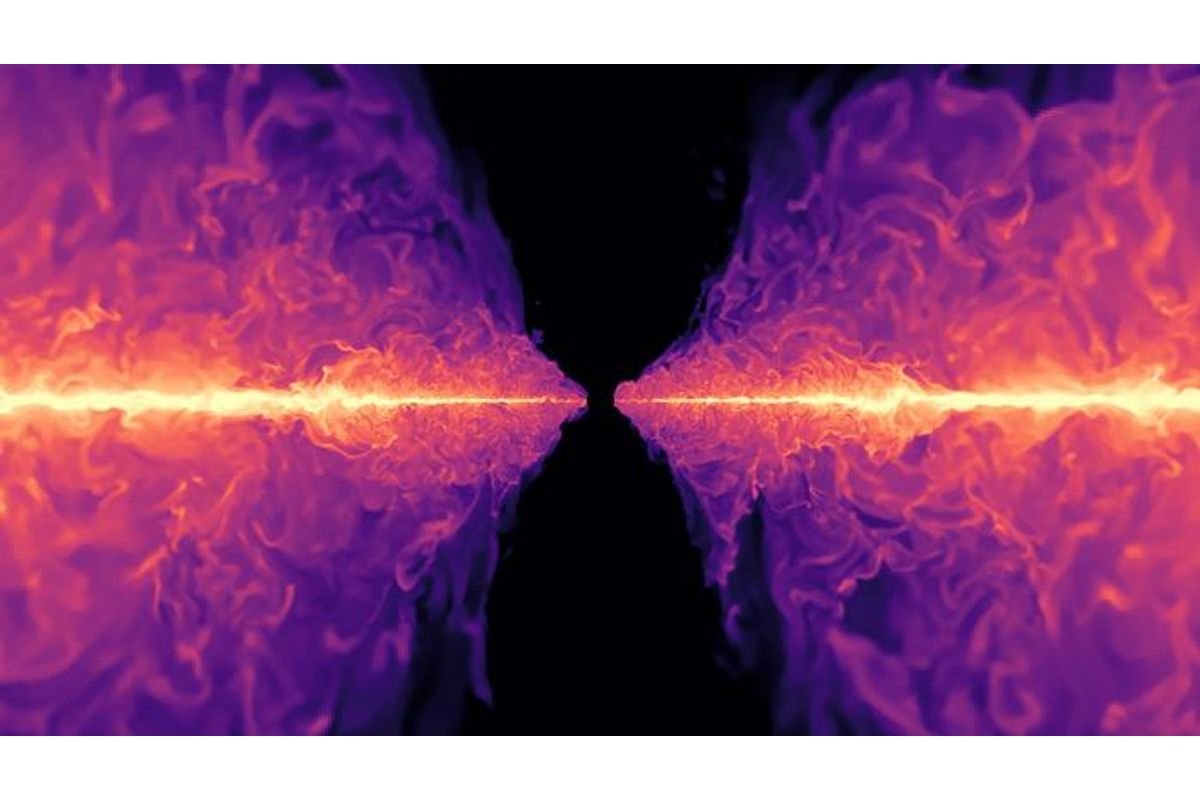
Einstein’s Theory of General Relativity Helped Create Dazzling Simulations of Stellar Black Holes

Think of a black hole, and you might imagine a literal dark hole, but contrary to expectations, these mysterious phenomena are among the brightest objects in the universe.
Now, computational astrophysicists writing in The Astrophysical Journal have built simulations capturing the magnificence of this celestial light show with unprecedented accuracy.
“This is the first time we’ve been able to see what happens when the most important physical processes in black hole accretion are included accurately,” Lizhong Zhang, lead author of the study and a research fellow at the Simons Foundation’s Flatiron Institute in New York City, said in a statement. “Any oversimplifying assumption can completely change the outcome.”
Read More: The Closest Black Hole to Earth Is Gaia BH1 at Only 1,600 Light-Years Away
A Black Centre Surrounded by a Halo of Light
The name “black hole” is misleading. Black holes are not holes but rather incredibly dense objects that contain a high concentration of matter in a relatively small amount of space and a gravitational pull so powerful that not even light can escape the event horizon, according to NASA.
They are surrounded by an accretion disk of gas and dust that has become entangled with their orbits. In contrast to the black hole at the centre, these disks are incredibly bright, spinning rapidly, causing the gas and dust particles to glow with ferocious intensity.
In a new study, a team of scientists at the Flatiron Institute and the Institute for Advanced Study used supercomputers and Einstein’s theory of general relativity to determine the behavior of material orbiting black holes with far greater accuracy than previous models.
“What’s most exciting is that our simulations now reproduce remarkably consistent behaviors across black hole systems seen in the sky, from ultraluminous X-ray sources to X-ray binaries. In a sense, we’ve managed to ‘observe’ these systems not through a telescope, but through a computer,” said Zhang.
Incorporating Einstein’s Theory Of General Relativity
Previous attempts have oversimplified the process using “approximations that treat radiation as a sort of fluid,” said Zhang, “which does not reflect its actual behavior.”
Instead, Zhang and his team incorporated Einstein’s theory of general relativity, which explains how large celestial bodies can warp the fabric of spacetime. This, in turn, influences the movement and behavior of light created by the dust and particles orbiting the black hole.
“Ours is the only algorithm that exists at the moment that provides a solution by treating radiation as it really is in general relativity,” said Zhang.
The algorithm was applied to stellar black holes with a wide range of accretion rates and spins, creating simulations that show how matter interacts to create radiation-dominated disks, vigorous jets, and powerful equatorial outflows.
The results also appear to support a leading theory that suggests little red dots (LRDs) — faint, red-tinted objects found in the early universe — are black holes consuming matter too fast. The high accretion rate causes them to emit extremely high amounts of energy.
Why Stellar Black Holes?
Stellar black holes are well-suited to the task, changing over minutes and hours rather than years and centuries (as do supermassive black holes). Furthermore, their (relatively) small size makes them harder to observe using traditional methods, underscoring the need for simulations.
While a supermassive black hole like the Milky Way’s Sagittarius A* has a mass millions and even billions of times larger than the sun, the smallest stellar black holes are equivalent to just a few suns, according to NASA.
Moving forward, the team will test their method on black holes of other types (including supermassive black holes) to see if the simulations can improve our understanding of these mysterious objects.
Read More: Two Black Hole Mergers Emitted Gravitational Waves, Upholding Einstein’s Theory of Relativity
Article Sources
Our writers at Discovermagazine.com use peer-reviewed studies and high-quality sources for our articles, and our editors review for scientific accuracy and editorial standards. Review the sources used below for this article: