
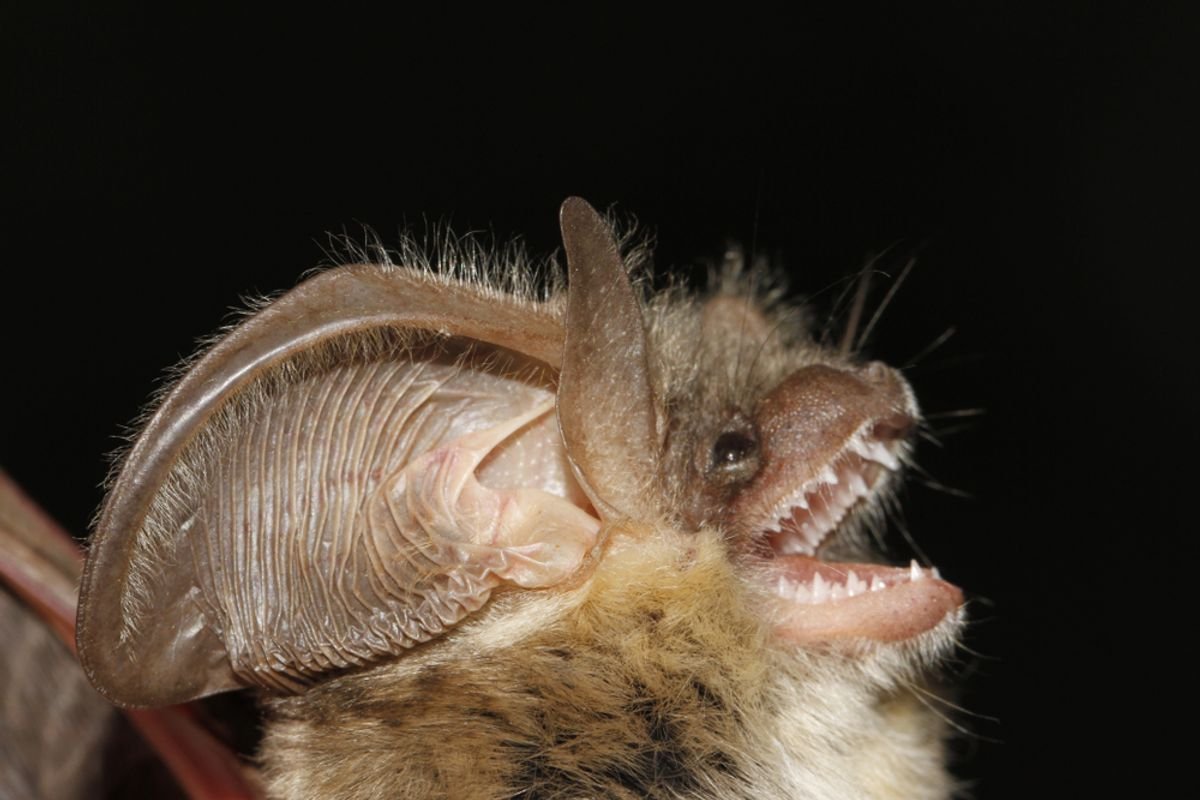
Echolocation Shapes a Bat’s Skull to Match Specific Frequencies

For a bat to be at the top of its game for echolocation, it needs a good head on its shoulders. Not all bats, though, are the same when it comes to sensing their surroundings in total darkness — some bats emit sonar waves through the mouth, while others do so through the nose. And depending on the method of echolocation, one bat’s skull may look different from another’s.
A new study published in Royal Society Open Science has found that echolocation influences the skull shape of bats in more ways than one. A bat’s skull shape hinges on how it produces sonar, as well as the specific frequencies it produces to find food or navigate environments. These factors lead to variations in several bones and ultimately determine whether a bat will have a smaller or larger skull.
Read More: Migrating Bats Surf Storm Fronts to Save Energy
Seeing Through Darkness
Bats evolved their flight and echolocation abilities over 50 million years ago, according to Bat Conservation International. They’re capable of producing high-frequency noises that bounce off various objects, and with the returning echoes, they can perceive everything in an immediate area.
Over 1,000 species of bats use echolocation, a feat that’s made possible with the larynx (or voice box); this specialized organ allows them to produce high-frequency sounds through oscillation of vocal membranes.
According to a 2022 study in PLOS Biology, the bat larynx exhibits several unique adaptations not found in other mammals, granting it an impressive seven-octave vocal range (while most mammals, including humans, have a three- to four-octave range).
To better understand the association between echolocation and bat skull shape, the researchers involved with the new study analyzed hundreds of specimens from museum collections.
“We now know that there is an association between skull shape in bats and the way they feed and how they emit sound,” said study co-author Carlo Meloro, a paleobiologist at Liverpool John Moores University, in a statement. “That’s because in bats, there is a clear dichotomy: some species emit the sound using the mouth, and other species instead use the nose.”
Fit for Different Frequencies
The researchers determined that bats known to emit sonar signals through the mouth tend to have an upwardly tilted skull, which may help project sound as they fly with their heads up.
Bats that emit signals through their noses, meanwhile, lack the same tilted skull and instead have bigger ear bones and elaborate nasal discs.
The skull differences in these two types of bats — “mouth emitters” and “nasal emitters” — relate to how they direct sonar signals. However, there is another layer of skull variation that concerns the use of higher or lower frequencies.
The researchers determined that species using higher frequencies have shorter faces, while those using lower frequencies have larger ear bones.
“This relationship had already been anticipated by several researchers, who proposed that the skull can function like an acoustic resonator,” said Meloro. Because high‑frequency sounds have very short wavelengths, they are more efficiently produced and received by smaller cranial and facial structures, whereas lower‑frequency sounds interact better with larger anatomical cavities.”
The Importance of Echolocation
The method of sonar emission isn’t the only factor affecting bats’ skull shapes; the new study also emphasized the role that diet plays in echolocation.
Bats that primarily eat insects need echolocation to target flying insects in the dark; on the other hand, fruit-eating bats rely more on other senses like sight and smell, so it was assumed that echolocation wouldn’t impact their skull shapes as much.
However, the researchers found that in both fruit-eating bats and insect-eating “nasal emitters,” species using higher frequencies usually had shorter faces. While echolocation isn’t the primary way that fruit-eating bats find food, it still helps them dodge objects and land in the right areas where fruit is present. This suggests that even across different groups of bats, the need to produce higher frequency sounds drives skull shape in a similar way.
Read More: These Bats Glow Green Under UV Light, But the Reason Is Still a Mystery
Article Sources
Our writers at Discovermagazine.com use peer-reviewed studies and high-quality sources for our articles, and our editors review for scientific accuracy and editorial standards. Review the sources used below for this article: