
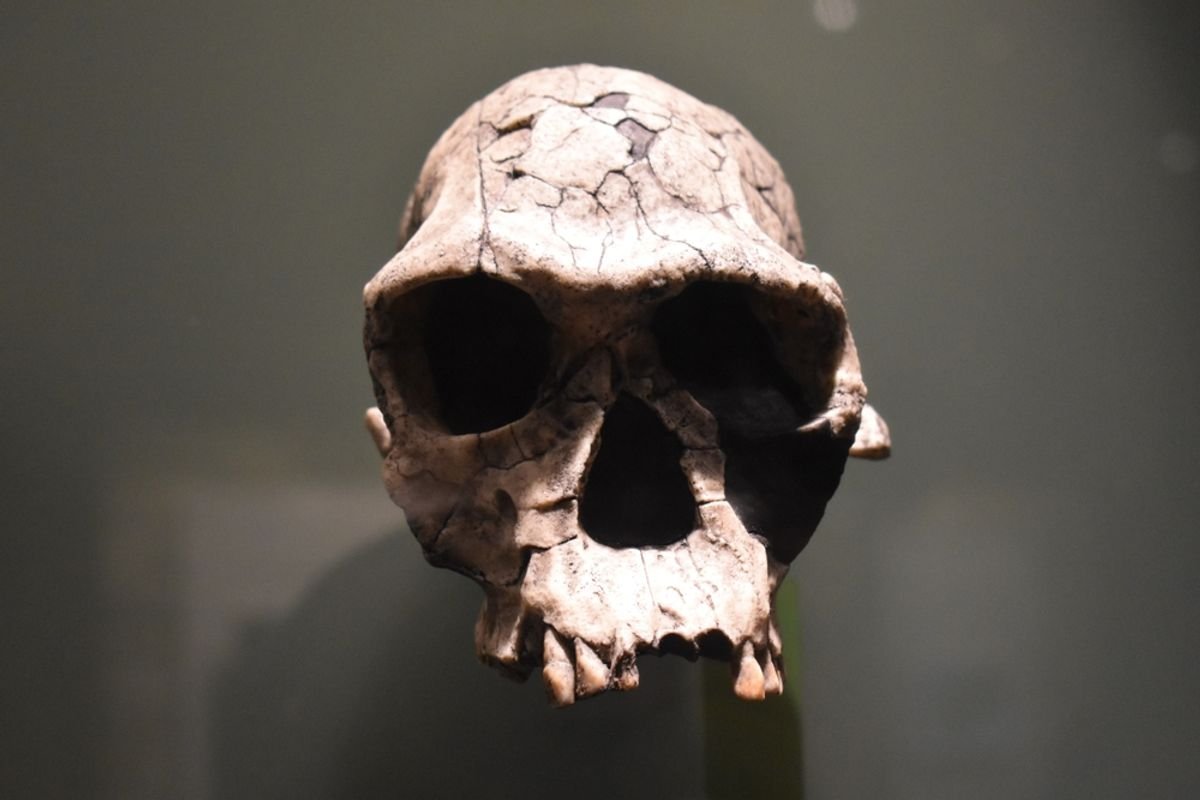
Early Human Ancestor Found to be More Leopard Prey than Predator Thanks to AI

It’s a long-held belief that one of our earliest ancestors, Homo habilis, was the first of our genus to transition from prey to predator. Archaeological evidence suggests that they were among the first meat-eaters and the first to use stone tools.
However, new research published in the Annals of the New York Academy of Sciences may change what we know about H. habilis. Thanks to AI technology, researchers have revealed that instead of preying on leopards, the leopards likely dined on H. habilis.
“AI is a game changer,” Manuel Domínguez-Rodrigo, an anthropologist at Rice University, said in a press release. “It’s pushing methods that have been stable for 40 years beyond what we imagined. For the first time, we can pinpoint not just that these humans were eaten but by whom.”
Who Was Homo habilis?
H. habilis lived in eastern and southern Africa about 2.4 million years to 1.4 million years ago. They likely only stood about 3 to 4 feet tall and were nicknamed the “handyman” due to evidence of early stone tool use.
According to the new study, H. habilis wasn’t alone. Fossil finds indicate that African Homo erectus lived alongside H. habilis about 2 million years ago. This begs the question as to which group was really the first to start using stone tools and consuming animal meat in a predatory way.
While many have agreed that H. habilis were the predators, the new study suggests that they were also the prey of leopards.
Read More: Homo Erectus: What Do We Know About Our Early Ancestors?
AI and Fossil Analysis
For this study, Domínguez-Rodrigo led a research team from Rice and the Archaeological and Paleontological Museum of Madrid, in collaboration with the Institute of Evolution in Africa (IDEA). After using AI to scan fossil remains, the team came to the conclusion that leopards likely preyed on H. habilis.
“We discovered that these very early humans were eaten by other carnivores instead of mastering the landscape at that time,” Domínguez-Rodrigo said in a press release.
The AI tools used to analyze the fossils allowed the research team to view the remains in ways they wouldn’t have been able to before using traditional methods. According to the study, Domínguez-Rodrigo is one of the first anthropologists to use AI for “taxon-specific analysis of bone surface damage.” Using these tools can help train models to identify microscopic bite marks from predators.
“Human experts have been good at finding modifications on prehistoric bones,” Domínguez-Rodrigo said in a press release. “But there were too many carnivores at that time. AI has opened new doors of understanding.”
The Future Meets the Past
During their research, the team trained AI models to identify and distinguish the bite marks between lions, leopards, wolves, hyenas, and crocodiles. After analyzing various H. habilis fossils found in Olduvai Gorge, Tanzania, the consistent bite marks were aligned with those of leopards.
These findings show that even though at that time early humans were beginning to evolve and develop the ability to use tools, they were still vulnerable to predators.
“The beginning of the human brain doesn’t mean we mastered everything immediately,” Domínguez-Rodrigo said in a press release. “This is a more complex story. These early humans, these Homo habilis, were not the ones responsible for that transformation.”
According to Domínguez-Rodrigo, there is still much to learn, and as AI advances, it could help uncover more of the mysteries around the evolution of our early ancestors.
Read More: What We Know About Homo Habilis
Article Sources
Our writers at Discovermagazine.com use peer-reviewed studies and high-quality sources for our articles, and our editors review for scientific accuracy and editorial standards. Review the sources used below for this article: