
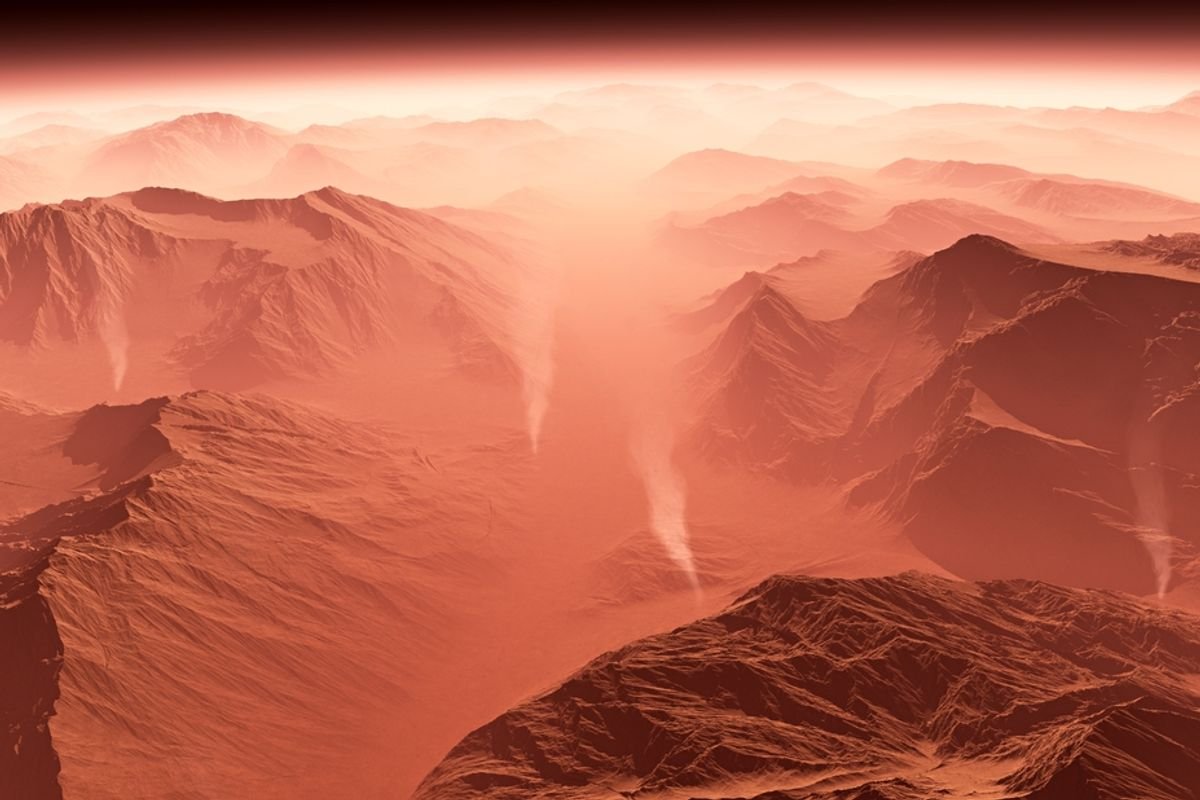
Dust Devils on Mars Crackle and Pop with Electricity, Showing How Sparks Fly in Martian Storms

Dust devils often pop up here on Earth when a column of wind whips up debris in deserts, but this frenzied weather spectacle also happens on Mars too. Although Martian dust devils may look somewhat similar to those on Earth, they’re much larger and can spin much faster.
NASA’s Perseverance Mars rover recently captured audio of dust devils, revealing the sounds of sparks and mini-sonic booms generated by swirling wind. The Perseverance recordings, as explained in a new study published in Nature, confirm that the movement of dust in these Martian mini-twisters can produce electrical discharges in the atmosphere. This discovery opens up all new opportunities in understanding Mars’ climate and the chemical reactions that take place there.
Read More: Einstein’s Theory Was Right — Mars Has Its Own Clock and It Runs Faster Than Earth’s
Dust Devils on Mars
Since Perseverance landed on Mars in 2021, its SuperCam microphone has managed to record 55 electrical events, and 16 of these occurred when dust devils passed right over the rover.
While dust devils on Earth are most prevalent in desert regions, those on Mars can happen just about anywhere on the planet. Weathering from ancient water and wind has made the entirety of the Red Planet dusty.
Dust devils on Mars materialize based on the heating of the surface from sunlight. As air is warmed when it gets close to the ground, it rises above denser, cooler air in a column. When other air fills in the space left by the rising warmer air, it starts to rotate and enters the column as well, getting so fast that the resulting whirlwind picks up dust.
Listening to Electrical Charges
Decades ago, scientists theorized that Martian dust devils could create electrical arcs as the dust grains swirled and rubbed against each other, a phenomenon known as the triboelectric effect.
“Triboelectric charging of sand and snow particles is well documented on Earth, particularly in desert regions, but it rarely results in actual electrical discharges,” said Baptiste Chide, a planetary scientist at L’Institut de Recherche en Astrophysique et Planétologie in France, in a statement. “On Mars, the thin atmosphere makes the phenomenon far more likely, as the amount of charge required to generate sparks is much lower than what is required in Earth’s near-surface atmosphere.”
Two events recorded by Perseverance were particularly notable to researchers; in the Sol 215 dust devil, the sounds of electrical activity and the dust devil itself moving over the rover were captured. In the audio of the Sol 1,296 dust devil, the researchers heard particles impacting the microphone.
These two events, along with 35 other discharges associated with dust storms, showed signs of the triboelectric effect, including sparks linked to charge separation — when two objects touch, transfer electrons, and separate.
Answers Hidden in Dust
The snaps and pops of the electrical activity in dust devils are exactly what researchers like to hear. This is because audible proof of electrical discharges on Mars could change what we know about the planet; the charges show that chemical reactions in the Martian atmosphere may be able to create oxidants, like hydrogen peroxide, that can destroy organic molecules on the surface.
Electrochemistry on Mars may also help explain why methane vanishes so rapidly on the planet, guiding scientists in the search for Martian life.
The researchers state that many unknown factors remain regarding the transport of dust on Mars and its effects on the planet’s climate. And although electrical discharges haven’t negatively impacted any robotic equipment on Mars in several decades of navigation, knowing how they work may allow scientists to pinpoint risks when facing dusty conditions during future missions.
Read More: Fine Mars Dust May Pose a Risk to Astronauts’ Health
Article Sources
Our writers at Discovermagazine.com use peer-reviewed studies and high-quality sources for our articles, and our editors review for scientific accuracy and editorial standards. Review the sources used below for this article: