
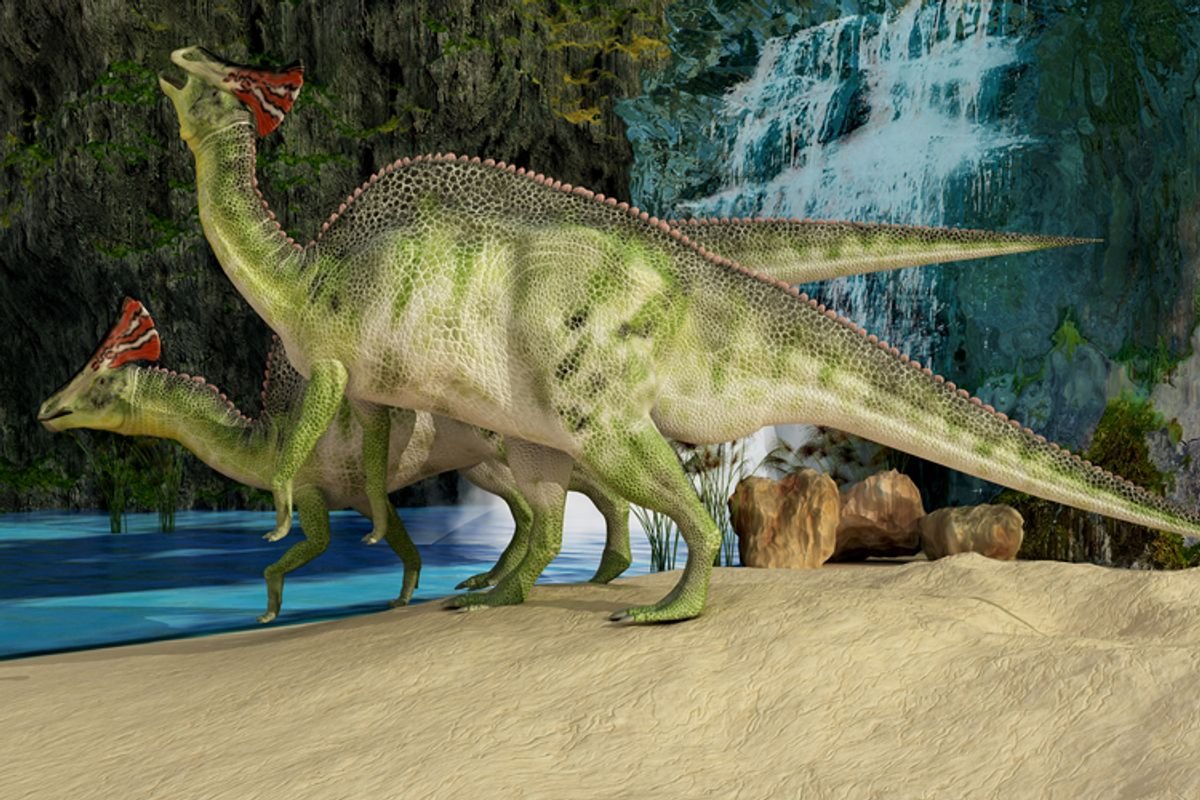
Duck-Billed Dinos Broke Their Mates’ Tails, Exposing Dinosaur Sex and Sexual Difference

The hadrosaurs had hard lives. That’s what their bones seem to suggest, anyway.
According to a new paper published in iScience, a team of paleontologists has analyzed the peculiar injuries found in the fossils of hadrosaurs, or “duck-billed” hadrosaurids. Positioned in the tails of these herbivorous dinosaurs, the injuries are probably mating injuries, the paleontologists suggest, and may provide important insights about sex and sexual difference in the Cretaceous Period, around 143 million to 66 million years ago.
“The weight of the male could have crushed the female’s back,” said Filippo Bertozzo, a paper author and a paleontologist at the Royal Belgian Institute of Natural Sciences in Brussels, according to a press release. “These injuries may help us identify female dinosaurs.”
Read More: How Did Dinosaurs Mate?
Worldwide Dinosaurs With Widespread Injuries
Whether it’s Parasaurolophus or Edmontosaurus, the fossils of these duck-billed herbivores, which are widespread today, feature trauma, tumors, and infections, and show the traces of these hardships practically wherever they’re found.
Analyzing the fossils of the hadrosaur Olorotitan arharensis in 2019, Bertozzo observed that the species’ vertebrae were frequently fractured at the tail.
“I was puzzled by that observation,” Bertozzo said in the release. “I have seen this pattern in other similar species, but only in isolated vertebrae. Here, the fractures were visibly concentrated in the vertebrae at the upper end of the tail, without extending down to its tip.”
Hoping to learn more about this phenomenon, Bertozzo turned to Darren H. Tanke, another paper author and a paleontologist at the Royal Tyrrell Museum of Palaeontology in Alberta, who has studied the tail injuries of hadrosaurids from Canada and has identified these injuries as possible outcomes of a fundamental hadrosaur activity.
“In contrast to other dinosaurs, hadrosaurids show fractured tail vertebrae in an area close to the likely location of the cloaca,” Tanke said in the release, referring to the opening of the reproductive system in dinosaurs and other reptiles. “This led me to propose the idea that these injuries were inadvertently caused during mating.”
Though Tanke’s idea was previously predicated on a small sample of specimens, Bertozzo’s discovery presented an opportunity to strengthen the theory, with fossils from around the world.
“Darren is the father of this hypothesis,” Bertozzo added in the release. “I cannot forget the look of surprise on his face when I told him I had discovered the same pattern in other hadrosaur remains outside Canada.”
Read More: How Did Dinosaurs Have Sex, Anyway?
Tough on the Tail
To test out the mating hypothesis, therefore, Bertozzo, Tanke, and a team took stock of around 500 vertebrae from hadrosaurs found worldwide. After studying the broken bones and applying a combination of statistical and stress analyses, the paper authors concluded that the same sorts of injuries were seen across species and were seemingly sustained through the application of pressure from above.
“Once we obtained the results, we had to consider every scenario,” said Simone Conti, another paper author from the NOVA School of Science and Technology in Lisbon, according to the release. “At the end, the mating hypothesis was the one that correlated best with our observations.”
While the theory itself indicates a certain amount of aggression in hadrosaur mating, with the males mounting the females and pressing on the upper parts of their tails, the fractures themselves tended to heal over time, with some specimens showing signs of recurring injury.
According to the team, the results reveal mating practices among hadrosaurids and open new avenues for detecting sexual dimorphism in Cretaceous dinosaurs, whose reproductive tissues are rarely preserved as fossils.
“If the mating hypothesis is correct,” Bertozzo concluded in the release, “we can infer that an individual with the injuries is female. This will be a game-changer since it will enable other questions to be answered about the differences between male and female dinosaurs. Did they have differently shaped skulls? Can we discover sexually dimorphic features that will help us understand the social structure of [a] hadrosaur herd?”
Read More: Theropod Dinosaurs Met to Dance, Mate, and Nest in Colorado About 100 Million Years Ago
Article Sources
Our writers at Discovermagazine.com use peer-reviewed studies and high-quality sources for our articles, and our editors review for scientific accuracy and editorial standards. Review the sources used below for this article: