
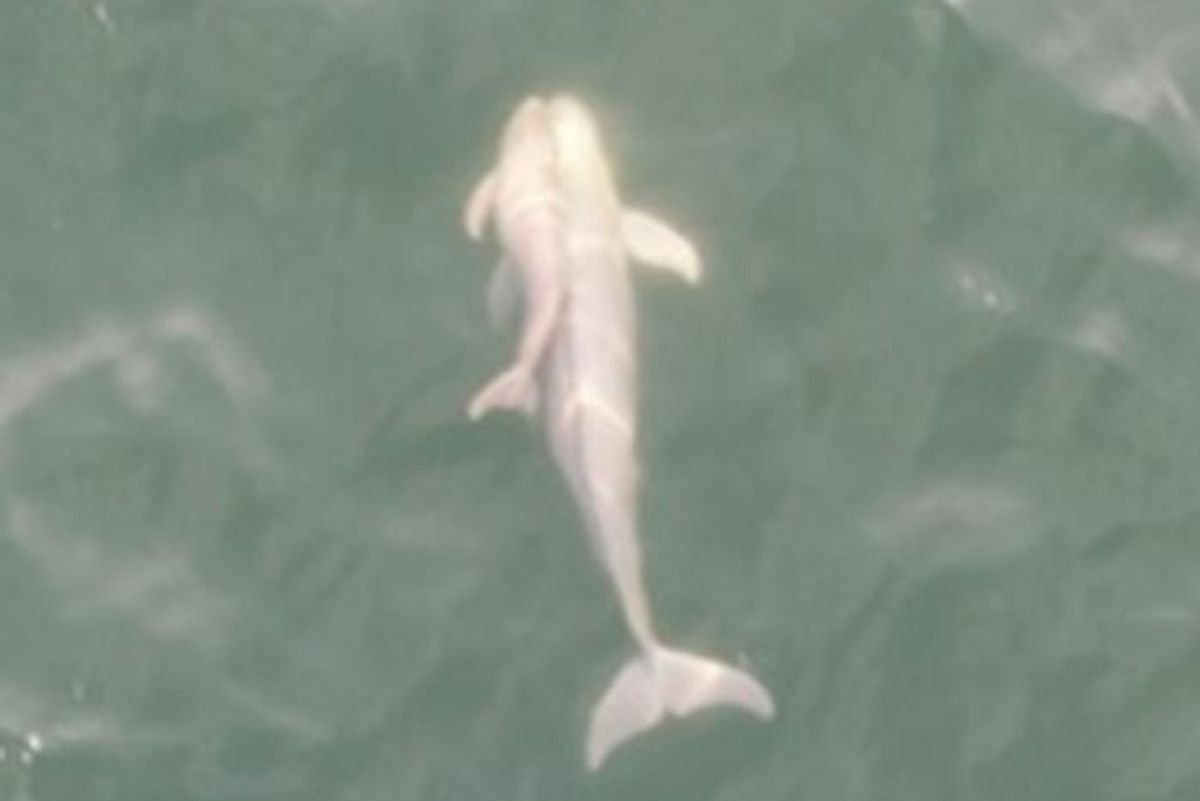
Drone Footage Captures Rare Moments of Finless Porpoises Caring for Others’ Calves

Finless porpoises have generally been regarded as loners. They are usually seen alone or in simple pairs, most often a mother swimming with her calf, leading researchers to assume the animals have relatively simple social lives.
But drone footage from Japan is challenging that idea. Researchers observed what appear to be allomaternal interactions, with porpoise calves approaching and swimming alongside adults that were not their mothers. The behavior, reported in the journal Mammal Study, suggests the species may be more social than previously believed.
“Allomaternal behaviors may be beneficial for neonates in the development of social relationships and/or as a supplement to the weaker mother-calf relationships that are typical of this vulnerable developmental stage,” said lead author Mai Sakai in a press release.
Read More: Like Kindergarten Buddies, Male Dolphins That Keep Friendships Can Live Longer
Allomaternal Care in Finless Porpoises
In many social mammals, infants are cared for by more than just their mothers.
Other adults, often young females without calves of their own, sometimes handle, guard, or swim with infants. This behavior, known as allomaternal care, has been observed in animals ranging from primates to dolphins.
For the young, these interactions can provide protection or help them learn social skills. For the adults, it may offer practice before raising their own offspring. And for mothers, it may allow them more time to forage for food.
Allomaternal behavior has been documented in many toothed whales, including dolphins and porpoises. But the narrow-ridged finless porpoise has remained an exception. Because these animals rarely form large groups, it was assumed such cooperative behavior was unlikely.
Tracking Finless Porpoise Calves
To investigate how these porpoises interact, Sakai and colleagues used consumer-grade drones to observe animals in Ise Bay, Japan.
Over 34 days between February and July 2023, the team recorded aerial footage of porpoises swimming near the surface. The goal was to identify instances in which an infant interacted with more than one adult within a single observation.
Those moments could indicate that the infant was spending time with a non-maternal adult. In four cases, the researchers observed groups consisting of one infant and two adults.
During many of these interactions, the infant swam parallel to an adult — a behavior researchers call parallel swimming. In every case, the infant stayed along the adult’s side.
This position may help the calf keep pace while using less energy, as the adult’s movement through the water reduces resistance.
Less Solitary Than Once Thought
Most of the time, calves approached nearby adults rather than the other way around, possibly seeking protection or an easier ride through the water. In two cases, however, adults moved toward the calves.
Those adults may have been young females without offspring, although the drone footage did not allow the researchers to confirm their sex.
The calves also spent less than 40 percent of their time swimming beside any single adult — far less than the time calves typically spend alongside their mothers in other dolphin species. That pattern suggests finless porpoises may form looser mother–calf bonds than many other toothed whales.
Despite this, the interactions challenge the long-standing idea that the species lives mostly solitary lives. The study also shows how simple drone technology can help track marine animals without disturbing them.
The finding could also matter for conservation. If other adults sometimes interact with calves, those relationships might help orphaned young survive.
“To understand allomaternal behavior in species with simple social structures, future studies need to evaluate the cost-benefit relationship for mothers, calves, and non-maternal adults,” Sakai concluded.
Read More: Much Like Humans, Dolphin Pods Have Complex Social Structures
Article Sources
Our writers at Discovermagazine.com use peer-reviewed studies and high-quality sources for our articles, and our editors review for scientific accuracy and editorial standards. Review the sources used below for this article:
This article references information from a study published in the journal Mammal Study: Observations of Changing Partners During Parallel Swimming Behavior Between Neonatal and Adult Finless Porpoises (Neophocaena asiaeorientalis) in Ise Bay, Japan