
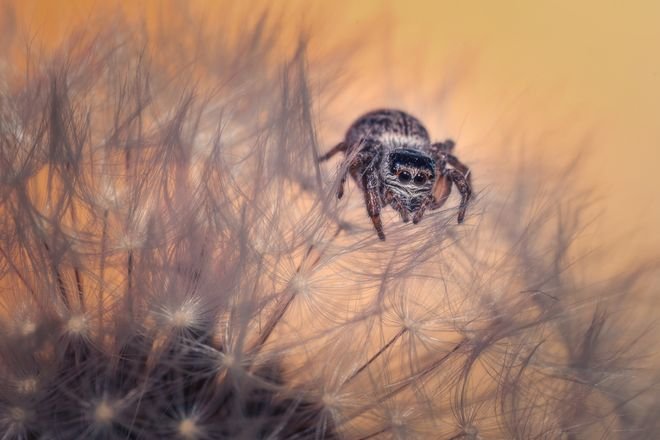
Do Spiders Sleep? Research Says Yes, and They May Even Dream

Key Takeaways on if Spiders Sleep:
-
Yes, spiders sleep. Sleeping behavior is very noticeable in jumping spider species that dangle from their silk at night.
-
Experts can tell spiders are “sleeping” based on a series of body twitches that appear similar to Rapid Eye Movement (REM) sleep in humans.
-
While we cannot ask spiders if they’re dreaming, the behaviors they exhibit during their REM sleep are similar to what humans do when they are dreaming, leaving many to believe that spiders indeed dream.
Science has not found an animal that doesn’t sleep, though some animals have wildly varying ways of getting their shut-eye. Elephants sleep only about two hours a day, while koalas can sleep as much as 20 hours out of 24. Sea otters hold hands with each other while sleeping. Dolphins snooze with half their brains asleep, the other half awake. And humans, of course, famously toss and turn and fret about how little sleep they’re getting. However they go about it, most — likely all — animals sleep, including arachnids.
A few years ago, in an article in Science, Washington University neuroscientist Paul Shaw put it this way: “I think if it’s alive, it sleeps.”
Still, not many animals have been studied to see if they sleep, and most of those whose sleep has been studied are mammals. Until recently, spiders were not invited to the sleep lab.
Do Spiders Sleep?
Despite the lack of experimental evidence that spiders sleep, it was known that they at least take some downtime. Evarcha arcuata is a common European jumping spider that hunts during the day and settles down to chill at night.
A few years ago, Daniela Rößler, then at Harvard University, and colleagues described how this little jumping spider rests at night by dangling upside down from a line of silk attached to vegetation.
Read More: Sea Otters Hold Hands While Sleeping and They Even Cuddle
What Happens While Spiders Sleep?
In a paper published the following year, Rößler, now at the University of Bonn and the Max Planck Institute of Animal Behavior in Konstanz, Germany, closely examined the events that occurred during these rest periods.
In many animals, including humans, sleep alternates between quiet and active periods. During the active phases, breathing can be irregular, muscles often twitch, and, most famously, the eyes dart about, a state called Rapid Eye Movement (REM) sleep, the phase in which, in humans at least, most dreaming occurs.
Do Spiders Sleep While Dangling From Their Webs?
Rößler found that jumping spiders, dangling from their silk threads, did show evidence of active and quiet phases while resting. During the active periods, their legs curled, and their spinnerets and legs twitched.
E. arcuata turned out to be a great spider for looking for evidence of REM sleep as well. Unlike most insects and spiders, jumping spiders have movable retinal tubes they use to direct their gaze here and there, and because the young spiders are translucent, those movements can be observed directly in spiderlings.
And indeed, Rößler and her team were able to see that the tiny retinal tubes moved around during the active phases. They called these periods “REM sleep-like states.” (She won’t be willing to call it sleep until she’s published all her evidence of sleep in spiders, including a paper now in pre-print.)
Spiders May Be Dreaming
Does this mean the spiders are having visual dreams during these phases?
“This will most likely stay a mystery forever,” says Rößler, pointing out that even in humans, the only way we know for sure that someone is dreaming is to ask them. “Unless we manage to talk to spiders in the next 100 years, we will not know for sure.”
However, researchers could, she says, design experiments that would test whether spiders process previous experiences during the REM phase. This would involve tracking eye and limb movements during a task and then determining if those movements were repeated during REM sleep.
“This could indicate a behavioral replay or sensory processing, but still would not allow us to know for sure if they experience visual dreams,” Rößler says.
Spiders Probably Need Sleep Like the Rest of Us
Rafa Rodríguez is a researcher at the University of Wisconsin-Milwaukee who studies spiders, their memory, and behavior. There are metabolic reasons for sleep, such as repair of mitochondria, and sleep is also crucial for memory consolidation and in the formation of long-term memory, Rodríguez points out. Even jellyfish have periods of quiescence when they’re slower to respond to stimuli, he says.
“There’s nothing going on [in jellyfish] that we would think of as what a brain would do, yet even a simple network like that needs sleep.” So it’s not surprising that spiders sleep.
But do they dream? Rodríguez says he would not have guessed that before reading Rößler’s paper. But now? “I’m persuaded that they’re dreaming.”
Read More: Can Animals Have Sleep Disorders?
Article Sources:
Our writers at Discovermagazine.com use peer-reviewed studies and high-quality sources for our articles, and our editors review for scientific accuracy and editorial standards. Review the sources used below for this article: