
Do Octopuses Dream? Their Colorful, Skin-Changing Sleep Cycles May Hold the Answer
If you’ve ever wondered if octopuses dream, science has a fascinating answer. When these eight-armed masters of disguise fall asleep, they don’t simply settle into a quiet snooze. Instead, they occasionally burst into short episodes where their arms twitch, their breathing quickens, and their skin ripples with vibrant, shifting colors.
According to research published in Nature, these dazzling sleepy-time displays aren’t just for show. They may actually reveal that octopuses experience a form of dream-like sleep surprisingly similar to our own.
Read More: The Curious Traits of an Octopus: How Do They Experience the World?
How Scientists Studied the Sleeping Octopus Brain
To figure out what was really happening during these dramatic sleep bursts, scientists first needed to confirm that the octopuses were actually asleep. To do this, they gently prodded them during their calm and active sleep phases and discovered that the octopuses needed stronger stimulation to react compared to when they were awake. This lack of reaction was confirmed as the hallmark of genuine sleep.

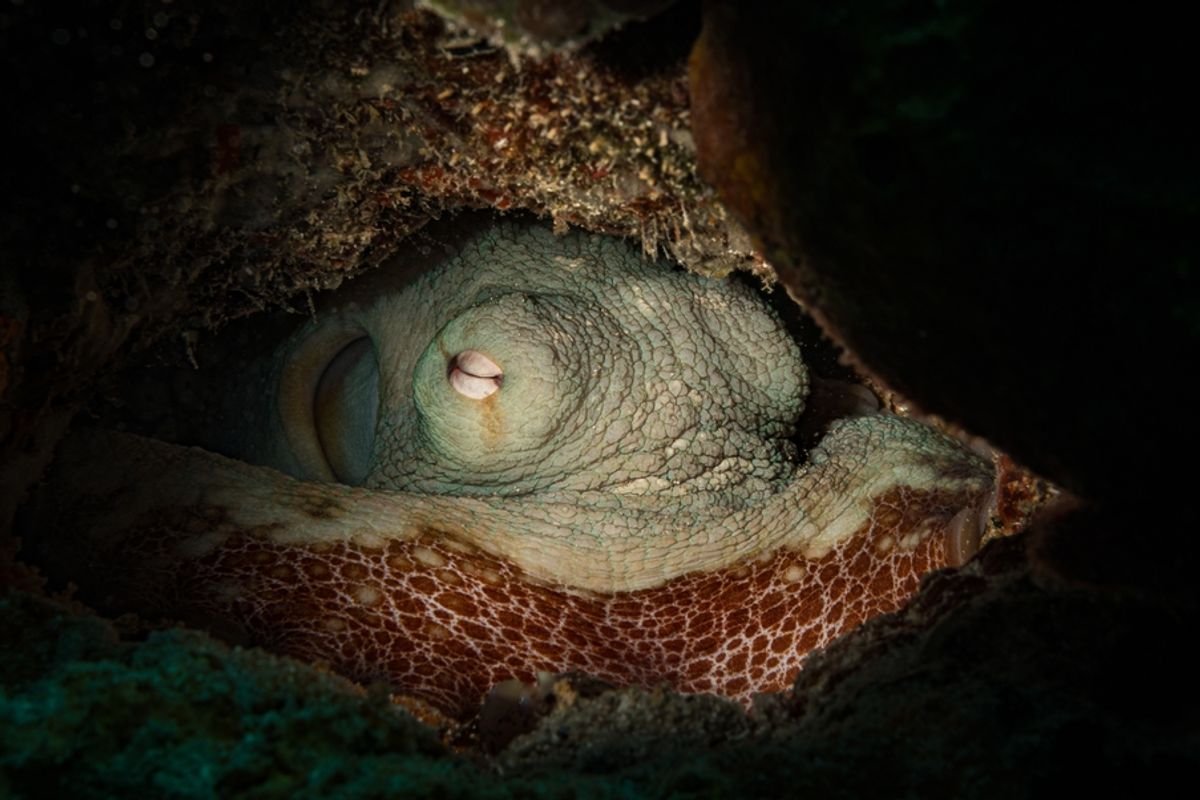
During quiet sleep, octopus laqueus appears white and motionless. This quiet sleep is punctuated by bursts of sleep that show wake-like activity (active sleep) roughly every hour.
(Image Credit: Keishu Asada (OIST))
With sleep status confirmed, the research team began tracking the octopuses’ brain activity while awake and asleep. During the phase known as quiet sleep, the team observed neural activity that resembled mammalian “sleep spindles” — a brainwave pattern seen in humans during non-REM sleep. Though the function of sleep spindles remains a mystery even in humans, many scientists suspect they help cement memories. Using a high-resolution microscope, researchers found that these spindle-like waves occurred in brain regions linked to learning and memory in octopuses as well.
About once an hour, though, everything changed. Each octopus would enter a roughly one-minute burst of activity where their neural patterns suddenly matched what the team saw when the animals were awake — patterns reminiscent of human REM sleep.
“The fact that two-stage sleep has independently evolved in distantly related creatures, like octopuses, which have large but completely different brain structures from vertebrates, suggests that possessing an active, wake-like stage may be a general feature of complex cognition,” explained Leenoy Meshulam, a statistical physicist at the University of Washington, in a press release.
Do Octopuses Really Dream?
One of the most alien aspects of an octopus is its skin. Octopuses control an astonishing collection of pigmented skin cells that produce dramatic patterns used for camouflage and communication. To watch how these patterns appeared during sleep, the research team filmed the octopuses in ultra-high 8k resolution.
“By filming in such high resolution, we can see how each individual pigmented cell behaves in order to create an overall skin pattern,” said Meshulam. “This could help us create simple skin pattern models to understand the general principles of waking and sleeping patterning behavior.”
When looking at the footage, the research team was surprised by what they found. During active sleep, the octopuses cycled through those same skin patterns as when they were awake, suggesting they may be experiencing dreams that influence their skin color to change while sleeping.
What Do Octopuses Dream About?
One explanation for this behavior is practical: perhaps they are rehearsing camouflage using something like muscle memory. Another explanation suggests the changes in skin patterning during sleep may actually be a sign that the octopuses are dreaming. In this state, the octopus may be reliving real experiences from their day, triggering the skin patterns linked to the memory of evading a predator or stalking prey.
“In this sense, while humans can verbally report what kind of dreams they had only once they wake, the octopuses’ skin pattern acts as a visual readout of their brain activity during sleep,” notes senior author Sam Reiter.
The findings suggest that complex sleep, complete with a REM-like dream phase, has evolved in surprising ways and may not be exclusive to mammals.
Read More: Dogs Do Dream, and It’s Most Likely About Their Toys, Food, and You
Article Sources
Our writers at Discovermagazine.com use peer-reviewed studies and high-quality sources for our articles, and our editors review for scientific accuracy and editorial standards. Review the sources used below for this article: