
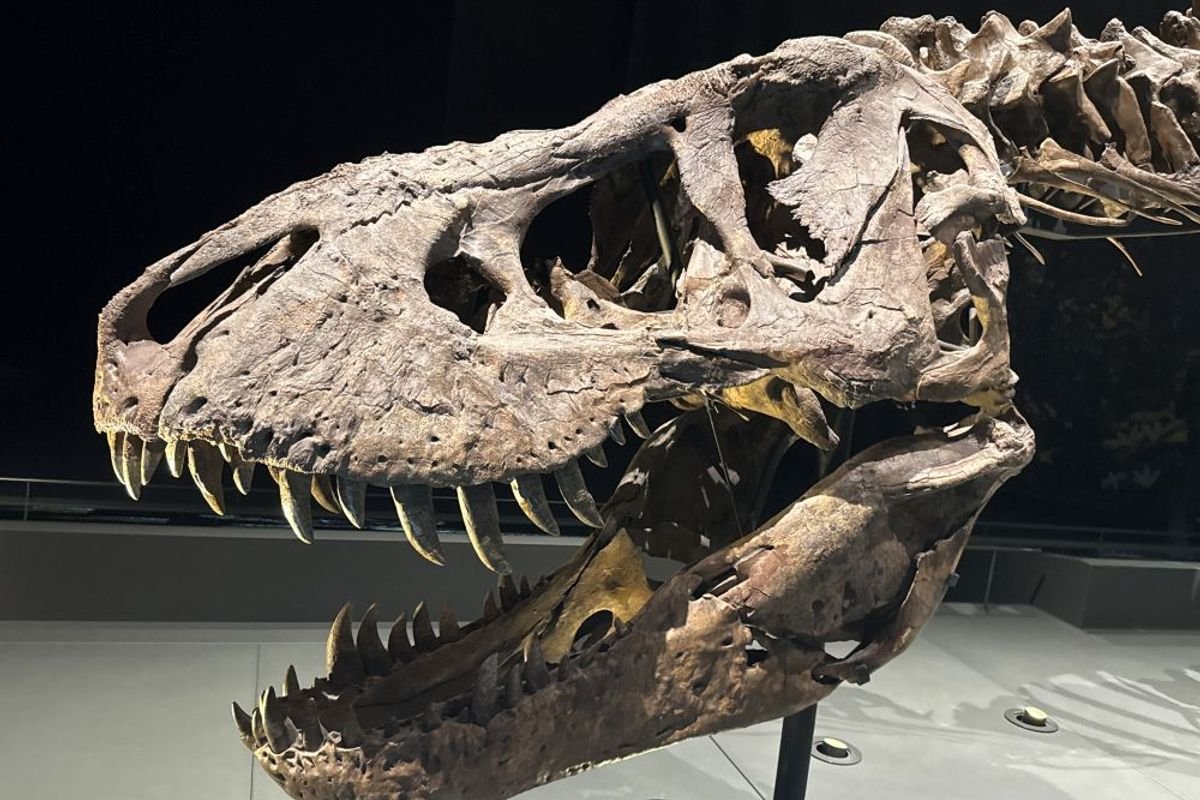
Did the T. rex Actually Evolve in America? A 74-Million-Year-Old Shin Bone Suggests It May Have
Imagine stumbling across a fossilized shinbone so massive it nearly rivals that of “Sue,” the most famous Tyrannosaurus rex ever unearthed. That is exactly what paleontologists are grappling with after analyzing a 74-million-year-old leg bone pulled from New Mexico’s Kirtland Formation.
As explained in Scientific Reports, this new prehistoric heavyweight tipped the scales at an estimated 10,000 pounds, making it the largest tyrannosaur from the Late Campanian epoch ever recorded.
But this colossal discovery is more than just a record-breaker. It might be the crucial puzzle piece needed to solve one of paleontology’s most enduring debates: the true evolutionary origins of the tyrant lizard king.
“Here, we report a giant tyrannosaur dating to approximately 74 Ma, from the late Campanian of New Mexico. This represents the oldest known giant tyrannosaur from North America and may represent the oldest known member of the Tyrannosaurini,” said the study’s authors.
Read More: The T. Rex Dined on Huge, Plant-Eating Dinosaurs — and Each Other
Why Experts Believe This is a Tyrannosaur Ancestor

Tyrannosaur tibia
(Image Courtesy of Nick Longrich)
Discovered in the Hunter Wash area, this isolated tibia measures an impressive 960 millimeters (about 37 inches) long and 128 millimeters (about 5 inches) across. To put that into perspective, it’s roughly 84 percent the length and 74 percent the width of Sue’s massive shin.
Upon analysis, researchers initially considered three distinct possibilities for the bone’s identity. One theory was that it belonged to an oversized Bistahieversor sealeyi, another known local species. This theory is unlikely as the new specimen is double the weight of a typical Bistahieversor, features a straight bone shaft, and boasts a unique triangular shape at its lower joint — traits the smaller local species lacks.
Another theory suggested that it might be an entirely separate, unknown lineage of giant predators that independently grew to massive sizes.
Overall, the evidence strongly favors the third — and most exciting — option: this creature is likely an early member of the Tyrannosaurini, the elite biological group that includes T. rex and its Asian cousins, such as Tarbosaurus. The incredibly robust, straight leg bone perfectly matches the hallmark physical traits of this formidable family.
“Regardless of what hypothesis is adopted, the unusual size of the Hunter Wash tyrannosaur is significant, as it represents a previously unrecognized appearance of large tyrannosaurids in the late Campanian, and shows that they evolved earlier than previously believed,” said the study authors.
Rewriting the Story of Dinosaur Evolution
The family tree of these late-stage, apex predators has always been slightly murky. Did the iconic Tyrannosaurus lineage migrate over from Asia, or was it born and bred in North America?
The sheer scale and age of this New Mexico fossil lend serious weight to the idea that these giants actually evolved right here in the southern U.S. When combined with other recent discoveries of massive predators in Texas and New Mexico, the southern origin story is becoming increasingly difficult to argue against.
“Competing theories have favored an origin of T. rex either in Asia or North America, specifically southern Laramidia. While models have been put forth regarding the non-North American origins of tyrannosaurs, this study shows that these models must account for this large, derived tyrannosaur from the Campanian of New Mexico,” explained the study’s authors.
The Missing Piece of the Prehistoric Puzzle
While this solitary shinbone offers a glimpse into the Late Cretaceous period, scientists need more to close the book entirely. To definitively identify this ancient beast and accurately place it in the tyrannosaur family tree, the research team hopes to find more complete skeletal remains.
Until a skull or additional limbs are recovered, the dusty rock beds of the American Southwest will remain a crucial location for unraveling the mysterious history of Earth’s most famous predators.
Read More: Tyrannosaurus Rex Took 40 Years to Grow Up, Fossil Bones Reveal
Article Sources
Our writers at Discovermagazine.com use peer-reviewed studies and high-quality sources for our articles, and our editors review for scientific accuracy and editorial standards. Review the sources used below for this article: