
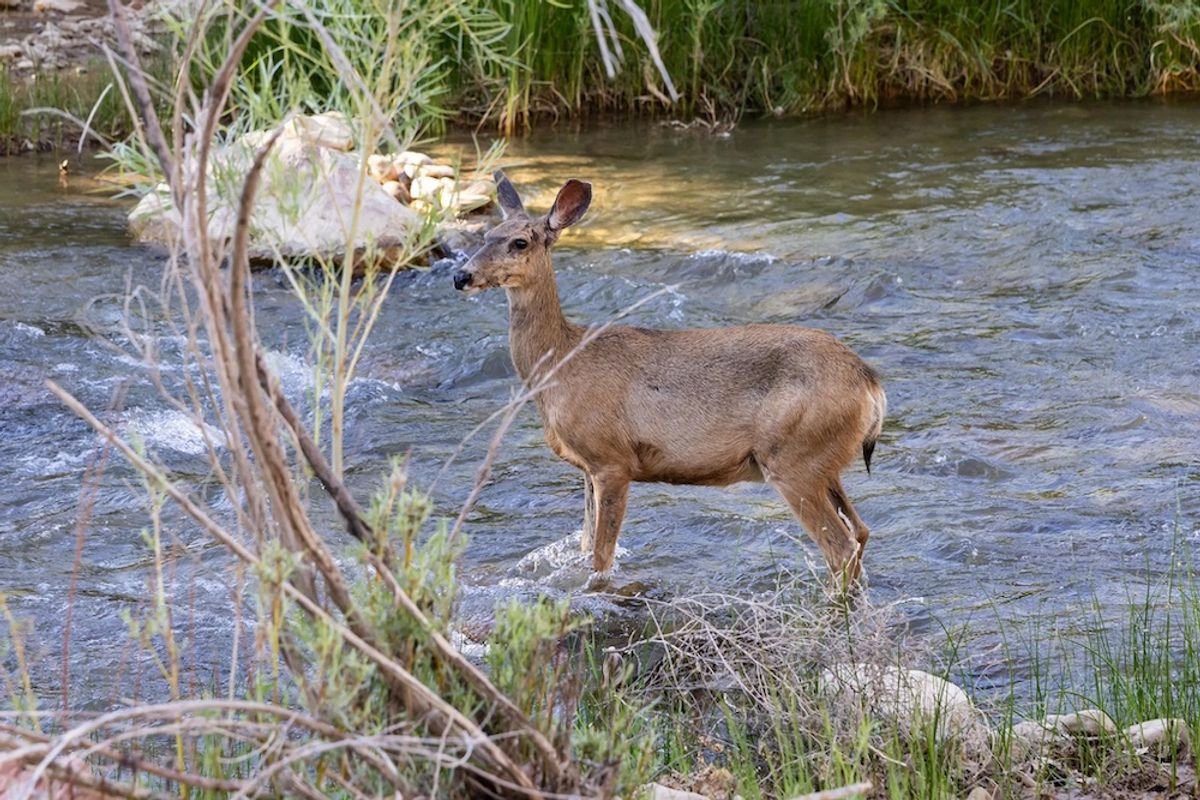
Deer May Leave Glowing Scent Marks to Find a Potential Mate
Single deer may not strike up a conversation to get to know each other as we do, but they’ve found an unusual way to secretly communicate with lovers that, until now, evaded human detection. Deer are famously discreet, relying on scent to advertise their presence and mating interest. But researchers from the Warnell School of Forestry and Natural Resources at the University of Georgia (UGA) have discovered that those scent markings not only smell but also glow.
According to the study published in Ecology and Evolution, scrapes and rubs left behind by deer emit photoluminescence, making them visible to other deer during dusk and dawn. Detectable under natural low-light conditions, these glowing clues suggest deer intentionally place visual signals to help find mates, revealing that even well-studied mammals still hold surprises.
“The scrapes become a communication hub where other deer will visit it after it’s created and contribute to it,” said study co-author Gino D’Angelo, associate professor in the Warnell School, in a statement. “It’s like a phone booth out in the city when trying to make nighttime plans at a meeting point.”
Deer and a Glowing Forest
Ultraviolet-induced photoluminescence is widespread in mammals, yet its purpose remains largely unclear. While several theories exist about glowing environmental markings, deer had never been part of that conversation, explained lead author Daniel DeRose-Broeckert, a research associate in the UGA Deer Lab, in the news statement.

Glow from deer signatures from rubs and scrapes.
(Image Courtesy of Daniel DeRose-Broeckert)
To explore that connection, the research team surveyed an 800-acre research area in Whitehall Forest, just four miles from downtown Athens, Georgia. They focused on deer signposts, which are specific locations where animals intentionally leave scent, usually by rubbing their antlers on vegetation or scraping the ground before urinating.
After nightfall, the researchers returned with ultraviolet lights. Across the forest, they analyzed 109 antler rubs and 37 urine-marked scrapes. Both types showed strong ultraviolet signatures compared to their surroundings within the spectrum visible to deer.
Read More: Glow-in-the-Dark Succulent Plants May Lead to Glowing Trees Replacing Streetlights
Deer Can See in the Ultraviolet Light Spectrum
The glow appears to come from multiple sources. Antler rubs likely luminesce due to a mix of plant compounds, such as sap, and secretions from the deer’s forehead glands. Scrapes probably glow because of urine.
“As we got closer to breeding season, those markings increased in visibility as deer prepared for it,” said DeRose-Broeckert.
The team believes these glowing marks serve as a visual extension of an already scent-heavy communication system. Deer vision is uniquely adapted for low-light environments, making ultraviolet cues especially noticeable at dawn and dusk.
“Their vision is vastly different from ours. Once the sun is slightly gone around dusk and dawn, the UV light dominates for deer since it’s not being washed out by the visible light spectrum from the sun,” added DeRose-Broeckert.
Until now, most research on mammalian photoluminescence has focused on glowing fur or skin. Environmental photoluminescence has received far less attention.
A Glowing Message Board
When a deer creates a scrape or rub, it deposits chemical cues that convey identity and reproductive status directly into the landscape.
The scientists suggest that the ultraviolet glow likely helps deer locate hubs in low-light conditions when they’re most active. Rather than replacing scent-based communication, the glow enhances it, providing a visual shortcut to places rich in social and reproductive information.
Read More: Photoluminescence Makes These Mousy Australian Mammals Glow
Article Sources
Our writers at Discovermagazine.com use peer-reviewed studies and high-quality sources for our articles, and our editors review for scientific accuracy and editorial standards. Review the sources used below for this article: