
Dark Matter May Exist in Two States, Explaining Missing Signals in Dwarf Galaxies

What if not finding something is actually a clue? In the search for dark matter, missing signals in some galaxies may help explain what’s being detected in others.
At the center of the Milky Way, telescopes have picked up an unusual glow of gamma rays, the most energetic form of light. One possible explanation is that dark matter particles are colliding and destroying each other, releasing bursts of energy in the process. Yet the same signal hasn’t appeared in other places where it should.
That mismatch has become one of the biggest sticking points in interpreting the signal. If dark matter is responsible, why doesn’t it show up everywhere?
A new model outlined in the Journal of Cosmology and Astroparticle Physics offers a different way to think about that question. Instead of assuming dark matter behaves the same across the universe, the work suggests its signals may depend on local conditions, appearing in some galaxies while remaining undetectable in others.
“What we’re trying to point out in this paper is that you could have a different kind of environmental dependence,” explained Gordan Krnjaic in a press release. “Dark matter could straightforwardly be two different particles, and the two different particles need to find each other in order to annihilate.”
Why Dark Matter Signals Are Missing in Dwarf Galaxies
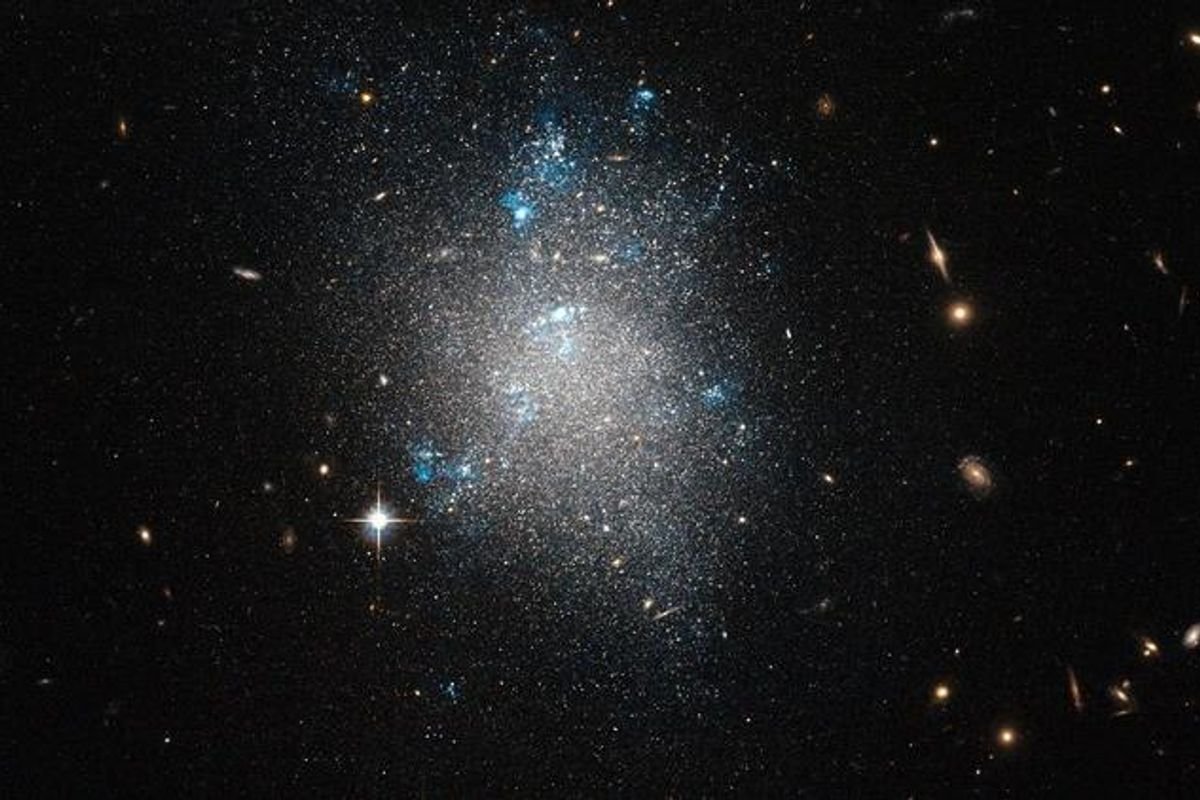
Dwarf galaxies, which orbit the Milky Way, are packed with dark matter and have relatively little background radiation. That makes them ideal places to look for clean signals. If dark matter interactions are producing gamma rays in one galaxy, similar signals would be expected in these smaller systems as well. But those signals haven’t appeared.
That gap has pushed some researchers to look for alternative explanations for the Milky Way glow, such as large populations of faint pulsars clustered near the galaxy’s center. Others see it as a sign that the simplest dark matter models may be incomplete.
Read More: Antarctica’s Mysterious Radio Pulses Remain Unexplained — but Better Particle Experiments Could Change That
How Dark Matter Behaves Differently Across Galaxies
This model takes a different approach to what dark matter might be. Instead of a single particle, it describes two closely related states — a lighter version and a slightly heavier one. For a signal to appear, particles in the lighter state need enough energy to shift into the heavier state before they can interact and produce gamma rays.
In large galaxies like the Milky Way, dark matter particles move faster, giving them enough kinetic energy to make that transition. Once they do, interactions between the two states can generate the gamma-ray signal that telescopes detect.
In dwarf galaxies, particles move much more slowly. Without enough energy to reach the heavier state, those interactions become extremely rare — effectively shutting the signal down. The same particles are present in both environments, but the conditions aren’t.
Rethinking What a Missing Signal Means
Missing signals in dwarf galaxies no longer contradict the idea that dark matter could be behind the Milky Way’s gamma-ray glow. In this framework, they fit.
The usual expectation that similar galaxies should produce similar signals doesn’t hold if those interactions depend on energy. Some systems would light up, while others would remain quiet.
As more observations come in, especially from dwarf galaxies, it should become clearer whether faint signals are just below current limits or absent altogether.
Either outcome helps refine what dark matter can and cannot be. For now, the picture is less uniform than it once seemed, with the absence of a signal becoming part of the explanation rather than a problem.
Read More: Is Dark Matter Real? Most Experts Say Yes, but Its Still Hotly Debated
Article Sources
Our writers at Discovermagazine.com use peer-reviewed studies and high-quality sources for our articles, and our editors review for scientific accuracy and editorial standards. Review the sources used below for this article:
- This article references information from a study published in the Journal of Cosmology and Astroparticle Physics: dSph-obic dark matter