
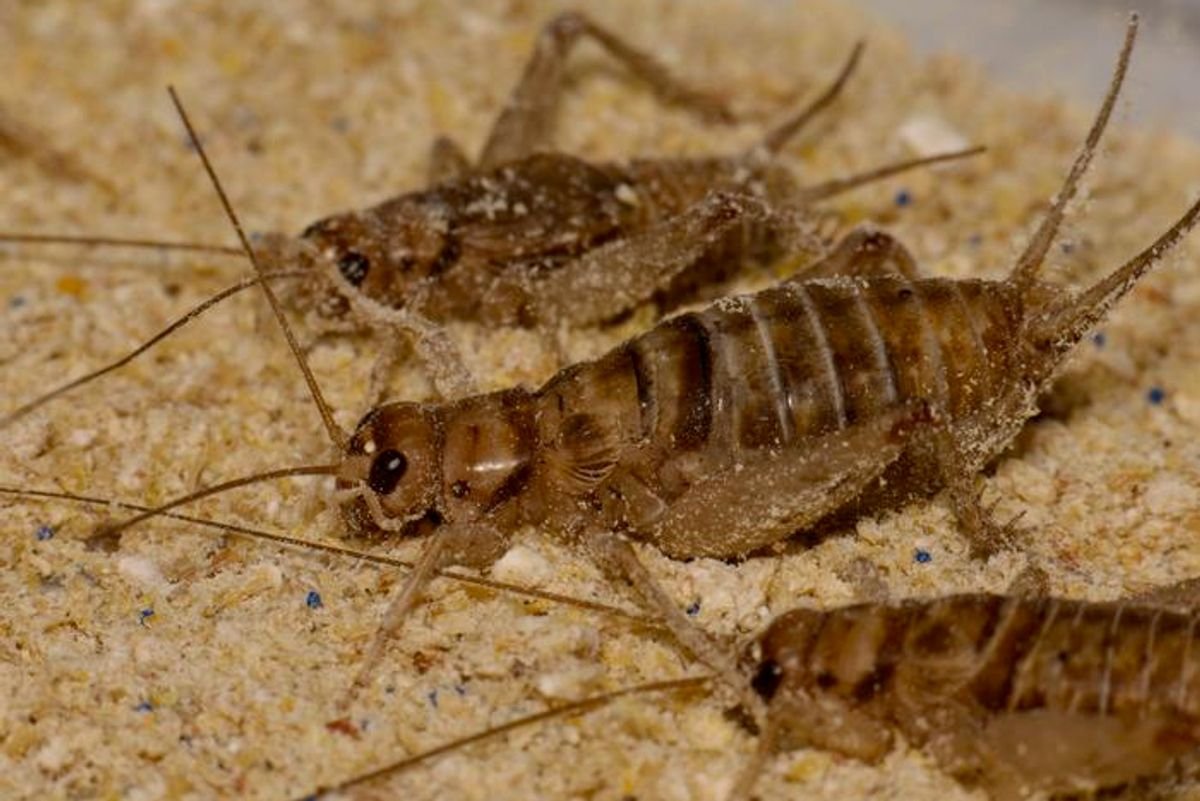
Crickets That Munched on Microplastics Grew 25 Times in Body Size, and Spread Nanoplastics

While we as humans are now aware of microplastics and are actively trying to avoid them, crickets may choose to consume them as a tasty snack.
Microplastics can range in size from 5 millimeters (mm) wide to 1 micrometer, according to a new study published in Environmental Science & Technology, insects and other invertebrates unfortunately often consume them.
Crickets aren’t too concerned about whether or not their food is a plastic particle, but they won’t consume it if the particle is larger than their mouths, indicating that the larger they grow, the more plastic they’re likely to consume.
Read More: Where Do Microplastics Come From and What Can We Do About Them?
Microplastics as Cricket Food
Previous research from a 2022 Environmental Science & Technology study found that consuming microplastics, particularly those made from polyethylene, can have negative effects on organisms such as snails and earthworms. Earthworms may ingest these microplastics while burrowing through the soil. During digestion, they can break down these plastics and leave smaller fragments in the soil, or they can be harmed by any toxic substances the plastics contain.
Many of these microplastics likely enter the environment from certain fertilizers and plastic waste in garbage. Even as some companies work to create plastics that don’t contain polyethylene, there are still copious amounts of microplastics in the environment.
Once in the environment, depending on particle size, microplastics are easily consumed. According to the new study, crickets are “generalists,” meaning they will eat just about anything, including these plastic particles. Because of this, Marshall Ritchie and a research team decided to look into how crickets and other generalist insects responded to consuming microplastics as they grew.
Crickets Seem to Enjoy a Plastic Snack
For the study, the research team collected groups of adult tropical house crickets — Gryllodes sigillatus. Once in the lab, the team then presented the crickets with two food options. One was plastic-free food, while the other was contaminated with either small or large microplastics.
The research team found that the crickets didn’t really have a preference, but they did seem to consume more of the contaminated food over time. One thing the team found interesting was that cricket growth was not stunted after consuming microplastics, unlike in other animals.
Over a seven-week period, the team analyzed the sizes of the microplastics the crickets would consume. During this period, the cricket’s body size increased by about 25 times. The team noted that as the crickets grew, so too did the size of the plastic particles they could fit into their mouths. The crickets would only consume plastic particles that fit into their mouths and eat them whole.
“Once a particle was big enough to be eaten, crickets continued to eat it for the rest of their life,” Ritchie said in a press release.
Creating More Microplastics
Besides gobbling down microplastics, the team also found that as the plastic particles passed through the cricket’s digestive system, the microplastics would break down into much smaller nanoplastics. These particles are unfortunately much more harmful for the environment than their larger counterparts.
Though as the crickets grew larger, the plastic particles were much less fragmented than those in the smaller crickets.
According to the research team, the study results show that insects, such as crickets, are also affected by microplastics in the environment. Even though the plastics don’t seem to harm the crickets, this cannot be said for other creatures living in those environments, especially if crickets are helping microplastics break down even further.
Read More: What Are Microplastics and How to Tackle Them
Article Sources
Our writers at Discovermagazine.com use peer-reviewed studies and high-quality sources for our articles, and our editors review for scientific accuracy and editorial standards. Review the sources used below for this article: