
Cougars Are Learning to Coexist With Wolves in Yellowstone by Changing Their Diet

When wolves and cougars cross paths, it’s rarely a friendly encounter. But as these two apex predators increasingly share territory across the western United States, a new study suggests cougars may be finding clever ways to avoid conflict by changing what’s on their menu.
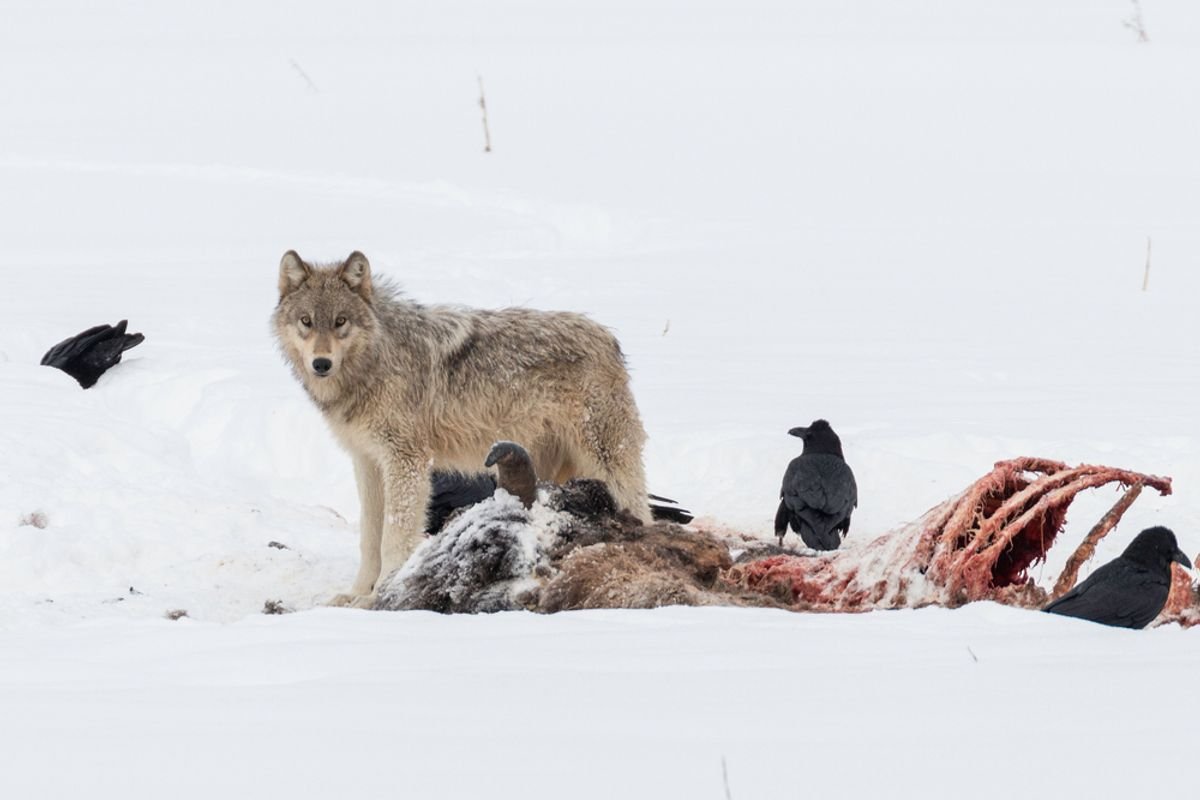
Drawing on nearly a decade of GPS tracking and thousands of kill-site investigations in Yellowstone National Park, the research reveals a dynamic relationship of wolves stealing cougar kills, and cougars adapting their hunting strategies to stay out of trouble.
The study, published in PNAS, comes at a time when cougar and wolf habitats are overlapping more than ever. While wolves were found to occasionally kill cougars, the reverse never happened. Instead, cougars appear to be responding to pressure from wolves in a quieter way: shifting toward smaller prey that can be eaten faster, reducing the chances of a deadly encounter.
“In North America and worldwide, carnivore communities are undergoing major changes,” said study lead author Wesley Binder, a doctoral student at Oregon State University, in a press release. “Our research provides insight into how two apex predators compete, which informs recovery efforts.”
Wolf and Cougar Recovery
Top predators in the U.S. look back at a grim past. Out of fear and a desire to protect livestock, government-supported predator-control programs in the 19th and 20th centuries, combined with habitat loss, pushed large carnivores like cougars and wolves to the brink of extinction.
With growing evidence of these predators’ crucial ecological role in keeping ecosystems in balance, the U.S. began rolling out protection programs to recover their rapidly declining populations. Since the steady return of cougars and wolves to the western states — including Yellowstone National Park — over the past 30 years, new questions have emerged about how these two top predators get along and how their relationship is shaping the landscape.
“You’ve had these places that in the last 20, 30 years have had cougars come back, and now wolves are coming back as well,” Binder said. “There are a lot of people asking questions like, ‘What are our ecological communities going to look like now that we have both of these large carnivores back on the landscape?’”
We already have studies on how subordinate carnivores fare when they share territory with larger, more dominant predators: they tend to live more dangerous lives but adapt by scavenging more. But what about wolves versus cougars? Their similar rank on the food chain begs the question: how do these top predators coexist?
Read More: Are Animals Like Mountain Lions and Bears Leaving Yellowstone National Park?
Shifting Diets to Avoid Deadly Encounters
To better understand how cougars and wolves adapt to one another in Yellowstone, researchers positioned 140 cameras across the northern part of the park and fitted both wolves and cougars with GPS collars. By comparing data collected between 1998 and 2005 and again from 2016 to 2024 (covering nearly 4,000 kill sites), the team observed a striking shift in prey choice.
While wolves increasingly moved toward larger prey such as bison, cougars began targeting deer more frequently. Both predators hunted elk less over time, a prey species that had once dominated their diets (dropping from 95 percent to 63 percent for wolves, and from 80 percent to 52 percent for cougars).
As described in the release, by using machine learning models, the researchers identified the main drivers of wolf–cougar interactions. Nearly half of all encounters occurred at sites where cougars had made a kill, with only one instance in which a wolf had killed the prey first.
The team also examined mortality data. Of the 12 documented cougar deaths, two were caused by wolves, which then consumed the elk killed by the cougars. None of the 90 documented wolf deaths were caused by cougars.
Pack-Hunters Versus Solitaries
The new study supports previous evidence that wolves tend to dominate shared spaces, largely due to their pack-hunting strategy, compared with the solitary hunting style of cougars. However, rather than relying more heavily on scavenging, cougars may be avoiding dangerous encounters altogether by shifting away from their preferred prey, elk, which are also highly sought after by wolves.
The new data suggest that coexistence between wolves and cougars is possible, particularly if there is a diversity of prey available and enough escape terrain for cougars, which often retreat to trees when confronted by wolves.
Read More: Tracking Past Eruptions In Yellowstone Is Harder Than You Think
Article Sources
Our writers at Discovermagazine.com use peer-reviewed studies and high-quality sources for our articles, and our editors review for scientific accuracy and editorial standards. Review the sources used below for this article: