
Cosmic Snowmen Gained Their Unique Shape After Gently Spiraling Into Each Other

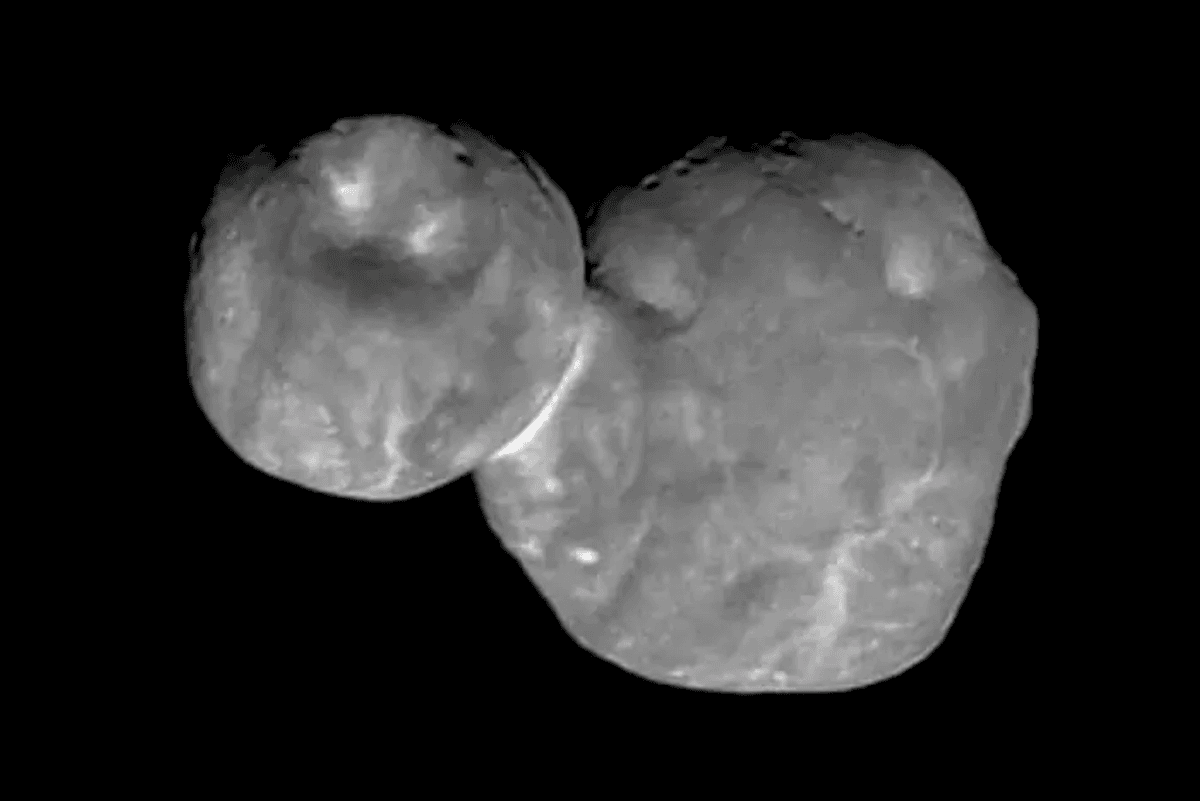
It may come as a shock that snowmen can be found in space, although they’re not the same jolly, carrot-nosed fellows we have here on Earth. Just beyond Neptune, icy rocks have combined to create objects that take on the appearance of rugged snowmen.
A new study published in the Monthly Notices of the Royal Astronomical Society offers an explanation for how these snowmen, or “contact binaries,” are born. Small groupings of ancient planetesimals — objects shaped from gas and dust during the Solar System’s earliest days — fused into each other by way of gravitational collapse. Now, a handful of planetesimals exist as contact binaries, building a whole population of spacefaring snowmen.
Read More: NASA’s Colorful Cosmic Map Could Shed Light on First Moments After Big Bang
Building Space Snowmen
An abundance of rocky relics populate the Kuiper Belt, a ring of icy planetesimals that lies beyond Neptune. Millions of objects are thought to exist in this region, according to NASA. They’re much like cosmic fossils that have been preserved from the Solar System’s formation around 4.6 billion years ago.
According to the new study, 1 in 10 objects in the Kuiper Belt have been fashioned into contact binaries that have what’s called a “bilobate” shape, meaning they appear to have two lobes. In simpler terms, they look like snowmen without all of the fancy accouterments — one round lobe is the head, and the other, larger one is the body.
These contact binaries likely gained their snowman-like proportions through gravitational collapse; this process isn’t as rare as earlier theories suggested, according to the study’s authors.
“If we think 10 percent of planetesimal objects are contact binaries, the process that forms them can’t be rare,” said senior author Seth Jacobson, a professor at Michigan State University’s Department of Earth & Environmental Science, in a statement. “Gravitational collapse fits nicely with what we’ve observed.”
Combining After Collapse
The origins of bilobate contact binaries have been debated by scientists in the past, with early models erroneously considering colliding planetesimals as fluid blobs; these models envisioned the objects merging into spheres, which didn’t explain the unique snowman shape.
The simulations featured in the new study, however, have been able to accurately recreate the conditions that allow planetesimals to merge and become contact binaries.
Planetesimals start out as collections of pebble-sized objects that are bound together by gravity into a rotating cloud. But sometimes the cloud may collapse inward, self-destructing and forming two separate planetesimals. The new study’s simulations show that after this gravitational collapse happens, the planetesimals’ orbits bring them closer to each other until they gently come into contact. They then stick together, solidifying the snowman shape.
Exploring the Kuiper Belt
While objects in the Kuiper Belt occasionally collide into each other, contact binaries are unlikely to crash into other objects, according to the study authors. By not getting into any collisions, they’ve been able to retain their shape for millions of years.
Ongoing explorations of the Kuiper Belt, aided by new simulations that explain the formation of contact binaries, may reveal more about planetesimals and the early Solar System. NASA’s New Horizons space probe, which first imaged contact binaries in 2019, will keep operating until it exits the Kuiper Belt in the late 2020’s, according to the agency.
Researchers, meanwhile, are developing a new simulation to improve their understanding of the gravitational collapse process.
Read More: Hubble Discovers Dracula’s Chivito, the Largest-Known Chaotic Planet Nursery
Article Sources
Our writers at Discovermagazine.com use peer-reviewed studies and high-quality sources for our articles, and our editors review for scientific accuracy and editorial standards. Review the sources used below for this article: